
Is It Normal to Have White Discharge Everyday?

Yes, it can be normal to have white discharge every day. Vaginal discharge is a natural part of how the vagina keeps itself healthy, and its amount, color, and texture can change throughout the menstrual cycle.
Normal discharge may be clear, milky white, off-white, creamy, watery, sticky, or slightly thick. It usually has little to no strong odor and should not cause itching, burning, pain, or significant irritation.
The important thing is not simply how often you have discharge. Your usual pattern matters. A sudden change in the amount, color, smell, or texture or discharge accompanied by other symptoms may need medical evaluation.
Clear, white, milky, or creamy discharge can occur every day as part of normal vaginal function. It is usually less concerning when it has little or no strong odor and does not cause itching, burning, pain, or irritation.
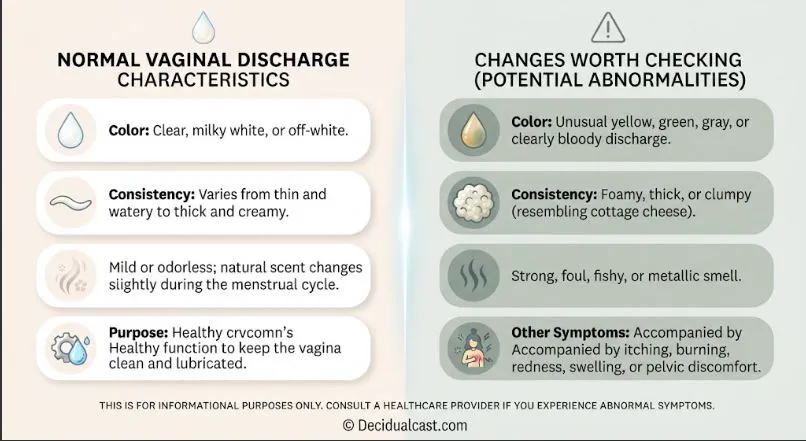
Daily discharge is more likely to be normal when it is:
- Clear, white, milky, or off-white
- Creamy, watery, sticky, or mildly thick
- Mild-smelling or has no strong odor
- Not associated with itching
- Not associated with burning or swelling
- Not painful
- Similar to what is normal for you
It is more concerning when discharge:
- Suddenly becomes very different from your usual pattern
- Has a strong or fishy odor
- Becomes green, gray, or unusually yellow
- Is thick and chunky, especially with intense itching
- Occurs with burning or swelling
- Causes pelvic pain
- Occurs with unexplained bleeding or spotting
These changes can have several causes, including infections, irritation, hormonal changes, or other vaginal or reproductive-health conditions.
What does normal white discharge look like?
Normal vaginal discharge can range from clear to white or off-white, and its consistency can change during the month. It may be thin and watery at one point and creamy, sticky, or thicker at another.
Why do I have white discharge every day?
Your vagina is not supposed to be completely dry.
Vaginal discharge is made from fluid and cells and is produced as part of normal vaginal function. It helps maintain moisture and contributes to the vagina’s natural protective environment.
Hormones also influence cervical mucus and vaginal secretions. That means your discharge may naturally become more noticeable at certain times of the menstrual cycle.
Your normal pattern can also change with factors such as:
- Ovulation
- Pregnancy
- Hormonal birth control
- Puberty
- Perimenopause and menopause
- Sexual arousal
- Some medications
- Irritation from products used around the vulva or vagina
Cleveland Clinic notes that everyone produces different amounts of discharge, and factors such as pregnancy, birth control, and ovulation can affect the amount.
So, having discharge every day does not automatically mean something is wrong.
Does vaginal discharge change during your menstrual cycle?
Yes. This is one of the biggest reasons daily discharge can look different from week to week.
How discharge can change during your cycle
Hormones can change the amount and consistency of cervical mucus throughout the menstrual cycle. Your pattern may look different from the example below, and that can still be normal.
Is more discharge around ovulation normal?
Often, yes.
Hormonal changes around ovulation can increase cervical mucus. Some people notice discharge that is clearer, wetter, slippery, or stretchy during this part of the cycle.
However, having white discharge every day does not prove that you are ovulating.
Discharge can be normal throughout the cycle, and its appearance alone is not a reliable way to determine whether ovulation has occurred.
If you are specifically trying to track ovulation, other fertility-awareness methods or an appropriate ovulation test may provide more useful information.
Does white discharge every day mean pregnancy?
Not necessarily.
Pregnancy can cause an increase in vaginal discharge because of hormonal changes, but white discharge by itself cannot tell you whether you are pregnant. Normal vaginal discharge also occurs in people who are not pregnant.
If pregnancy is possible and your period is late, a pregnancy test is much more useful than trying to interpret discharge alone.
You should also pay attention to other symptoms and seek medical advice if you have significant pain, heavy bleeding, or other concerning symptoms.
If you’re researching unusual tissue or discharge around your menstrual cycle, you may also find our guide on decidual cast during a period helpful.
Can birth control cause more vaginal discharge?
It can.
Hormonal changes caused by contraception can alter the amount or consistency of vaginal discharge. Cleveland Clinic lists birth control pills among factors that can affect discharge, while Mayo Clinic also notes that hormonal contraceptives can change normal vaginal discharge patterns.
That does not mean every change after starting birth control is abnormal.
However, if the change is accompanied by a strong odor, itching, burning, pain, unusual color, or other symptoms, it is worth discussing with a healthcare professional.
Is white discharge without smell normal?
Usually, white or clear discharge with little or no strong odor can be normal, particularly when it is not accompanied by itching, burning, pain, or irritation.
A vagina does not need to be completely odorless.
A mild natural scent can occur. What is more concerning is a new, strong, unpleasant, or fishy odor, especially when it occurs with a change in discharge.
For example, bacterial vaginosis can cause a thin grayish-white discharge with a fishy odor, while trichomoniasis may cause yellowish or greenish discharge.
Is white discharge without itching normal?
It can be.
White discharge without itching, burning, swelling, pain, or a strong odor is often consistent with normal vaginal discharge.
However, the absence of itching does not allow you to diagnose or completely rule out an infection. Some vaginal infections can have mild symptoms or no obvious symptoms.
That is why a new or persistent change from your usual discharge pattern deserves attention, particularly if there are additional symptoms or a recent sexual exposure.
When is white discharge not normal?
White discharge itself is not necessarily a problem. The concern is when its characteristics change or it comes with other symptoms.
White discharge that is thick and chunky
Thick, white discharge that resembles cottage cheese, especially when accompanied by significant itching or irritation, can occur with a vaginal yeast infection.
Do not assume every case of white discharge is a yeast infection, though. Other conditions can cause similar symptoms, and treatment depends on the cause.
White or gray discharge with a fishy odor
A thin grayish-white discharge with a noticeable fishy odor can occur with bacterial vaginosis (BV). BV is associated with a disruption of the normal balance of vaginal bacteria.
Yellow or green discharge
Yellow or green discharge, particularly when accompanied by odor, irritation, pain, or other symptoms, can be associated with infection and should be evaluated.
Trichomoniasis, for example, can cause yellowish or greenish, sometimes frothy discharge.
Discharge with pelvic pain or bleeding
Discharge accompanied by pelvic pain, painful urination, bleeding between periods, bleeding after sex, or other unusual symptoms should not simply be assumed to be normal.
Normal discharge vs. possible infection
Use this comparison as a starting point, not as a self-diagnosis:
| Feature | More consistent with normal discharge | May need medical evaluation |
|---|---|---|
| Color | Clear, white, milky, off-white | Green, gray, unusual yellow, or unexpected brown/red |
| Texture | Watery, creamy, sticky, mildly thick | Chunky, foamy, pus-like, or a major sudden change |
| Smell | None or mild natural odor | Strong, fishy, or foul odor |
| Itching | None | Present |
| Burning | None | Present |
| Pain | None | Pelvic or vaginal pain |
| Amount | Your usual amount | Sudden unexplained increase |
| Cycle pattern | Changes with hormonal cycle | New or persistent change unrelated to your usual pattern |
Color alone does not provide a diagnosis. A healthcare professional may need to examine the discharge or perform testing to determine the cause.
How much vaginal discharge is too much?
There is no single amount that is automatically “too much” for everyone.
People naturally produce different amounts of vaginal discharge. Some notice discharge throughout the day, while others notice very little. Hormonal changes, ovulation, pregnancy, and contraception can also affect the amount.
Instead of focusing only on quantity, ask:
Is this amount normal for me?
A sudden increase that is persistent or occurs with a change in smell, color, texture, itching, burning, pain, or bleeding is more important than simply noticing a larger amount of discharge.
Should you try to stop daily white discharge?
If your discharge is normal, you usually do not need to stop it.
Vaginal discharge is part of normal vaginal function. It is not a sign that your vagina is dirty or needs to be “cleaned out.”
Avoid putting soaps, perfumes, deodorants, or douches inside the vagina. These products can irritate vaginal tissues or disrupt the natural vaginal environment.
For everyday comfort, you can:
- Wash the external vulva gently with water.
- Avoid scented vaginal products.
- Change out of damp clothing when practical.
- Wear breathable underwear.
- Avoid douching.
- Practice safer sex and use condoms when appropriate.
The vagina is self-maintaining; routine internal cleansing is not necessary.
When should you see a healthcare provider?
Make an appointment if your discharge is noticeably different from your normal pattern, especially if the change continues or is accompanied by other symptoms.
Seek medical evaluation if you notice:
- Strong or fishy odor
- Green, gray, or unusual yellow discharge
- Thick, chunky discharge with significant itching
- Burning or swelling
- Pelvic pain
- Pain when urinating
- Pain during sex
- Bleeding or spotting outside your expected period
- A new change after sexual contact with a new partner
- Symptoms that do not improve or keep returning
These symptoms can have different causes, including bacterial vaginosis, yeast infection, sexually transmitted infections, irritation, hormonal changes, or other conditions. Testing may be needed to identify the actual cause.
Frequently asked questions
Is it normal to have discharge every day?
Yes. Daily vaginal discharge can be normal because the vagina naturally produces fluid and sheds cells throughout the day. What matters is whether the discharge is typical for you and whether you have symptoms such as itching, burning, pain, strong odor, or unusual color.
Is it normal to have white discharge every day?
Yes, it can be. Clear, white, milky, or off-white discharge can occur normally every day, and its amount and consistency may change throughout your menstrual cycle.
Why do I have white discharge every day?
Daily white discharge can result from normal vaginal secretions and hormonal changes. Ovulation, pregnancy, birth control, and different stages of the menstrual cycle can change how much discharge you notice.
Is creamy white discharge normal?
Creamy white discharge can be normal, particularly when it does not have a strong odor and does not cause itching, burning, swelling, or pain.
Does white discharge mean pregnancy?
No. Pregnancy can increase vaginal discharge, but white discharge alone cannot confirm pregnancy. If pregnancy is possible, use a pregnancy test rather than relying on discharge as an indicator.
Does white discharge mean ovulation?
Not necessarily. Discharge can change around ovulation, often becoming wetter, clearer, slippery, or stretchy, but daily white discharge does not by itself confirm ovulation.
Can a yeast infection cause white discharge?
Yes. A yeast infection can cause thick white discharge, often described as cottage-cheese-like, along with itching or irritation. Similar symptoms can have other causes, so persistent or uncertain symptoms should be evaluated.
Can bacterial vaginosis cause white discharge?
Yes. BV can cause a thin grayish-white discharge and a noticeable fishy odor. Some people with BV have few or no symptoms, so discharge alone cannot establish the diagnosis.
Should vaginal discharge have an odor?
A mild natural odor can be normal. A new strong, fishy, or foul odor—especially with changes in discharge or other symptoms—should be evaluated.
When is daily discharge a problem?
Daily discharge is more concerning when it represents a sudden change from your normal pattern or occurs with itching, burning, pelvic pain, unusual odor, unusual color, bleeding, or other symptoms.
The bottom line
Is it normal to have white discharge every day? In many cases, yes.
Clear, white, milky, creamy, watery, or slightly sticky discharge can all be part of normal vaginal function. Your discharge may change during your menstrual cycle and with hormonal changes such as ovulation, pregnancy, or birth control.
The most useful thing to watch is your personal baseline. If the discharge suddenly changes in color, smell, texture, or amount—or comes with itching, burning, pain, bleeding, or another concerning symptom—talk with a healthcare professional rather than trying to diagnose the cause from appearance alone.
Normal discharge is not something you need to eliminate. It is a normal part of vaginal health.