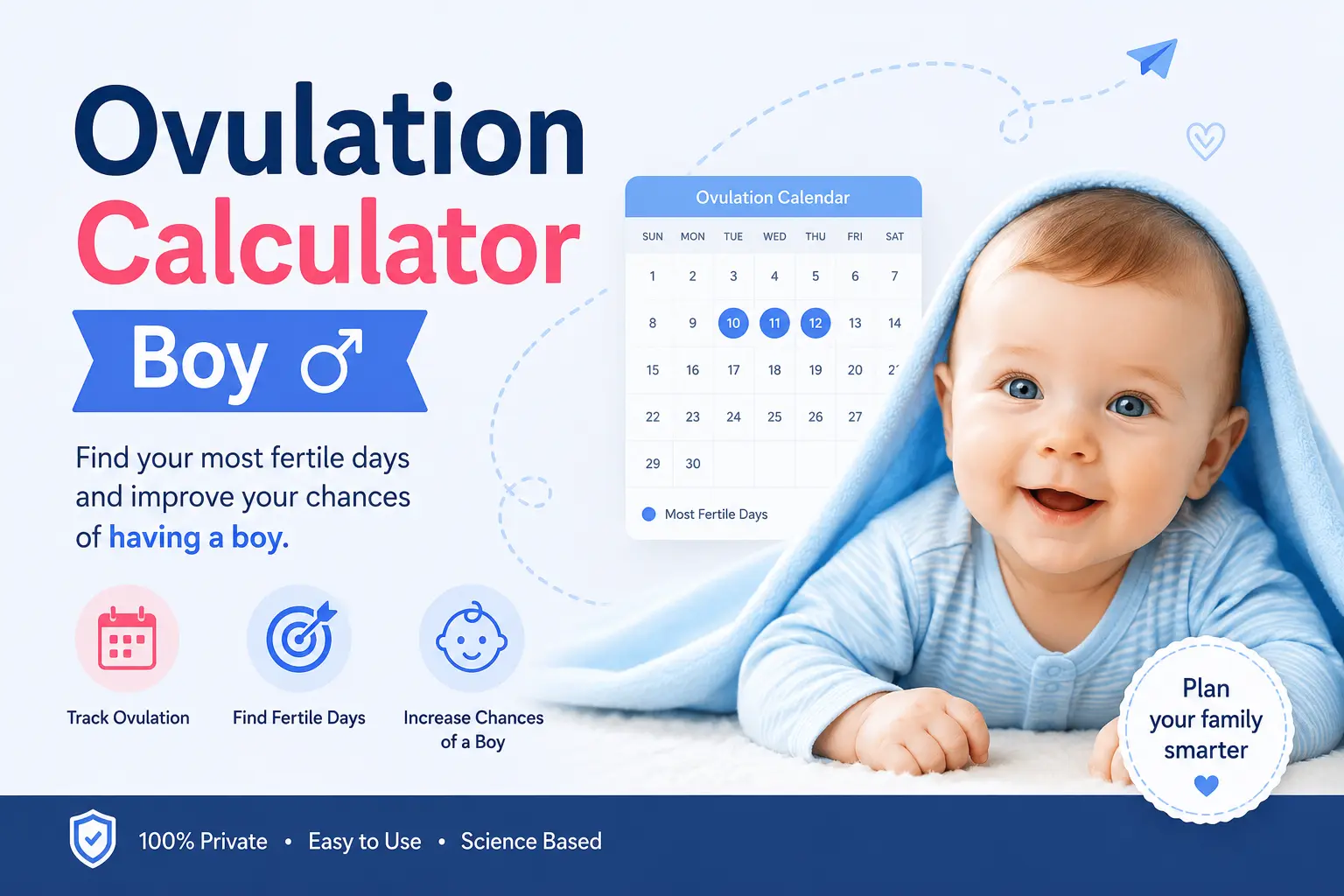
Ovulation Calculator for a Boy
Estimate your ovulation and fertile window, then see the timing suggested by the Shettles theory. The theory has not been proven to reliably determine a baby’s sex — this tool gives you the evidence-based fertility estimate and the theory-based timing side by side, clearly labeled.
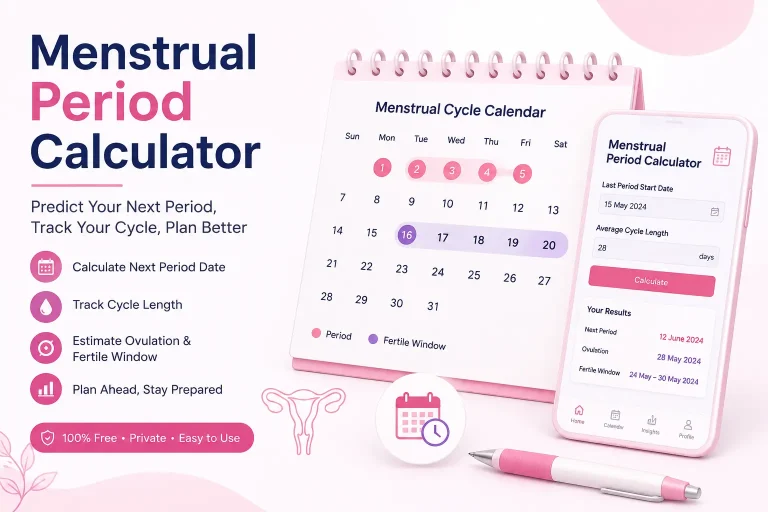
Ovulation and fertile window calculator
Your estimated results
- Estimated ovulation
- —
- Fertile window
- —
- Peak fertility
- —
- Estimated next period
- —
- Cycle day of ovulation
- —
Boy timing according to the Shettles theory
—
This timing is based on the Shettles theory and is not a scientifically proven method for choosing a baby’s sex.
Cycle timeline
Evidence-based (period, fertile window, ovulation) Theory-based boy timing (Shettles theory)
| Sun | Mon | Tue | Wed | Thu | Fri | Sat |
|---|
- Period
- Fertile day
- Peak fertility
- Estimated ovulation
- Theory-based boy timing
How we calculate your estimate
Estimated ovulation is calculated from your expected cycle length. A common approximation places ovulation about 14 days before the next period, but actual timing can vary from cycle to cycle and from month to month.
The fertile window includes the several days before ovulation, since sperm can survive in the body for up to about five days, plus the day of ovulation itself, since the egg is viable for roughly 12–24 hours.
The theory-based boy-timing window is calculated separately, from the same estimated ovulation date, using the timing described by proponents of the Shettles theory. It is a theory overlay, not an additional evidence-based calculation.
Your calculator inputs are processed in your browser and are not stored by this tool.
How Does an Ovulation Calculator for a Boy Work?
An ovulation calculator uses the first day of your last period and your average cycle length to estimate when you are likely to ovulate. Ovulation is the point in your menstrual cycle when an ovary releases an egg. The days leading up to and including ovulation make up your fertile window, when pregnancy is most likely if sperm is present.
This tool adds one more layer on top of that biology: a theory-based estimate of the timing some people use when they are hoping for a boy, based on the Shettles method. That layer is clearly separated from the fertility estimate, because it rests on a theory rather than confirmed science.
Can Timing Ovulation Help You Have a Boy?
Timing intercourse around ovulation has not been proven to reliably determine whether a baby will be a boy or girl. The idea comes from the Shettles method, a theory developed in the 1960s. It has stayed popular because it is simple to follow, but well-designed studies have not confirmed that it changes the odds of conceiving a boy versus a girl.
What Is the Shettles Method?
The Shettles method, developed by Dr. Landrum Shettles, is based on the idea that sperm carrying a Y chromosome (associated with male embryos) swim faster but survive for a shorter time than sperm carrying an X chromosome (associated with female embryos). From that idea, the theory proposes that intercourse very close to ovulation may favor Y-chromosome sperm reaching the egg first, while intercourse a few days before ovulation may favor X-chromosome sperm, since they can survive longer while waiting for the egg.
That reasoning was plausible when it was first proposed, but later research on sperm biology has not consistently supported the underlying assumptions, and studies attempting to test outcomes from Shettles-based timing have not shown a reliable effect on baby sex. Most researchers now consider it an unproven theory rather than an established method.
Boy vs. Girl: What Does Science Say?
A baby’s sex is determined by whether the sperm that fertilizes the egg carries an X or a Y chromosome. Biologically, X- and Y-carrying sperm are genetically different, and there has long been interest in whether their physical differences could be used to influence conception outcomes through timing alone. So far, ordinary intercourse timing has not been demonstrated as a dependable way to select a baby’s sex. Methods with stronger evidence for influencing sex, such as sperm-sorting combined with assisted reproduction, are medical procedures, not calendar-based timing.
When Is the Best Time to Have Sex to Get Pregnant?
Regardless of which sex you hope for, the days that matter most for conception are the fertile window: roughly the five days before ovulation and the day of ovulation itself. Sperm can survive in the reproductive tract for up to about five days, while the egg is viable for only about 12 to 24 hours after release. Having intercourse regularly during this window, rather than trying to pinpoint a single day, gives you the best overall chance of conception.
How Accurate Is This Ovulation Calculator?
Calendar-based calculators like this one provide an estimate, not a certainty. Cycle length can vary from month to month even in people who are usually regular, and factors such as stress, illness, travel, and changes in sleep or exercise can shift ovulation earlier or later than expected. The estimate becomes less reliable the more irregular your cycles are.
For a closer look at your own cycle, ovulation predictor kits (OPKs) detect the LH surge that happens shortly before ovulation, and basal body temperature tracking can help confirm, after the fact, that ovulation has occurred. Neither tool nor this calculator can tell you your baby’s sex in advance.
What If My Periods Are Irregular?
If your cycles vary a lot in length, a single calculated ovulation date is less meaningful, because the underlying math assumes a fairly predictable cycle. Entering your typical shortest and longest cycle lengths in the advanced options widens the estimated fertile window instead of showing one falsely precise date. Tracking ovulation signs directly, such as cervical mucus changes or LH strips, or speaking with a healthcare professional, can give you more dependable information than calendar estimates alone.
Can an Ovulation Test Tell Me When I Will Ovulate?
Ovulation predictor kits measure luteinizing hormone (LH) in urine. LH rises sharply 24 to 36 hours before ovulation, so a positive test suggests ovulation is likely to happen soon, giving you a shorter-term, more direct signal than calendar math. They do not confirm that ovulation has actually happened, and results can occasionally be misread in people with certain hormonal conditions.
Does Having Sex on Ovulation Day Guarantee a Boy?
No. Having intercourse on ovulation day may align with what Shettles-theory proponents suggest for a boy, but it does not guarantee any particular outcome. Baby sex depends on which sperm fertilizes the egg, a process influenced by many biological factors that timing alone has not been shown to control.
Does the Shettles Method Really Work?
Independent studies looking at outcomes among people who used Shettles-based timing have generally found results consistent with roughly 50/50 chance, rather than a shift toward more boys. Because of this, most reproductive-health sources describe the Shettles method as a popular but scientifically unconfirmed theory rather than a reliable method of sex selection.
Frequently Asked Questions
Can I use an ovulation calculator to conceive a boy?
An ovulation calculator can estimate your fertile window from your cycle information. Some people use that estimate along with the Shettles theory to time intercourse, but this timing strategy has not been proven to reliably determine a baby’s sex.
What day should I try for a boy?
Some versions of the Shettles theory suggest intercourse very close to or on the estimated ovulation day. This is a theory-based suggestion, not a medically established rule, and it is not guaranteed to work.
Is ovulation day best for conceiving a boy?
Ovulation day is when the theory suggests the timing may favor a boy, based on ideas about how X- and Y-chromosome sperm behave. Reliable scientific evidence for this effect is lacking.
How many days before ovulation should I try for a boy?
Shettles-theory proponents generally suggest intercourse as close to ovulation as possible rather than in the days before it. Again, this has not been confirmed as an effective method by reliable research.
Does the Shettles method work?
Available research has not reliably confirmed that timing intercourse around ovulation changes the odds of having a boy or a girl. Most studies looking at this question have found chance to be the best explanation for the results.
Can an ovulation calculator guarantee a boy?
No. No calculator, app, or timing method can guarantee the sex of a baby. This tool estimates ovulation and fertile days only; it does not predict or control baby sex.
How do I calculate my ovulation date?
A common estimate subtracts 14 days from your average cycle length to find the likely ovulation day, counting from the first day of your last period. Actual ovulation timing can vary from cycle to cycle.
What if my cycle is irregular?
Calendar-based estimates are less reliable with irregular cycles. Tracking signs like cervical mucus, using ovulation predictor kits, or talking with a healthcare professional can give you more precise information.
Can an ovulation test help?
Yes. Ovulation predictor kits detect the LH surge that happens shortly before ovulation, which can narrow down your fertile window more precisely than calendar math alone.
Can I use this calculator for a girl?
The evidence-based ovulation and fertile-window estimates are the same regardless of which sex you hope for. Some Shettles-theory guidance for a girl suggests intercourse a few days before ovulation rather than on ovulation day, but this is unproven for the same reasons described above.
Sources & Further Reading
- American College of Obstetricians and Gynecologists (ACOG) — patient resources on ovulation and the menstrual cycle.
- Office on Women’s Health, U.S. Department of Health and Human Services — fertility awareness and menstrual cycle information.
- Peer-reviewed reproductive-medicine literature evaluating timed-intercourse methods for sex selection.
Medical information reviewed for accuracy. Last updated: August 2026.