
Decidual Cast: What It Is, Causes, Symptoms, Treatment & When to Seek Help
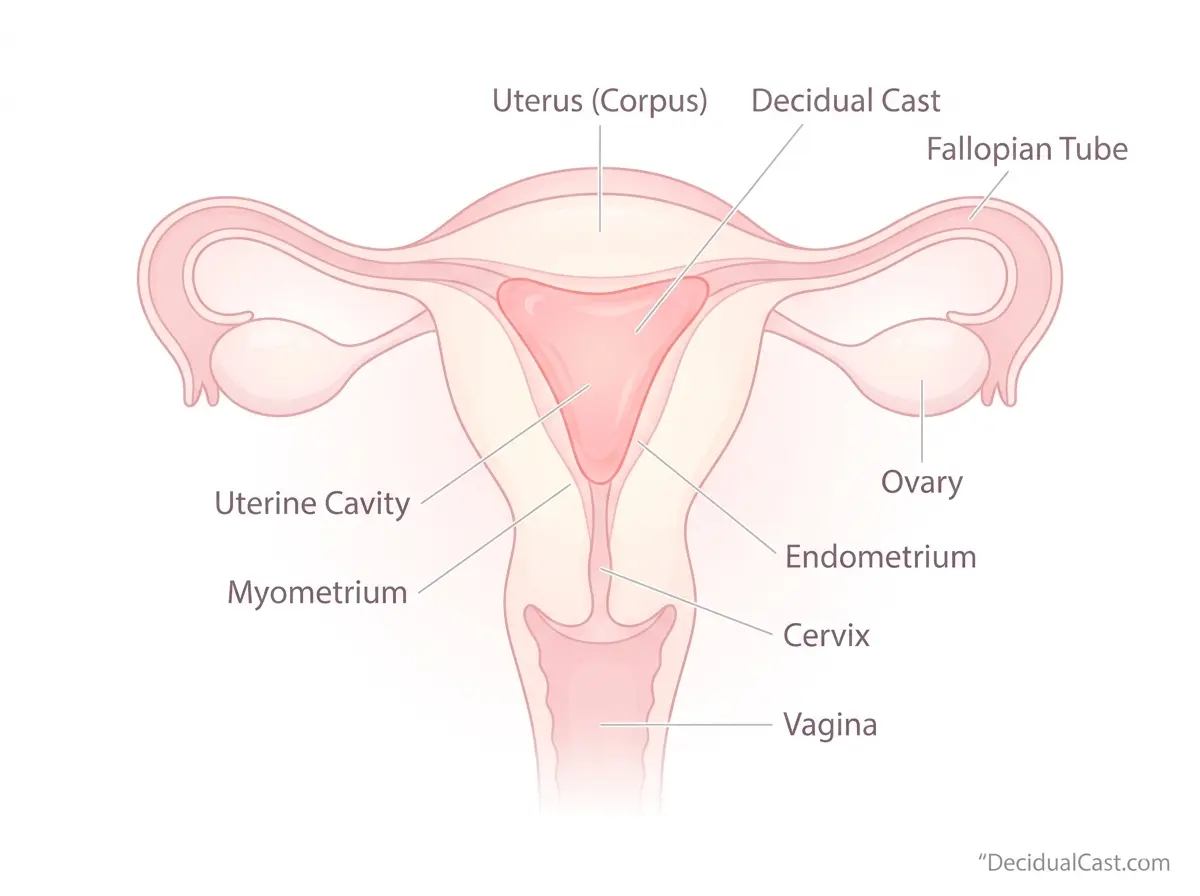
Quick Answer
A decidual cast is when the uterine lining sheds in one complete piece instead of gradually during menstruation, often causing severe cramps and passing of tissue.
It happens when your body sheds the lining of your uterus in one solid piece instead of slowly breaking it down during your period. This tissue often comes out in the shape of the uterus and can look large and unusual. It is a rare event, but it can feel very scary if you see it for the first time. Many people confuse it with something more serious, like a miscarriage.
You may feel strong cramps, heavy bleeding, and pass a large piece of tissue through the vagina. The pain can feel more intense than normal period cramps and may come on suddenly. Some people also feel nausea or discomfort during this time. Even though it looks alarming, it is usually not dangerous in most cases.
Doctors believe this can happen due to changes in hormones, especially when using birth control or in certain pregnancy-related conditions like ectopic pregnancy. It can also be linked to how the uterine lining builds up and sheds. While it is not common, it is important to understand what is happening in your body so you don’t panic.
In most cases, a decidual cast does not cause long-term problems. However, because it can look similar to a miscarriage or other conditions, it is important to pay attention to your symptoms. If something feels unusual or very painful, it is always a good idea to talk to a doctor.
What Is a Decidual Cast?
A decidual cast happens when the lining of the uterus sheds all at once in a single, solid piece instead of gradually over several days. This tissue often keeps the shape of the uterus and passes through the vagina as one large piece. It is different from a normal period, where blood and small tissue fragments come out slowly. The medical term for this condition is membranous dysmenorrhea, and it is considered rare.
The uterine lining, called the endometrium, normally thickens each month to prepare for pregnancy and then sheds if pregnancy does not occur. In some cases, this entire lining comes out together, forming what is known as a decidual cast.
Definition (decidual tissue shedding)
A decidual cast happens when the lining of your uterus sheds in one whole piece instead of slowly during your period. This lining, called the endometrium, usually breaks down over a few days. In this case, it stays intact and comes out all at once through the vagina.
You may notice a large, tissue-like piece that can look like the shape of your uterus. It can feel painful and surprising, especially if you have never seen it before.
Why it happens in one piece?
This happens because the lining becomes thick and sticks together instead of breaking apart. Your uterus then contracts strongly to push it out in one piece. These strong contractions can cause sudden and severe pain. Hormonal changes, especially from birth control or pregnancy-related conditions, may play a role in why this happens.
What Does a Decidual Cast Look Like?
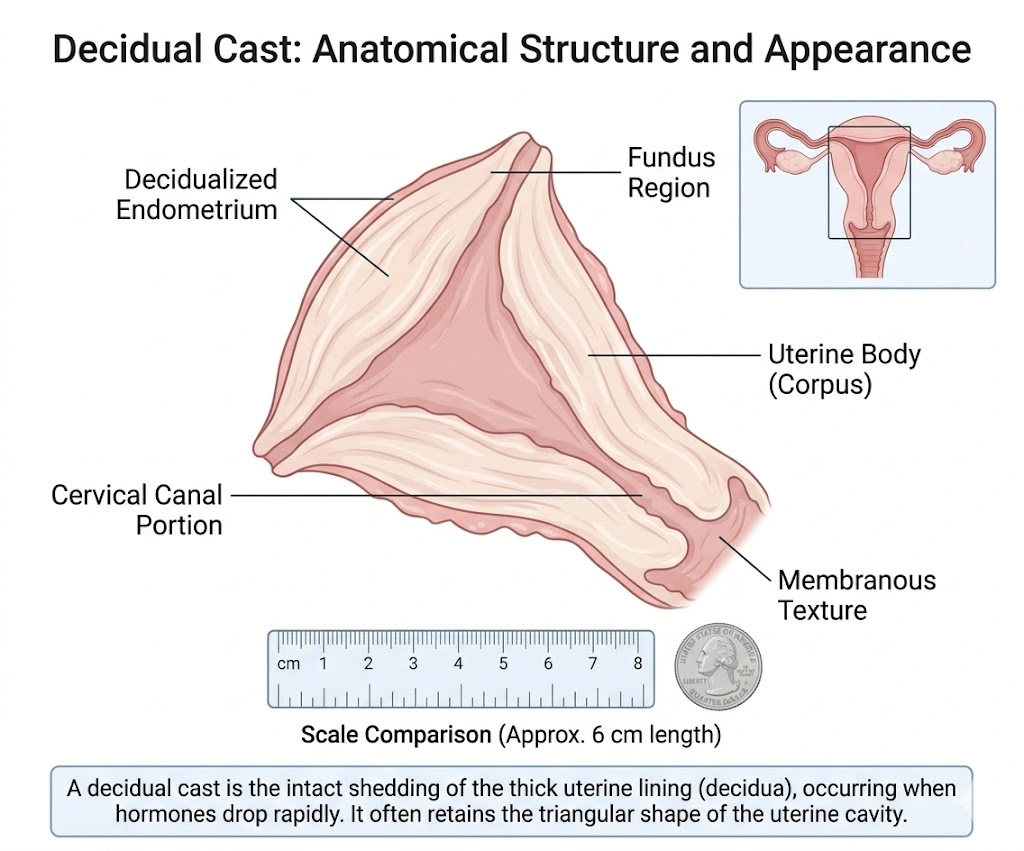
A decidual cast is the tissue lining of the uterus that comes out in one complete piece instead of breaking into smaller parts during a period. It is usually thick, fleshy, and firm, made of endometrial tissue mixed with blood and mucus. The color can vary and may appear pink, red, dark red, gray, or whitish. In some cases, it may look like a large blood clot, but it has a more solid and structured form.
Size, shape, and appearance
A decidual cast often keeps the shape of the inside of the uterus. It is commonly triangular, V-shaped, or like an upside-down pear or lightbulb. This happens because the tissue takes the exact form of the uterine cavity as it comes out. Before it passes, many people feel strong cramping or intense abdominal pain. After it is expelled, the pain often reduces quickly.
Decidual cast Images


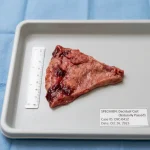
HOW BIG IS A DECIDUAL CAST?
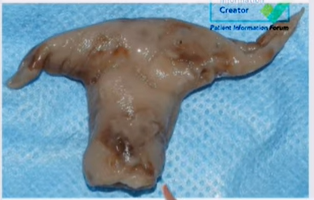
The size can vary from a few centimeters to about the size of a palm. In many cases, It may resemble the shape of the uterine cavity, but size varies and is usually smaller than the actual uterus. This is why it can look much larger than normal menstrual clots. Its size is one of the reasons it feels so alarming when it happens.
Can it come out in one piece or fragments?
A decidual cast usually comes out in one single piece instead of breaking apart. This is what makes it different from a normal period, where tissue and blood are shed gradually. In rare cases, it may pass in parts, but the typical pattern is one complete piece.
Appearance
People often describe it as a thick, fleshy, and firm piece of tissue with a strange shape. The color may range from pink to dark red, gray, or whitish tones. It can feel similar to a large clot, but it is more solid and structured. Although it can look alarming and may be mistaken for a miscarriage, it is usually not linked to long-term health problems.
Symptoms of a Decidual Cast
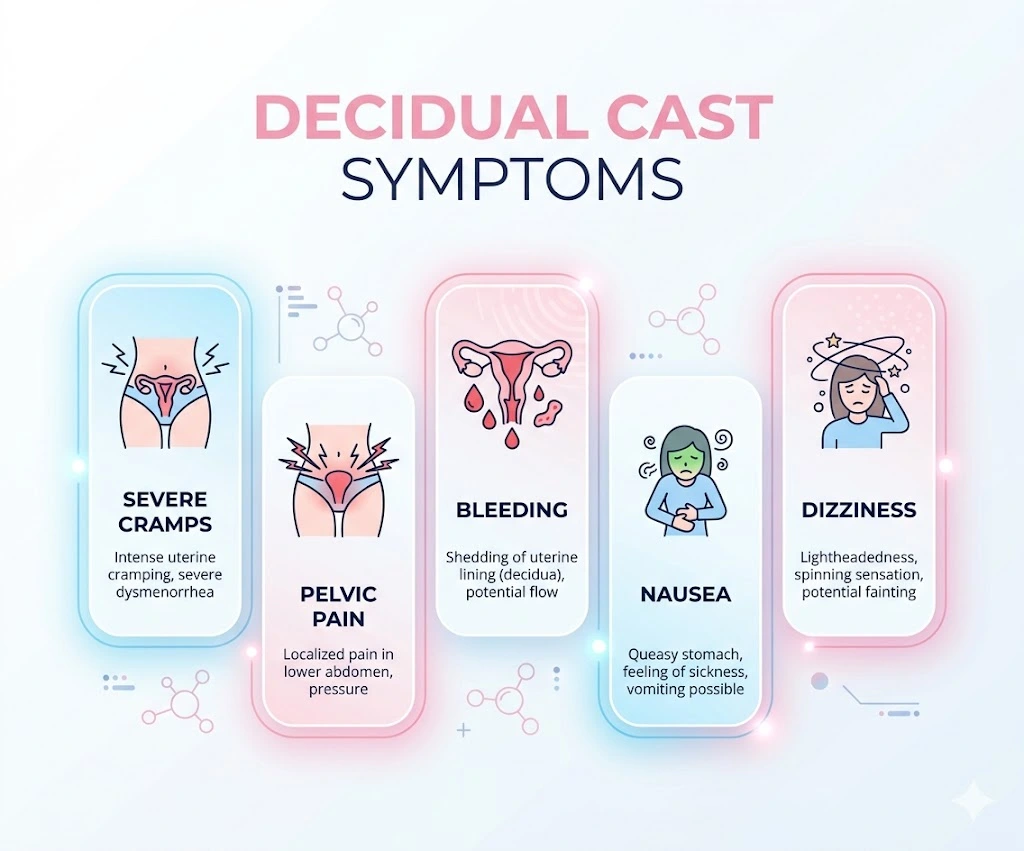
A decidual cast can cause symptoms that feel very similar to a strong period but often much more intense. You may first notice severe cramping, pelvic pain, heavy bleeding, or spotting. Some people also feel nausea, dizziness, lightheadedness, or even vomiting. These symptoms can build up before the tissue is passed.
Severe cramping and pain
The most common symptom is strong abdominal or pelvic pain. This pain is usually sharper and more intense than normal menstrual cramps. It happens because the uterus contracts strongly to push out a solid piece of tissue. In some cases, the pain can feel like contractions.
Passing tissue during period
A key sign is passing a large piece of tissue through the vagina. This tissue may come out all at once or in fragments. It often happens suddenly and can feel very alarming. After it passes, many people feel quick relief from pain.
Bleeding patterns
Before and during a decidual cast, bleeding can be heavy and sometimes mixed with spotting. The bleeding may look different from a normal period because it is often combined with thick tissue. After the cast is passed, bleeding usually becomes lighter.
Other warning signs
Other symptoms may include nausea, dizziness, vomiting, or a feeling of pressure in the lower abdomen. Some people also feel weak or uncomfortable due to the intensity of symptoms.
Decidual Cast Period vs Normal Menstruation
A normal period and a decidual cast period may look similar at first, but they are actually very different. In a regular period, your body slowly sheds the uterine lining over several days. In a decidual cast, the entire lining comes out in one solid piece, which can feel sudden and intense.
Difference from regular period
In a normal period, blood and small tissue pieces leave the body slowly over a few days. With a decidual cast, the uterine lining does not break apart. Instead, it comes out all at once as one large piece. This is why the pain and experience can feel much more extreme compared to a regular period.
Uterine lining shedding without blood
In a normal period, although blood is still present, the tissue remains intact instead of breaking into smaller pieces. It can look very different from typical menstrual flow and may feel surprising or alarming.
Causes of a Decidual Cast
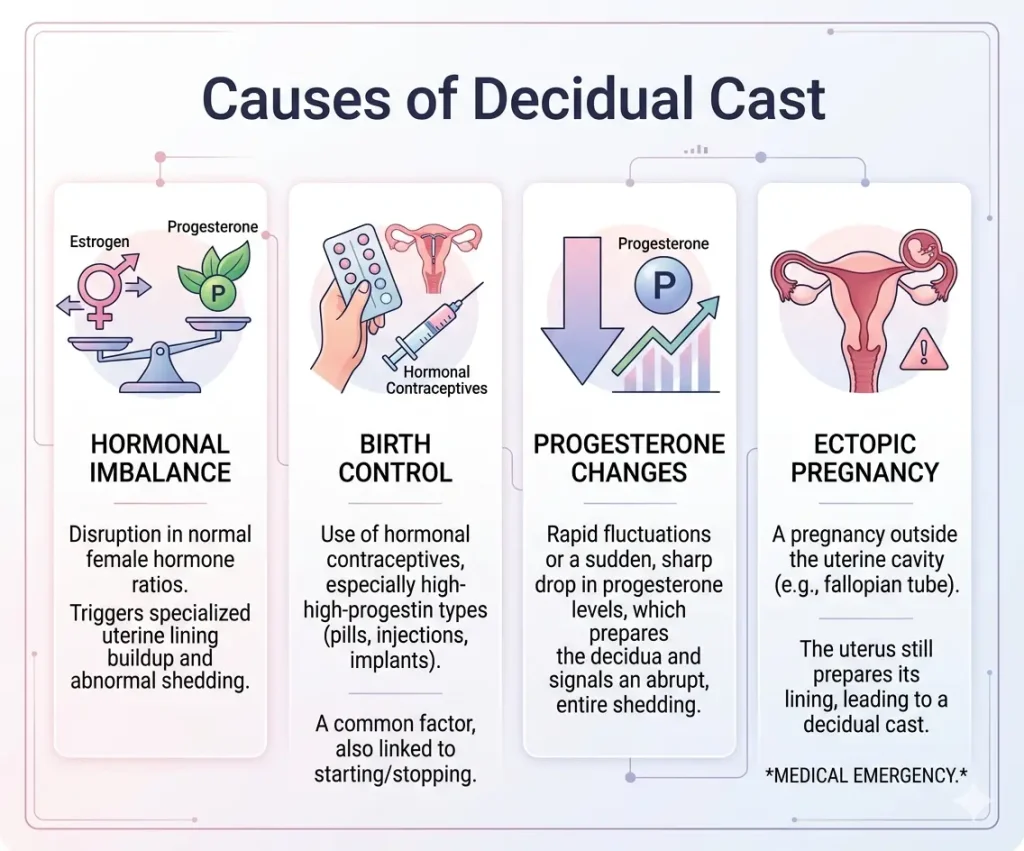
A decidual cast usually happens when there is a change in how your uterine lining responds to hormones. Normally, the lining breaks down slowly during your period, but in some cases, it stays intact and comes out as one piece. The exact cause is not always clear, but several factors are linked to it.
1. Hormonal imbalance
Hormones control how your uterine lining builds up and sheds. If these hormones become unbalanced, the lining may not break down properly. Instead, it can stay together and leave the body in one solid piece. This is one of the most common reasons behind a decidual cast.
2. Decidual cast birth control (contraceptives)
Hormonal birth control can sometimes affect how the uterine lining forms. Pills, injections, or other contraceptives that change hormone levels may increase the chance of a decidual cast. This is because they can make the lining thicker or change how it sheds during your cycle.
3. Decidual cast ectopic pregnancy
In rare cases, a decidual cast may be linked to an ectopic pregnancy. This is when a pregnancy grows outside the uterus. The body may respond by shedding the uterine lining in an unusual way. If pregnancy is possible, medical evaluation is very important.
4. Irregular menstrual cycles
If your periods are irregular, your hormone levels may not follow a stable pattern. This can affect how the uterine lining builds up and sheds. As a result, the lining may come out in one piece instead of gradually.
5. Other possible triggers
Other factors may also play a role, such as sudden hormonal changes, stopping or switching birth control, or unknown reproductive system reactions. In some cases, no clear cause is found. Because it can sometimes look like other serious conditions, medical advice is always recommended.
Decidual Cast in Menopause
A true decidual cast is extremely unlikely after menopause. Any bleeding or tissue passage should be evaluated urgently to rule out serious conditions.
During menopause, estrogen and progesterone levels drop and become unstable. These hormonal shifts can sometimes affect the uterine lining. Any bleeding or tissue passage after menopause should always be checked by a doctor.
Is a Decidual Cast Dangerous?
A decidual cast can look scary, but in most cases it is not dangerous. It happens when the uterine lining comes out in one piece, which is rare but usually temporary. Still, because the symptoms can be intense, many people worry when it happens for the first time.
Is it normal or rare?
A decidual cast is considered rare. Most people will never experience it in their lifetime. When it does happen, it is usually linked to hormonal changes or contraceptive use. Even though it is not common, it is generally not a sign of a long-term disease.
Is it bad or harmless?
In most cases, a decidual cast is harmless and does not cause permanent damage. The pain and bleeding can be strong, but they usually stop after the tissue is passed. However, because it can look similar to other serious conditions, it should still be checked by a doctor.
Possible complications
Most people do not have complications after a decidual cast. In rare cases, severe pain, heavy bleeding, or dizziness may occur. If symptoms are extreme or do not improve, medical attention may be needed to rule out other problems.
When it’s NOT serious vs when it is
It is usually not serious if symptoms stop quickly after the tissue passes and you feel better soon after. It may be serious if you have ongoing heavy bleeding, strong pain that does not improve, fever, or signs of infection. These symptoms need medical evaluation right away.
Who is more likely to experience it
People using hormonal birth control, or those with strong hormonal changes, may have a slightly higher chance of experiencing a decidual cast. It can also happen during irregular menstrual cycles. However, it is still uncommon even in these groups.
Should I be Worried?
In most cases, you do not need to panic. A decidual cast is usually not life-threatening. But because it can look similar to miscarriage or other conditions, it is always a good idea to talk to a healthcare provider to be safe and get proper confirmation.
Decidual Cast vs Miscarriage
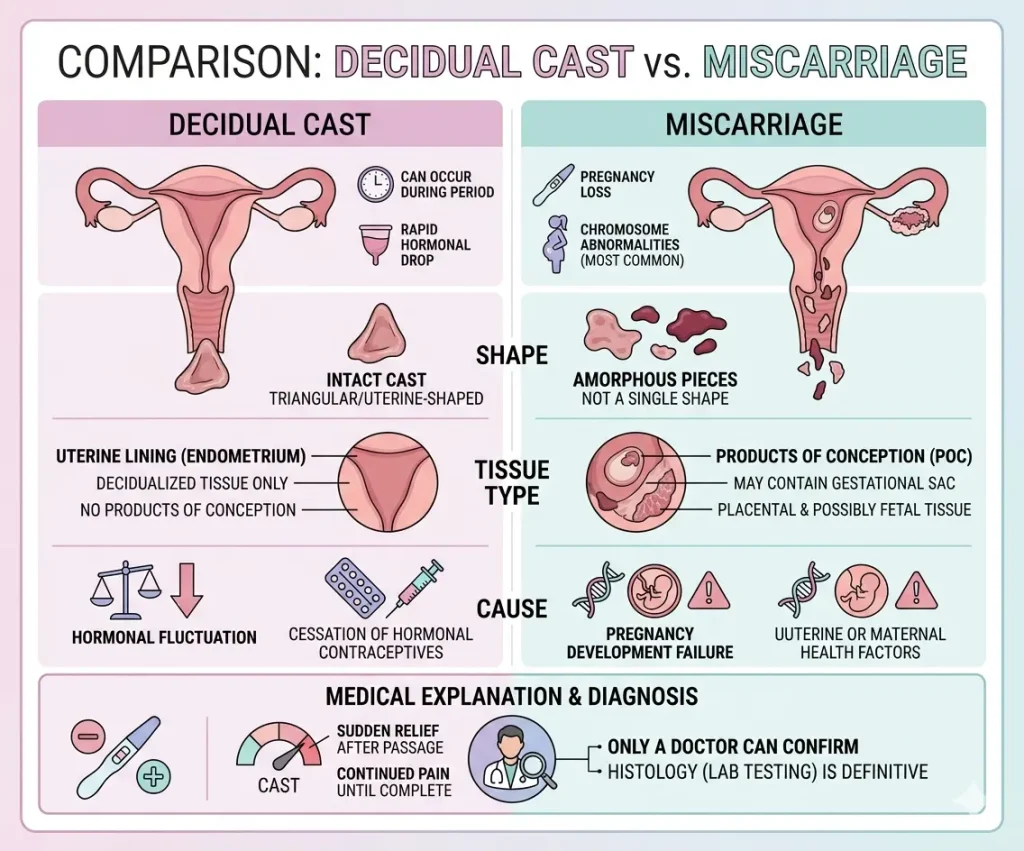
A decidual cast and a miscarriage can look and feel very similar, but they are not the same condition. Both can involve pain, bleeding, and passing tissue, which is why many people get confused. Understanding the difference is important so you know what might be happening in your body.
| Feature | Decidual Cast | Miscarriage |
|---|---|---|
| Cause | Hormonal changes | Loss of pregnancy |
| Tissue | Uterine lining | Pregnancy tissue |
| Pregnancy present | Usually no | Yes |
| Pain level | Severe cramps | Severe cramps + other symptoms |
If there is any chance of pregnancy, take a pregnancy test immediately.
Key differences
A decidual cast is when the uterine lining sheds in one complete piece, usually without pregnancy. A miscarriage happens when a pregnancy ends and pregnancy tissue is passed from the uterus. The main difference is that a decidual cast is not caused by a developing pregnancy.
Symptoms
Both conditions can cause strong cramps, abdominal pain, and vaginal bleeding. You may also pass tissue in both cases, which can look similar. However, miscarriage symptoms are linked to pregnancy, while a decidual cast is related to hormonal changes in the uterine lining.
Decidual Cast After Miscarriage
In some cases, hormonal changes after a miscarriage can lead to unusual shedding of the uterine lining. This may sometimes resemble a decidual cast. Because the body is still adjusting, symptoms can overlap, so medical evaluation is important if you are unsure.
Why confusion happens
Confusion happens because both conditions involve tissue passing through the vagina and similar pain patterns. The tissue in both cases can also look alike. Without medical testing, it can be very hard to tell the difference on your own. That is why checking with a healthcare provider is always recommended.
Decidual Cast and Pregnancy
A decidual cast can sometimes be linked with pregnancy-related changes in the body, but it is not the same as a pregnancy. It happens when the uterine lining sheds in one piece, and this can create confusion if pregnancy is involved or suspected. Because the symptoms can look similar to other conditions, medical advice is always important in this situation.
Can it happen during pregnancy?
A decidual cast is generally not considered a normal part of pregnancy. However, it can sometimes be confused with early pregnancy loss or other pregnancy-related issues because of similar symptoms like cramping and tissue passing. If pregnancy is possible, it is important to get a medical check to confirm what is happening.
Decidual cast after abortion
After an abortion, hormonal changes in the body can affect how the uterine lining sheds. In some cases, the lining may come out in a larger piece, which can look similar to a decidual cast. Because the body is still adjusting, symptoms like bleeding and cramping may also occur. If anything feels unusual or very painful, medical follow-up is important for safety and reassurance.
Risk Factors of a Decidual Cast
A decidual cast is a rare event, but certain factors can increase the likelihood of it occurring. It is most commonly linked to sudden hormonal changes that affect how the uterine lining builds up and sheds. These changes may happen when starting, stopping, or switching birth control, or in people with irregular menstrual cycles where the lining does not shed in a consistent pattern. In some cases, hormonal shifts related to pregnancy may also play a role.
Hormonal imbalances are another important factor. When hormone levels are not well regulated, the uterine lining can become thicker than usual or shed abnormally. Instead of breaking down gradually during a period, the lining may come out in one piece. While these conditions may increase the risk, it is important to remember that a decidual cast remains uncommon overall.
Decidual Cast vs Clot
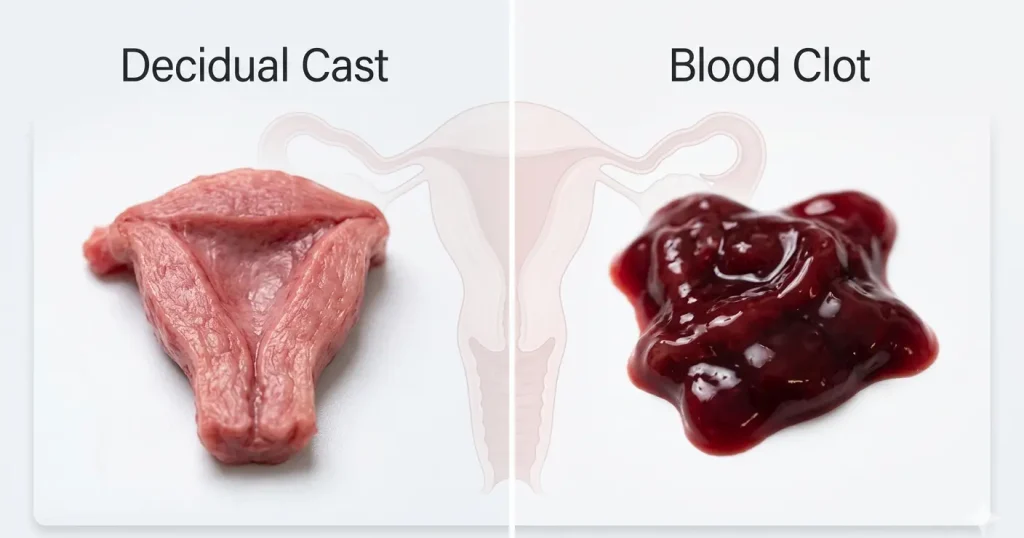
A decidual cast and a blood clot can both appear during your period, but they are not the same thing. A blood clot is a normal part of menstrual bleeding, while a decidual cast is the shedding of the entire uterine lining in one piece. Because they can look similar, many people confuse the two.
| Feature | Decidual Cast | Blood Clot |
|---|---|---|
| Structure | Solid tissue mass | Gel-like |
| Shape | Uterus-shaped | Irregular |
| Size | Larger | Smaller |
| Texture | Firm | Soft |
What are menstrual clots?
Menstrual clots are thick, jelly-like masses of coagulated blood that form during heavy bleeding and when blood pools inside the uterus. They are common during heavy periods. These clots are usually small and break apart easily because they are made mostly of blood, not tissue.
How to tell the difference
A decidual cast is a solid piece of uterine lining that holds its shape, while a blood clot is softer and breaks apart easily. A cast often has a defined structure and may look like the shape of the uterus. Clots do not have a clear shape and are more irregular.
Symptoms
A decidual cast is usually firm, fleshy, and shaped like the uterine cavity, and it often comes with severe cramping before passing. Blood clots are softer, darker, and usually pass with normal period flow. Pain from clots is usually mild compared to the intense cramping that can happen with a decidual cast.
Decidual Cast and Endometriosis
What is endometriosis?
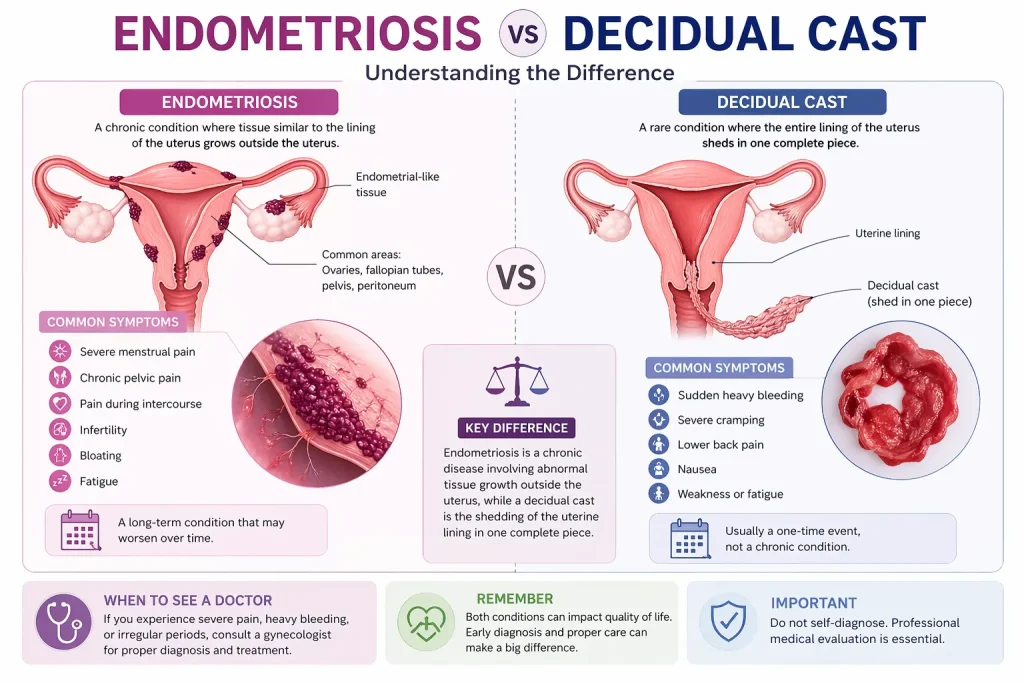
Endometriosis is a long-term condition where tissue similar to the lining of your uterus grows outside the uterus. This tissue reacts to your monthly cycle, so it bleeds and causes inflammation inside your body.
Unlike a normal period, this blood has no way to leave the body, so it leads to pain, swelling, and sometimes scar tissue. Over time, it can also affect daily life and even fertility in some cases.
Are they related?
A decidual cast and endometriosis are not directly the same condition, but they are linked in one way: hormones.
Both conditions are influenced by hormonal changes, especially progesterone and estrogen. That’s why symptoms like pain and abnormal bleeding can sometimes look similar.
However, a decidual cast happens inside the uterus and is usually a one-time event. Endometriosis happens outside the uterus and continues over a long period.
Pain
The pain in both conditions can feel very intense, but the pattern is different.
With a decidual cast, the pain comes suddenly, becomes very strong, and usually stops quickly after the tissue is passed. It feels like strong contractions because the uterus is pushing out a solid piece of lining.
With endometriosis, the pain is more long-term. It may come before, during, and even after your period. It can also appear outside your cycle and slowly get worse over time.
So, the key difference is simple:
- Decidual cast = sudden, short-term pain
- Endometriosis = long-term, recurring pain
How Is a Decidual Cast Diagnosed?
A decidual cast is often confusing because it can look like a miscarriage or a large blood clot. For this reason, diagnosis is not always something you can confirm on your own. Doctors usually check your symptoms, medical history, and run some tests to be sure what actually happened.
When to see a doctor
You should see a doctor if you pass a large piece of tissue during your period, especially if it comes with severe pain or heavy bleeding. It is also important to get checked if you are unsure whether you might be pregnant.
Even if the pain goes away after the tissue passes, medical advice is still important. This helps rule out serious conditions like miscarriage or ectopic pregnancy.
Medical tests and evaluation
Doctors usually start by asking about your symptoms and menstrual cycle. They may also do a pelvic exam to check for any abnormalities.
A pregnancy test is often done first to rule out pregnancy-related causes. In some cases, an ultrasound is used to look at the uterus. If possible, the passed tissue may also be examined to confirm if it is a decidual cast.
Self-identification vs professional diagnosis
You may suspect a uterine lining shedding in one piece if you see a large, fleshy piece of tissue with strong cramps and sudden relief after passing it. However, self-identification is not enough to confirm it.
Many conditions can look similar, such as blood clots or early pregnancy loss. That is why only a healthcare professional can give a final and safe diagnosis.
In simple words, you can notice it, but you should not confirm it yourself without medical evaluation.
Treatment and Management
In most cases, a decidual cast (full lining expulsion) does not need long-term treatment because it is usually a one-time event. Once the tissue passes, symptoms often improve quickly. Still, managing pain and checking the cause is important for your safety and comfort.
Medical treatments
There is no specific medicine just for a decidual cast. Doctors mainly focus on treating the symptoms and finding the underlying cause.
If the condition is linked to hormonal birth control, a doctor may adjust or change your contraceptive method. Pain relief medicines may also be given if cramps are severe. In some cases, further tests are done to rule out miscarriage, ectopic pregnancy, or infection.
If another condition is found, like hormonal imbalance or reproductive issues, treatment will depend on that diagnosis.
Pain management at home
You can manage mild to moderate pain at home with simple steps. Over-the-counter pain relievers like ibuprofen or paracetamol are commonly used to reduce cramps.
Using a heating pad or warm water bottle on your lower abdomen can also help relax uterine muscles. Resting and staying hydrated may reduce discomfort during recovery.
If pain becomes very severe or does not improve, you should seek medical help instead of self-treating.
Lifestyle adjustments
After a decidual cast, most people return to their normal routine without any long-term issues. Still, keeping track of your menstrual cycle can help you notice any future changes.
If hormonal birth control is involved, discussing alternatives with your doctor may be helpful. Eating a balanced diet, managing stress, and maintaining regular sleep can also support hormonal health.
Other helpful habits include:
- Tracking period symptoms in a journal or app
- Avoiding self-medication without guidance
- Scheduling regular gynecological checkups if symptoms repeat
These steps do not prevent a decidual cast completely, but they help you understand your body better and catch any underlying issues early.
Can You Prevent a Decidual Cast?
A decidual cast is rare, and in many cases, it cannot be fully prevented because it is linked to natural hormonal changes in the body. However, understanding your hormones and menstrual health can help reduce risk factors and improve overall reproductive health.
Hormonal balance
Hormones play a key role in how the uterine lining builds up and sheds. Sudden changes in hormones, especially progesterone, are often linked with a decidual cast.
You cannot completely control hormones, but you can support balance by maintaining a healthy lifestyle. Regular sleep, stress control, and a balanced diet may help your body stay more stable hormonally.
If you notice frequent irregular periods or unusual symptoms, it is important to get checked by a doctor instead of ignoring them.
Birth control considerations
Hormonal birth control, especially progesterone-based methods, may sometimes be linked to decidual cast cases. This does not mean birth control is unsafe, but it means your body may react differently to certain types.
If you experience unusual bleeding, severe cramps, or tissue passing after starting or changing contraception, you should talk to your doctor.
They may adjust your dose or suggest a different method that suits your body better.
Menstrual health tips
Good menstrual health habits can help you stay aware of changes in your cycle and catch unusual symptoms early.
Simple steps include:
- Tracking your periods regularly
- Noticing changes in flow, pain, or timing
- Staying hydrated and eating iron-rich foods
- Managing stress through rest or light exercise
These habits do not guarantee prevention, but they help you understand your body better. Early awareness is the most important step in dealing with any menstrual irregularity.
What to Expect After Passing a Decidual Cast
After passing a decidual cast, most people feel a mix of relief and confusion. The experience can feel intense, but in many cases, the body returns to normal fairly quickly. Still, understanding what happens next helps you know what is normal and what needs attention.
Recovery timeline
In most cases, recovery starts immediately after the tissue passes. The strong cramps usually reduce or stop almost at once because the uterus is no longer contracting to push out tissue.
Light bleeding or spotting may continue for a short time, similar to a normal period. Some people may also feel tired or emotionally drained for a day or two. However, long-term recovery is usually smooth, and serious complications are rare.
If pain, fever, or heavy bleeding continues, it is not normal and should be checked by a doctor.
Future periods
After a decidual cast, your next period may feel slightly different. Some people notice a lighter flow or a small delay in their cycle because the uterine lining needs time to rebuild.
In most cases, future periods return to normal within the next cycle or two. A decidual cast is usually a one-time event, so it does not permanently change your menstrual cycle.
However, if irregular periods continue, it may point to a hormonal issue that needs medical attention.
Can a Decidual Cast Cause Infertility?
A decidual cast usually does not affect fertility. It is not considered a condition that damages the uterus or reduces the chance of pregnancy in the future.
Most people can still conceive normally after experiencing it. However, because it can sometimes be linked to hormonal changes or rare conditions like ectopic pregnancy, doctors often recommend a check-up.
If you are trying to conceive or have concerns about your reproductive health, it is always a good idea to speak with a healthcare provider for reassurance.
Can You Have a Decidual Cast Every Month?
A decidual cast is a rare event, and most people experience it only once in their lifetime.
- Myth vs reality
There is a common myth that a decidual cast can come out every month. In reality, this is not true for most people. A decidual cast is not part of a normal menstrual cycle, so it does not happen regularly like periods.
In almost all cases, it is a one-time or very rare event. If someone is passing large tissue every month, it is more likely linked to another medical or hormonal condition that needs proper evaluation.
- It does not happen every month because;
A decidual cast is mainly related to sudden changes in hormones, especially progesterone. This hormone helps keep the uterine lining stable during a cycle. When hormone levels drop or become unstable, the lining may shed in an unusual way.
For this reason, it does not repeat in a regular pattern like menstruation. Hormonal birth control changes, stress, or other medical conditions may trigger it once, but the body does not usually repeat the same response every cycle.
If something similar keeps happening every month, it is important to see a doctor to check for underlying issues rather than assuming it is a decidual cast.
When to See a Doctor
You should see a doctor immediately if you have very heavy bleeding, severe pain that does not improve, dizziness, fainting, or fever. These signs may point to something more serious than a decidual cast.
Also seek help if pain continues even after passing tissue or if you feel weak or unwell.
When to visit OB-GYN
Visit an OB-GYN if you pass unusual tissue for the first time, or if you are unsure whether it is a decidual cast, clot, or miscarriage. A medical check helps confirm the cause safely.
Doctors may run simple tests to rule out infections, hormonal issues, or pregnancy-related conditions.
Ectopic pregnancy warning
In some cases, similar symptoms can also appear in an ectopic pregnancy, which is a medical emergency. This is why self-diagnosis is not safe.
If you suspect pregnancy or have one-sided sharp pain with bleeding, get urgent medical care without delay.
Key Takeaways
A decidual cast happens when the entire uterine lining sheds in one solid piece instead of breaking into small parts during a normal period. It is rare and can look very unusual because the tissue often keeps the shape of the uterus.
It usually comes with strong cramps, heavy bleeding, and sudden passage of fleshy tissue. Many people feel quick relief once the tissue has passed.
Hormonal changes, especially related to birth control or progesterone shifts, are the most common causes. In some cases, it may also be linked to pregnancy-related conditions, so medical evaluation is important.
Even though it can feel scary, it is usually not dangerous and does not cause long-term problems. However, because it can look similar to miscarriage, getting a doctor’s confirmation is always the safest step.
Frequently Asked Questions
Is a decidual cast a miscarriage?
No, a decidual cast is not the same as a miscarriage. In a miscarriage, there is a pregnancy loss, but a decidual cast can happen without pregnancy. However, the symptoms can look very similar, so medical checking is important.
How common is a decidual cast?
Decidual casts are considered extremely rare, with limited documented cases in medical literature. Most people will never experience it in their lifetime. It is not considered a normal part of the menstrual cycle.
Can it happen more than once?
In most cases, it happens only once. Repeated episodes are extremely uncommon. If it happens again, doctors usually check for hormonal imbalance or other underlying issues.
Can birth control cause it?
Yes, hormonal birth control can sometimes be linked to a decidual cast. This is because it changes progesterone levels, which can affect how the uterine lining sheds.
Should I go to the ER?
Yes, you should go to the ER if you have severe pain, very heavy bleeding, fainting, fever, or if you think you might be pregnant. It’s always safer to get checked when symptoms feel extreme or unusual.
Can you flush a decidual cast?
No, you should not try to flush or force out a decidual cast. It usually passes naturally on its own when the uterus contracts. Trying to push it out can increase pain or cause complications. If you feel severe discomfort or something seems stuck, it is best to seek medical advice.
Does a decidual cast smell?
A decidual cast typically does not have a strong or unusual smell. It may have a mild odor similar to menstrual blood. However, if you notice a foul or strong smell, it could be a sign of infection, and you should contact a healthcare provider.
How long does it take to pass a decidual cast?
A decidual cast usually passes within a few hours during intense cramping. The buildup of symptoms may take longer, but the actual passage of the tissue is often sudden. After it passes, pain typically decreases quickly.
Can teenagers get a decidual cast?
Yes, teenagers can experience a decidual cast, especially if they have started menstruating and are using hormonal birth control or experiencing hormonal changes. However, it is still very rare in all age groups.
Is a decidual cast painful every time?
A decidual cast is usually associated with strong pain due to uterine contractions. However, the level of pain can vary from person to person. Some may experience very intense cramps, while others may have moderate discomfort. In most cases, the pain improves quickly after the tissue passes.
Related Guides
Explore more in-depth information about decidual casts:
- Decidual Cast Pain Level: How Bad Does It Hurt?
- What Causes a Decidual Cast? (Detailed Guide)
- Decidual Cast Pictures: What It Really Looks Like
- How Rare Is a Decidual Cast?
References
- World Health Organization (WHO) – Reproductive health guidelines
- NHS (National Health Service) – Menstrual health and conditions
- American College of Obstetricians and Gynecologists (ACOG) – Clinical guidance on menstrual disorders
- Cleveland Clinic – Patient education resources on uterine conditions
- Mayo Clinic – Evidence-based medical information
Meet the Experts Behind This Content
All medical content on DecidualCast.com is created and reviewed to ensure clarity, safety, and accuracy for readers seeking reproductive health information.
👤 Content Author
Muhammad Ali
Health content researcher & SEO specialist focusing on women’s reproductive health education and patient-friendly medical content.
Experience in creating evidence-based informational content designed for clarity, search accuracy, and user understanding.
Focus: Medical SEO • Health Education • Patient Awareness Content
🩺 Medical Reviewer
Dr. Sarah Ahmed, MD (OB-GYN)
Board-certified Obstetrician & Gynecologist with experience in reproductive health, menstrual disorders, and hormonal conditions.
This content is reviewed for medical accuracy, symptom interpretation, and safety guidance.
Specialty: OB-GYN • Reproductive Health • Hormonal Disorders
📌 Our Editorial Standards
- All content is reviewed for medical accuracy before publishing
- We cite trusted health sources such as medical institutions and clinical guidelines
- Content is regularly updated to reflect current medical understanding
- We do not replace professional medical advice