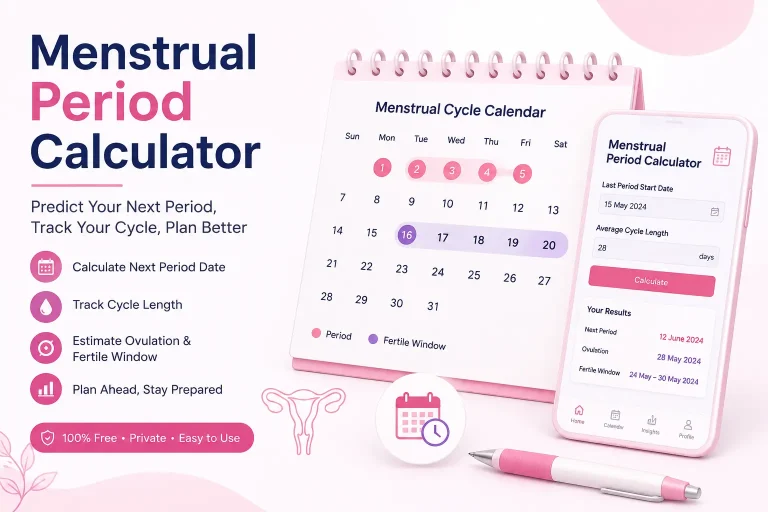
Luteal Phase Calculator
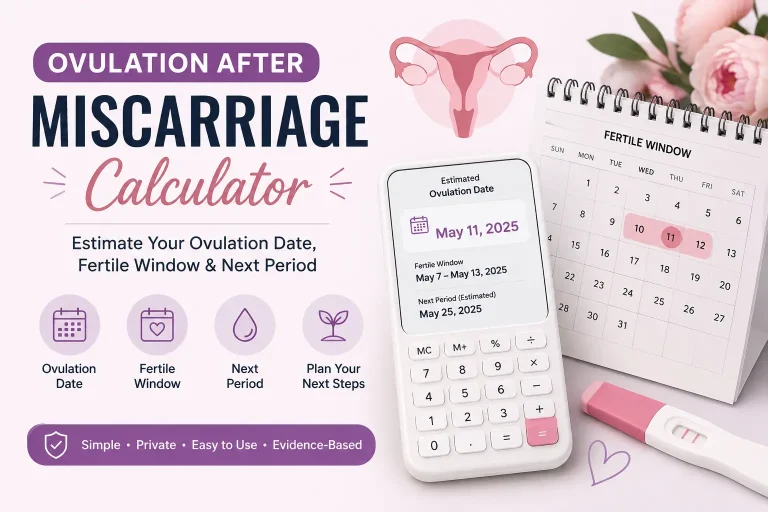
Enter your last ovulation date or your next expected period to calculate your luteal phase length, implantation window, fertile days, and next period — with a visual cycle calendar and plain-language results.
Calculate Your Luteal Phase
Choose what you know, then fill in the fields below.
Cycle Calendar
What Is the Luteal Phase?
The luteal phase is the second half of the menstrual cycle, beginning right after ovulation and ending the day before your next period starts. Once the ovary releases an egg, the ruptured follicle transforms into a temporary structure called the corpus luteum, which produces progesterone — and some estrogen — to prepare the endometrium (uterine lining) for a possible pregnancy.
If implantation occurs, the corpus luteum continues producing progesterone to support early pregnancy. If fertilization doesn’t happen, the corpus luteum breaks down, progesterone drops, and menstrual bleeding begins, starting the cycle over.
How to Calculate Your Luteal Phase
- Find your ovulation date. You can estimate this using basal body temperature (BBT) tracking, an ovulation predictor kit (OPK) that detects your LH surge, cervical mucus changes, or cycle-tracking apps.
- Count forward to your next period. The number of days between ovulation and the first day of your next period is your luteal phase length.
- Compare to the typical range. Most people have a luteal phase of about 12–14 days, with a normal range generally considered to be 11–17 days.
Example: If you ovulated on day 15 of your cycle and your period started on day 29, your luteal phase length is 14 days (29 − 15 = 14). If your period instead started on day 25, your luteal phase would be 10 days — on the shorter end, which may be worth tracking over a few cycles.
How Long Should the Luteal Phase Be?
A luteal phase is generally considered typical when it falls between 11 and 17 days, with 14 days being the most common average. Some variation from cycle to cycle — a day or two shorter or longer — is normal and usually nothing to worry about. What matters more than any single cycle is whether your luteal phase length is fairly consistent over time.
Typical pattern
Follicular phase (variable length) → ovulation → luteal phase (relatively fixed, ~11–17 days) → menstrual bleeding.
Why it’s “fixed”
Unlike the follicular phase, the luteal phase is largely governed by the lifespan of the corpus luteum, which is fairly consistent — usually around two weeks — unless pregnancy occurs.
Why Does Luteal Phase Length Matter?
The luteal phase plays a central role in fertility and early pregnancy support. Adequate progesterone during this window helps the endometrium thicken and become receptive to a fertilized egg. If the luteal phase is consistently too short, the lining may not have enough time to prepare for implantation, which can make conception more difficult — though many people with shorter luteal phases still conceive without issue. Tracking your luteal phase length over a few cycles can offer useful insight into overall cycle health and hormone balance, and can be a helpful conversation starter with a healthcare provider.
Signs of a Healthy Luteal Phase
- Reasonably regular periods and overall cycle length
- A stable luteal phase length from cycle to cycle (typically within a day or two)
- Predictable, detectable ovulation (via BBT shift, OPK, or cervical mucus changes)
- Progesterone levels that rise appropriately after ovulation
Short Luteal Phase: Possible Causes
A luteal phase shorter than about 10 days is sometimes called a “short luteal phase” and may be associated with lower progesterone output. Possible contributing factors can include:
- Chronic stress
- Low progesterone production
- Thyroid disorders (hypothyroidism or hyperthyroidism)
- Intense or excessive exercise
- Polycystic ovary syndrome (PCOS)
- Breastfeeding
- Perimenopause
Long Luteal Phase: Possible Causes
A luteal phase that runs noticeably longer than 17 days can sometimes simply reflect dating inaccuracies (for example, an OPK or app mis-estimating ovulation day). Other possible explanations include:
- Early pregnancy — a “late period” can actually be a longer luteal phase due to implantation and continued progesterone support
- Natural hormonal fluctuations
- Certain medications, including some fertility treatments
- Irregular or anovulatory cycles, where ovulation timing is harder to pinpoint
Tips to Track Your Luteal Phase
- Basal body temperature (BBT): Take your temperature each morning before getting up; a sustained rise typically signals ovulation has occurred.
- Ovulation predictor kits (OPKs): These detect the LH surge that precedes ovulation by roughly 24–36 hours.
- Cycle-tracking apps: Logging period start dates over several months helps reveal patterns in your luteal phase length.
- Calendar tracking: Simply marking ovulation signs and period start dates on a calendar, like the one above, can reveal a lot over time.
- Cervical mucus changes: Egg-white, stretchy mucus often signals approaching ovulation; a drier, thicker pattern typically follows during the luteal phase.
Frequently Asked Questions
What is a luteal phase?
The luteal phase is the part of the menstrual cycle that begins right after ovulation and ends the day before your next period. During this time, the corpus luteum produces progesterone to prepare the uterine lining for a possible pregnancy.
How do I calculate my luteal phase?
Count the number of days between your ovulation date and the first day of your next period. You can estimate ovulation using BBT tracking, an OPK, cervical mucus changes, or by entering your next expected period into the calculator above to reverse-calculate it.
Can luteal phase length vary from cycle to cycle?
Yes, a small amount of variation — typically a day or two — is normal. Larger swings from cycle to cycle may be worth tracking and discussing with a healthcare provider.
Is a 10-day luteal phase normal?
A 10-day luteal phase is on the shorter end and falls slightly below the commonly cited normal range of 11–17 days. It isn’t automatically a problem, especially as an isolated cycle, but a consistently short luteal phase may be worth mentioning to a healthcare provider.
Is a 14-day luteal phase normal?
Yes, 14 days is generally considered the average and is well within the typical range for most people.
Can stress shorten the luteal phase?
Chronic stress can influence the hormones that regulate ovulation and progesterone production, which may, in some people, contribute to a shorter luteal phase.
Does PCOS affect the luteal phase?
PCOS can affect ovulation timing and hormone balance, which may in turn affect luteal phase length and consistency for some people. Effects vary widely from person to person.
Can I get pregnant with a short luteal phase?
Many people with a shorter luteal phase do conceive. A consistently short luteal phase may make implantation timing tighter for some, which is why it’s a reasonable topic to raise with a healthcare provider if you’re trying to conceive and have concerns.
How accurate is this calculator?
This tool provides estimates based on the dates and averages you enter. It does not account for every individual factor that can affect your cycle, so results should be treated as educational guidance rather than a medical or diagnostic tool.
Does birth control affect the luteal phase?
Hormonal birth control generally prevents ovulation, so the concept of a natural luteal phase typically doesn’t apply in the same way while using it. Cycle patterns usually return over time after stopping hormonal contraception, though timing varies by individual.
What happens if my luteal phase is too long?
A longer-than-usual luteal phase can sometimes indicate early pregnancy, a dating inaccuracy in estimating ovulation, or natural hormonal variation. If it happens repeatedly without explanation, it may be worth discussing with a healthcare provider.
How is the luteal phase different from the follicular phase?
The follicular phase runs from the first day of your period until ovulation and varies in length from person to person and cycle to cycle. The luteal phase runs from ovulation until your next period and tends to be more consistent in length.
When should I talk to a doctor about my cycle?
Consider speaking with a healthcare provider if your luteal phase is consistently shorter than about 10 days, your cycles are very irregular, you’re experiencing difficulty conceiving after trying for several months, or you have other concerning cycle symptoms.
Can implantation occur during the luteal phase?
Yes. Implantation typically occurs roughly 6–10 days after ovulation, which falls within the luteal phase, and is supported by the progesterone the corpus luteum produces.
What is the best way to track ovulation?
There’s no single “best” method — many people combine approaches such as BBT tracking, OPKs, cervical mucus observation, and calendar tracking over several cycles to build a clearer picture of their personal pattern.