Daily Miscarriage Probability
Chance of Miscarriage by Week
Look up the probability of miscarriage—or the probability of continuing safely—for any day of the first 20 weeks of pregnancy. Pick a point below to see the odds at that exact day.
At 3 weeks: a 30% chance of miscarriage and a 70% chance the pregnancy continues past 20 weeks.
| Pregnancy Progress | Probability of Miscarriage | Probability of Not Miscarrying |
|---|
Swipe to scroll · miscarriage is defined as pregnancy loss before 20 weeks gestation.
Personalize the chart
All fields optional. Values should reflect pre-pregnancy measurements. Adjustments below use a simplified, illustrative model—not a clinical-grade calculation.
About this chart
The table above reports the probability of a miscarriage occurring on or after a given day of pregnancy, with gestational age counted in completed weeks and days. Miscarriage is defined as pregnancy loss before 20 weeks gestation; loss after that point is classified as a stillbirth rather than a miscarriage.
Gestational age is most accurate when based on a first-trimester (dating) ultrasound, followed by a known ovulation date, followed by the last menstrual period. Values are rounded to the nearest tenth of a percent, so very small day-to-day differences may not always be visible in the table.
The personalize panel applies a simplified adjustment for maternal age, prior pregnancy history, and BMI so you can see, directionally, how those factors shift the curve. It is built for illustration and learning, not as a diagnostic or clinical tool.
Pregnancy brings rising hormones, a changing body, and a long list of questions. Are you eating right? Is that cramp normal? Is the baby growing the way it should? Many of these questions trace back to one core worry: miscarriage.
Key Points:
- Most miscarriages happen early. About 80% occur in the first trimester, and risk drops sharply after week 10 (5%) and again at week 13 (1%).
- Genetics cause most losses. At least 50% of miscarriages trace back to chromosomal issues, meaning many fall outside anyone’s control.
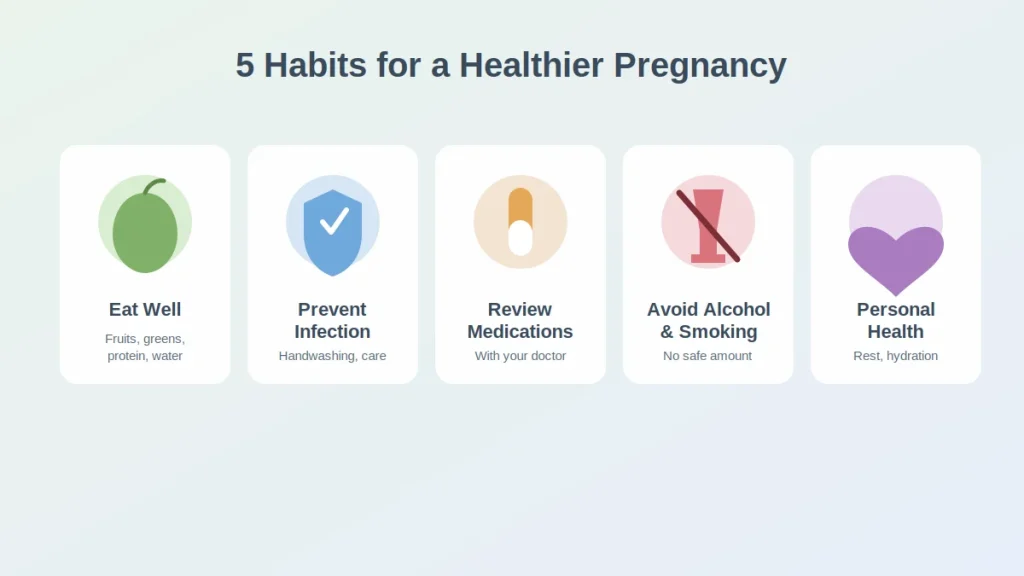
- Five habits lower risk: balanced nutrition, infection prevention, medication review, no alcohol or tobacco, and steady prenatal care.
- A maternal age and history calculator (the Miscarriage Probability Chart) gives a personalized estimate based on age, weight, and pregnancy history.
- Risk falls to near zero by week 20, when any loss is reclassified as a stillbirth rather than a miscarriage.
This guide covers the chance of miscarriage by week, five steps that support a healthy pregnancy, and a probability chart that adjusts for personal risk factors like maternal age, BMI, and prior pregnancy history.
What is your chance of miscarriage during pregnancy?
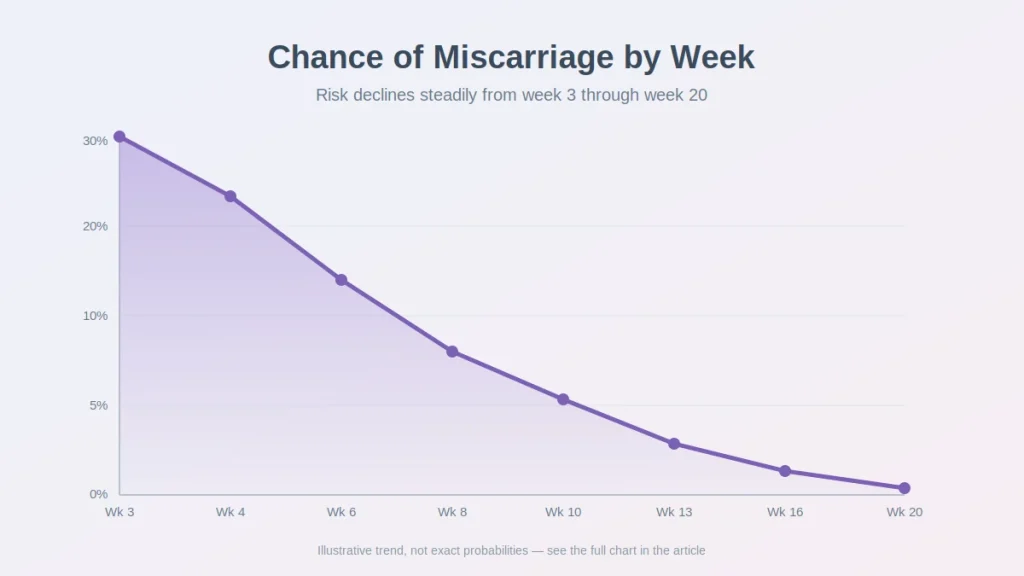
The chance of miscarriage during pregnancy ranges from roughly 25% in week 3 to near 0% by week 20. Risk falls fast and continuously as gestational weeks pass.
The first trimester runs from week 0 through week 13. Roughly 80% of all miscarriages happen in this window. The remaining 20% occur between weeks 13 and 20. After week 20, a pregnancy loss is called a stillbirth, not a miscarriage, and the event becomes rare.
Risk of Miscarriage by Week
Miscarriage risk is highest between weeks 3 and 4, at roughly 25% to 33%. Many people don’t yet know they’re pregnant at this stage; a loss can look like a late period.
Implantation happens around week 4, the same week a missed period typically signals pregnancy. Even sensitive pregnancy tests can’t detect the pregnancy hormone hCG until week 3 or 4, about one to two weeks after ovulation.
Risk drops to 15% to 20% by weeks 5 and 6. By week 10, risk falls to around 5%. By week 13, risk drops again to roughly 1%, and it keeps declining toward week 20.
These figures describe a healthy woman under 35 with no prior pregnancy complications. Maternal age, number of previous miscarriages, number of previous live births, height, and pre-pregnancy weight all shift individual risk up or down. The Miscarriage Probability Chart at the bottom of this page factors in those variables to produce a personalized estimate.
Many people wait until risk drops, often around week 12 or 13, before announcing a pregnancy. This is a personal choice tied to how much support someone wants if a loss occurs.
Miscarriage After Week 20
A pregnancy loss after 20 weeks gestation is called a stillbirth, not a miscarriage. Stillbirth is rare and has different causes and risk factors than early pregnancy loss.
At least 50% of miscarriages trace back to a chromosomal problem in the egg or sperm. A single genetic error can end a pregnancy regardless of anything the parent does or avoids. No action causes most early losses, and no action prevents them either. The five habits below address the risk factors that are controllable.
5 Things You Can Do to Help Lower Your Chance of Miscarriage
1. Eat Healthy Foods During Pregnancy
Pregnancy nutrition supports both miscarriage prevention and overall fetal growth. A pregnancy-supportive diet includes eight food groups.
- Dairy. Milk, cheese, and yogurt supply calcium, protein, magnesium, and zinc.
- Legumes. Beans, peanuts, chickpeas, peas, and soybeans provide fiber, folate, iron, protein, and calcium.
- Leafy greens. Spinach, broccoli, kale, and turnip greens deliver vitamin C, vitamin K, vitamin A, calcium, iron, potassium, folate, and fiber.
- Lean protein. Chicken, beef, and pork supply protein, B vitamins, and choline. Low-mercury fish like salmon adds omega-3 fatty acids and vitamin D; high-mercury fish like swordfish, mackerel, bigeye tuna, and shark should be avoided.
- Eggs. A single egg contains protein, fat, selenium, vitamin D, vitamin B6, vitamin B12, zinc, iron, and copper.
- Whole grains. Oats, brown rice, quinoa, and barley provide fiber, B vitamins, magnesium, and protein.
- Fruit and berries. Blueberries, strawberries, and bananas add vitamins and minerals alongside natural sugar.
- Water. Daily fluid needs rise during pregnancy and vary by body weight (lbs/kg); a doctor can set an individual target in ounces (oz) or liters (l).
2. Take Steps to Avoid Infections in Pregnancy
Infection prevention lowers miscarriage risk and protects fetal development. Six actions reduce exposure.
- Wash hands often, especially after contact with surfaces, pets, or sick people. Hand sanitizer works when soap isn’t available.
- Ask for STI screening. Most prenatal panels test for sexually transmitted infections as a standard step.
- Avoid people with active infections, including colds, COVID-19, chickenpox, rubella, and strep throat.
- Use insect repellent. Mosquitoes can carry Zika virus and ticks can carry Lyme disease; certain travel destinations carry higher exposure.
- Avoid cat litter and contaminated soil. Cat feces can carry a parasite that causes toxoplasmosis.
- Cook meat fully. Raw meat, hot dogs, lunch meat, and deli meats can carry listeria; heat processed meats until steaming and cook meat until juices run clear.
Schedule a Pregnancy Appointment
Regular prenatal care is the strongest defense against miscarriage risk. A doctor reviews medical history, screens for conditions, and runs ultrasounds and lab tests to track how the pregnancy is progressing. Early detection of a complication gives a doctor more options to treat it.
3. Evaluate Your Current Medications With a Doctor
Bring a full medication list to the first prenatal appointment, including prescriptions, vitamins, over-the-counter products, and any other substances. Some medications carry no risk before pregnancy but can harm fetal development. Some are safe in one trimester and risky in another. Some carry a benefit that outweighs the risk, and a doctor can weigh that tradeoff. A doctor can also prescribe a safer alternative if a current medication needs to stop.
4. Avoid Drinking Alcohol or Smoking While Pregnant
No amount of alcohol is safe during pregnancy. Any alcohol intake can lead to complications, including Fetal Alcohol Spectrum Disorders.
Smoking raises the risk of low birth weight, preterm birth, and birth defects during pregnancy, and raises the risk of Sudden Infant Death Syndrome (SIDS) after birth. A doctor can help build a plan to quit either substance.
5. Focus on Your Personal Health
Genetic miscarriages can’t be prevented, but personal health habits support the parts of pregnancy that can be influenced. Four habits make the biggest difference: steady hydration, balanced nutrition, avoidance of alcohol and tobacco, and a reviewed medication list. Limiting contact with sick people and washing hands often add a fifth layer of protection.
Most pregnancies reach full term without serious complications. Focusing on these five controllable habits supports both maternal health and fetal development through the weeks ahead.
FAQs
When is miscarriage risk highest?
Miscarriage risk peaks at weeks 3 to 4, between 25% and 33%. Risk drops to 15% to 20% by weeks 5 to 6, falls to roughly 5% by week 10, and reaches about 1% by week 13.
Does miscarriage risk vary by age?
Yes, miscarriage risk varies by age. The rates above describe a healthy woman under 35. Maternal age, number of previous miscarriages, number of previous live births, and other health factors raise or lower individual risk. A miscarriage probability chart that accounts for maternal age gives a more personalized estimate than general population statistics.
Is there a safe amount of alcohol during pregnancy?
No, there is no safe amount of alcohol during pregnancy. Any alcohol intake can lead to complications, including Fetal Alcohol Spectrum Disorders.
What foods should be avoided during pregnancy?
Avoid raw meat, hot dogs, lunch meat, and deli meats unless heated until steaming. Avoid high-mercury fish, including swordfish, mackerel, bigeye tuna, and shark.
Should I stop my medications when I find out I’m pregnant?
No, stop medications only after consulting a doctor first. Some medications are safe during pregnancy, some need a substitute, and some carry a benefit that outweighs the risk. Bring a complete medication list, including vitamins and over-the-counter products, to the first prenatal visit.