Academic Pressure and the Teen Menstrual Cycle: What Parents Should Watch For
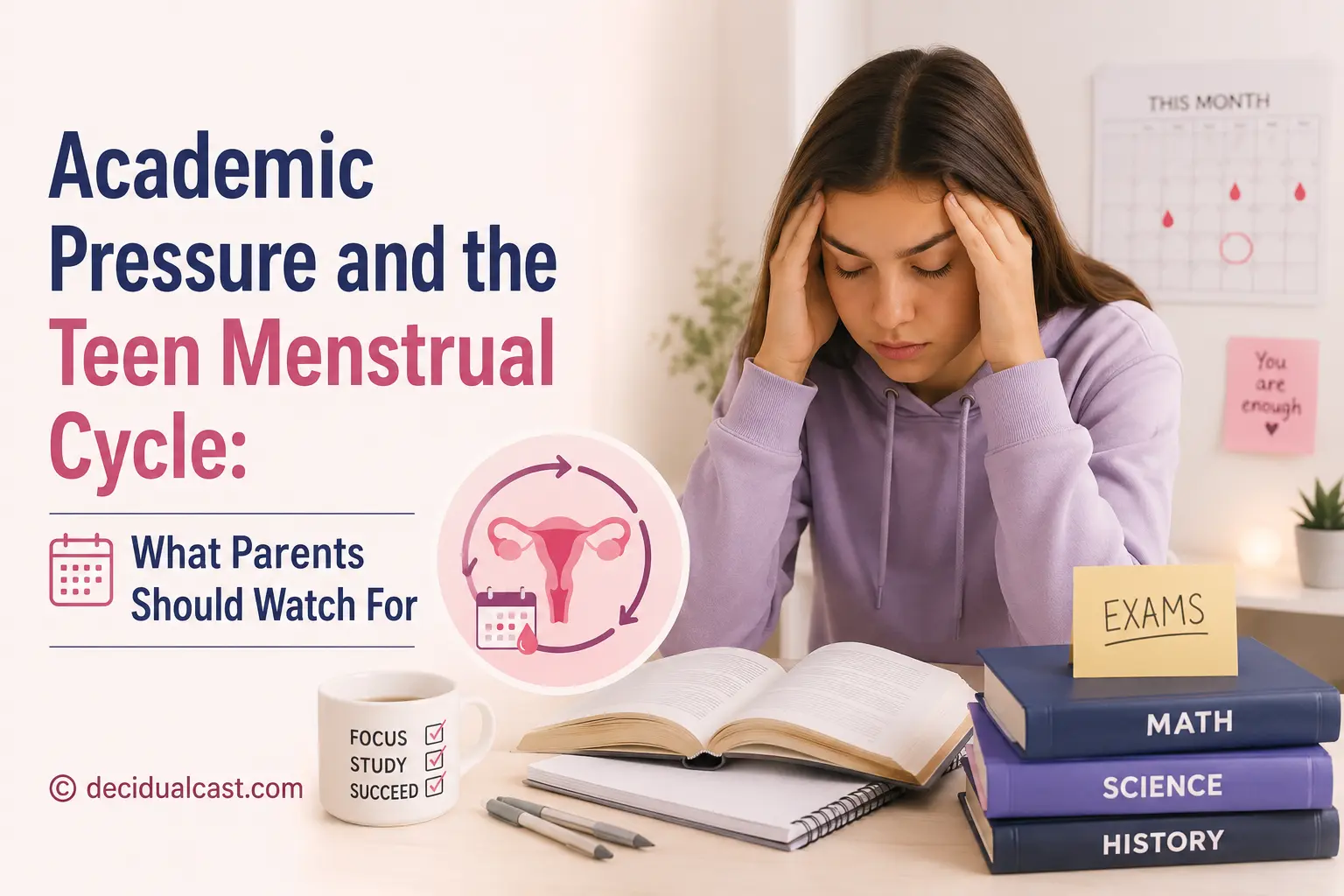
Between AP classes, club commitments, sports, and the ever-growing pressure to build a “well-rounded” college application, today’s teenagers are under more academic pressure than ever. Most parents keep a close eye on grades, sleep, and mood during stressful stretches of the school year — but there’s one stress signal that’s easy to miss entirely: changes in your daughter’s menstrual cycle.
A late period during finals week, unusually painful cramps during a heavy project deadline, or several months of irregular cycles during a demanding school year aren’t just “bad luck.” They can be your body’s direct response to chronic stress — and understanding why can help you know when it’s normal and when it’s worth a call to the doctor.
The stress-cycle connection, explained
The menstrual cycle is controlled by a finely tuned hormonal relay between the brain and the ovaries, known as the hypothalamic-pituitary-ovarian (HPO) axis. Stress either its academic, social, or physical can activates a separate but closely linked system, the hypothalamic-pituitary-adrenal (HPA) axis, which triggers the release of cortisol.
The problem is that these two systems don’t operate in isolation. When cortisol stays elevated for an extended period, it can interfere with the production of estrogen and progesterone, the two hormones responsible for regulating ovulation and keeping a cycle predictable. Researchers studying adolescent populations have consistently found this link: one study of teenage students found that higher academic stress was associated with a greater risk of menstrual irregularities, including longer cycles and disrupted flow, while other research using salivary cortisol testing found that persistently elevated stress hormones were tied to functional menstrual disorders in young people.
In practical terms, this can look like:
- A delayed or skipped period during an intensely stressful week or month
- Heavier or lighter flow than usual
- More severe cramping than in previous cycles
- Longer or shorter cycles, especially clustering around exam periods or major deadlines
It’s worth noting that adolescent cycles are naturally more irregular than adult cycles to begin with. According to guidance from the American College of Obstetricians and Gynecologists, a normal cycle length in the first couple of years after a first period can range anywhere from 21 to 45 days, gradually settling into the more familiar 24- to 38-day adult range by late adolescence. That baseline irregularity makes it even harder for parents (and teens) to tell whether a change is just normal development or a stress response layered on top. See our full guide on what’s a normal amount of delay in a period →
Why busy, high-achieving teens are especially at risk
It’s not really about how many extracurriculars a teenager has — plenty of well-rounded students thrive on a full schedule. It’s about the chronic, sustained nature of the pressure. A single stressful week rarely disrupts a cycle in a lasting way; it’s the season-after-season grind of high-stakes commitments that tends to matter.
This is common among students juggling honors coursework, competitive sports, and leadership-track extracurriculars, from student council to academically selective groups like the Middle School Honor Society. None of these activities are the problem on their own — they’re often genuinely good for a teen’s development and confidence. The issue is when a student’s schedule leaves little to no room for recovery: consistently late nights, skipped meals, disrupted sleep, and constant background anxiety about grades or extracurricular standing.
Parents are often the first to notice these patterns before a teen connects the dots herself. A daughter who’s proud of her academic momentum may not think to mention that her period has been three weeks late, or that her cramps have become noticeably worse since the semester started — because she may not realize the two are related at all.
When it’s normal — and when it’s not
Most stress-related cycle changes are temporary and resolve once the stressful period passes. That said, a few signs are worth paying closer attention to:
| Likely just stress | Worth a doctor’s visit |
|---|---|
| One or two late/irregular cycles tied to a specific stressful stretch | No period for 3 months or more (or cycles consistently longer than 45 days apart, more than two years after her first period) — the clinical threshold doctors use for evaluation |
| Mildly heavier or lighter flow than usual | Bleeding heavy enough to soak a pad within an hour |
| Slightly worse cramping during a stressful week | Severe pain that doesn’t respond to over-the-counter medication |
| Cycle returns to normal once the stress eases | New, unusual symptoms like fainting, significant fatigue, or a sudden change in an otherwise regular cycle |
| Irregularity within the first two to three years after a first period | Signs of PCOS, such as excess hair growth or persistent acne alongside irregular cycles |
If a pattern doesn’t resolve after a stressful season ends, or if your daughter is experiencing pain or bleeding severe enough to interfere with daily life, it’s reasonable to bring it up with a pediatrician or gynecologist. This isn’t just about comfort — prolonged missed periods can affect bone density during a critical bone-building window, and consistently heavy bleeding raises the risk of iron-deficiency anemia. A doctor can also rule out other causes — thyroid issues, polycystic ovary syndrome, or low body weight from inadequate nutrition during a hectic schedule — that can disrupt cycles in ways that look identical to stress on the surface.
How to support your daughter without adding pressure
A few practical steps can help take some of the physiological load off a busy teen’s body:
- Protect sleep as non-negotiable. Chronic sleep debt independently raises cortisol, compounding academic stress. Even an extra 30–45 minutes a night can help.
- Watch for skipped meals. Under-eating during high-stress stretches — common when a teen is cramming or rushing between activities — adds another layer of hormonal disruption on top of stress alone.
- Normalize talking about it. Many teens won’t mention cycle changes unless asked directly, either from embarrassment or simply not realizing it’s connected to stress. A casual, low-pressure check-in goes a long way.
- Build in genuine downtime. Not “productive rest” like reviewing flashcards — actual downtime that lets cortisol levels come back down between demanding stretches.
- Track patterns together. A simple period-tracking app can help both of you spot whether irregularity is tied to specific stressful periods or seems to be a more persistent pattern worth discussing with a doctor.
The bottom line
Academic ambition and physical health aren’t naturally at odds, but a packed schedule with no recovery time can quietly show up in a teenager’s menstrual cycle long before it shows up anywhere else. Keeping an eye on both — not just grades and activities, but sleep, nutrition, and cycle regularity — helps make sure a driven, high-achieving season doesn’t come at the expense of your daughter’s underlying health.
Frequently asked questions
Can stress really delay a teenager’s period? Yes. Chronic stress raises cortisol, which can interfere with the hormonal signals that regulate ovulation, sometimes delaying or skipping a period entirely.
How long can a stress-related delay last? Typically it resolves within the stressful stretch or shortly after. If a period is missing for three months or more, it’s worth a doctor’s visit regardless of the likely cause. Read more on what counts as a normal delay →
Is it normal for a teen’s cycle to be irregular in general? Yes, especially in the first two to three years after her first period, while the hormonal system that controls ovulation is still maturing.
Should we stop an extracurricular activity if it’s affecting her cycle? Not necessarily. The activity itself is rarely the issue — it’s usually the lack of recovery time around it. Focus on protecting sleep, meals, and downtime before cutting commitments.
Sources & references
- Study on academic stress and menstrual irregularities among adolescent students, International Journal of Indian Psychology, 2023.
- Research on menstrual and stress-related hormonal changes in adolescent females, examining HPA axis activation and cortisol’s effect on menstrual function, Procedia – Social and Behavioral Sciences.
- Clinical review of stress and irregular menstrual cycles in adolescent females, discussing the hypothalamic-pituitary-ovarian axis and its sensitivity to psychological stress.
- American College of Obstetricians and Gynecologists (ACOG). “Menstruation in Girls and Adolescents: Using the Menstrual Cycle as a Vital Sign.” Committee Opinion.
- American Academy of Family Physicians (AAFP). “Amenorrhea: A Systematic Approach to Diagnosis and Management.” American Family Physician.