How to Get Your Period in One Hour: Fast Period Tips That Actually Work
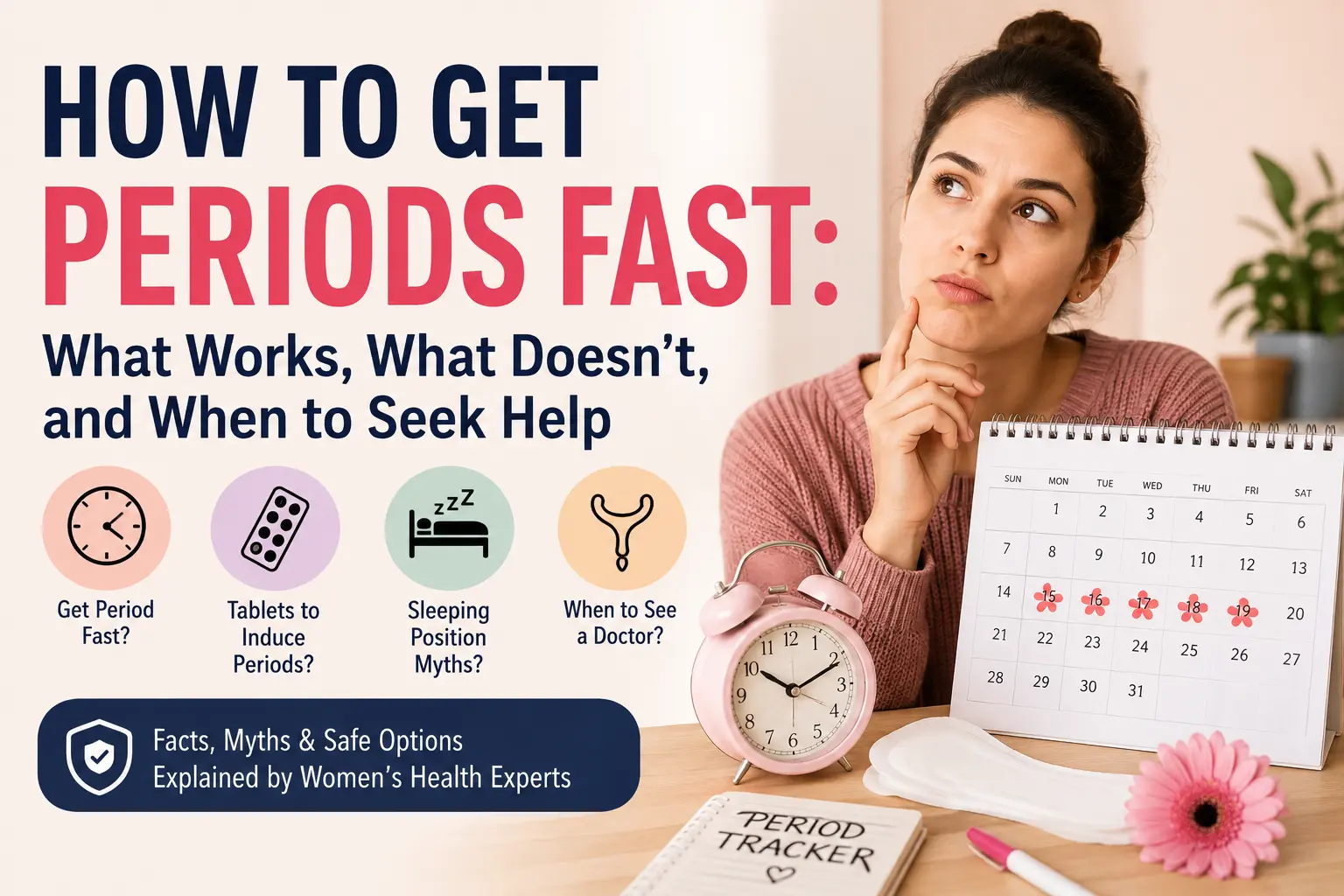
There’s no proven method to make your period start within an hour, and nothing can reliably guarantee it will arrive overnight either. Menstrual bleeding is triggered by a hormonal sequence involving estrogen and progesterone, not by something you eat, drink, or do the night before. If your period is late, the more useful question is usually why — stress, weight changes, a missed pill, PCOS, thyroid issues, or pregnancy are all common reasons. A few lifestyle factors can support a healthy cycle over time, but none of them work on demand. If you’re worried about a late period, a home pregnancy test and, if needed, a conversation with a doctor are the most reliable next steps.
Can You Get Your Period in One Hour?
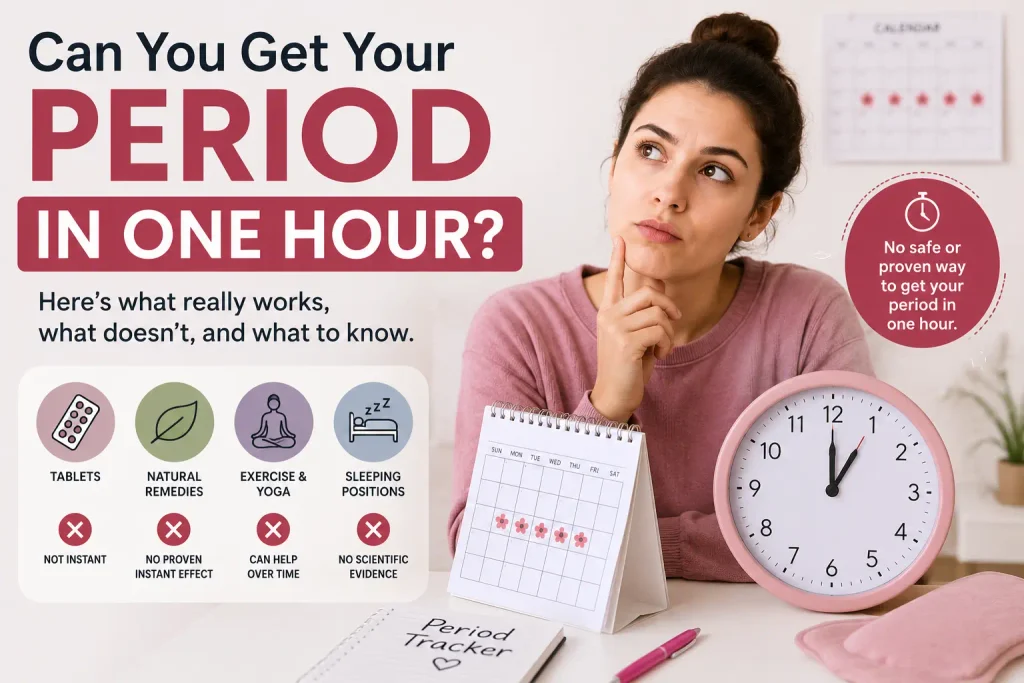
No. There is no method, food, drink, position, or exercise that can trigger menstruation within an hour. Your period isn’t a switch you can flip; it’s the end result of a hormonal cascade that unfolds over the second half of your cycle.
By the time bleeding starts, your body has already spent one to two weeks preparing for it. Progesterone levels have dropped, the uterine lining has begun breaking down, and blood vessels in that lining are starting to open. That process can’t be compressed into 60 minutes by anything you do right now.
If your period does arrive within an hour of trying a remedy, it’s almost certainly coincidence, you were already about to start.
Can You Get Your Period Overnight?
Not reliably, and not through any specific remedy. What sometimes looks like “getting your period overnight” is usually one of two things: you were already very close to the start of your period and it would have arrived around then anyway, or you’re experiencing spotting rather than your actual period.
Here’s the important part: no supplement, food, or sleeping habit has been shown to reach into your hormonal cycle and shift its timing overnight. If you’re only a day or two “late” by your own estimate, some natural variation in cycle length is normal and doesn’t necessarily mean anything is wrong.
How Does Your Menstrual Period Actually Start?
Understanding the mechanics helps explain why quick fixes don’t work.
Each cycle, your ovaries release an egg — ovulation — roughly midway through the cycle. After ovulation, progesterone rises and thickens the uterine lining (endometrium) in case a fertilized egg implants there.
If pregnancy doesn’t occur, progesterone and estrogen levels fall sharply about two weeks after ovulation. That drop signals the uterine lining to shed, which is what you experience as your period. This entire sequence is governed by the hypothalamus, pituitary gland, and ovaries working together — a system that responds to signals over days and weeks, not minutes.
Because the timing depends on this hormonal drop, a period generally can’t come “early” unless the hormonal shift itself happens earlier — which isn’t something you can force safely.
How to Get Your Period Early: What Can You Actually Do?
It helps to separate what’s realistic from what’s an internet myth.
What may genuinely help, over time:
- Managing significant stress, which can delay ovulation and, in turn, your period
- Maintaining a stable, adequate body weight, since very low body weight or rapid weight loss can suppress ovulation
- Avoiding excessive or sudden increases in intense exercise, which can also delay cycles
- Talking to a doctor if you use hormonal birth control, since certain pill schedules can be adjusted under medical guidance to shift period timing
What won’t meaningfully speed things up:
- One-off remedies tried the night before you want your period
- Anything marketed as an “instant” or “one hour” solution
None of the first group works quickly. They support a more predictable cycle over months, not an early period this week.
Do Foods or Natural Remedies Make Your Period Come Faster?
Many popular lists recommend the same handful of foods and herbs. Here’s an honest look at the evidence behind them.
| Remedy | Can it reliably start a period? | What the evidence suggests |
|---|---|---|
| Papaya | No | Some traditional medicine systems associate unripe papaya with uterine stimulation, but there’s no reliable clinical evidence it induces menstruation in humans. |
| Pineapple | No | Contains bromelain, an enzyme sometimes claimed to affect the uterus; evidence in humans is lacking. |
| Ginger | No | May ease cramps or nausea for some people, but hasn’t been shown to trigger menstruation. |
| Vitamin C | No | A long-standing folk claim with no solid clinical evidence supporting it. |
| Parsley | No | Contains compounds studied in animal models at very high concentrations; not shown to reliably induce periods in people at normal dietary amounts. |
| Turmeric | No | Popular in wellness circles; no clinical evidence it starts menstruation. |
| Dates | No | Nutritious, but there’s no evidence linking them to period timing. |
| Herbal preparations (various) | Unproven to unsafe | Effects and safety vary widely; unregulated products can interact with medications or cause side effects. |
The honest takeaway: none of these have been shown in credible research to reliably start or speed up a period. Some may support general comfort or digestion, which is a reasonable enough reason to include them in your diet — just not as a period-inducing strategy.
Is There a Sleeping Position to Get Your Period Early?
No sleeping position has scientific evidence showing it can trigger menstruation. This is one of the most searched claims online, but it doesn’t hold up — your uterus and ovaries respond to hormonal signals, not to gravity or body position during sleep.
That said, certain positions can make you more comfortable if your period is approaching and you’re already dealing with cramps or bloating. Lying on your side with knees drawn up slightly (a fetal-like position) can ease pelvic tension for some people. That’s a comfort measure, though — not a way to make your period arrive sooner.
Are There Tablets to Get Periods Immediately?
There isn’t an over-the-counter tablet that safely and immediately starts a period on demand. What exists are prescription hormonal medications that doctors sometimes use to manage delayed or absent periods — but which one is appropriate depends entirely on the underlying cause.
For example, a clinician might use a short course of progestin to trigger a withdrawal bleed in someone with a hormonal imbalance, but this is decided after evaluation, not something to self-select. Using hormonal medication without knowing why your period is late can mask an underlying condition, interact with existing medications, or be inappropriate if you’re pregnant.
This is why self-medicating with borrowed pills, unregulated online “period tablets,” or someone else’s prescription isn’t safe. If your period is late and you’re considering medication, that’s a conversation for a doctor or gynecologist, not a decision to make alone.
Which Tablet Is Used to Get Periods Immediately?
There isn’t one universal tablet used to get periods immediately, because the right approach depends on what’s causing the delay in the first place. A doctor evaluating a late period will typically consider:
- Whether pregnancy is a possibility
- Hormone levels (thyroid, prolactin, and others)
- Whether polycystic ovary syndrome (PCOS) or another condition is contributing
- Overall health, weight, and recent life stressors
- Any medications or contraception already in use
Only after that evaluation would a clinician recommend a specific treatment, if one is needed at all. Sometimes a late period resolves on its own without any medication. Searching for “which tablet” without addressing the cause skips a step that actually matters for your health.
Why Is My Period Late?
A late period is common, and the reason varies quite a bit from person to person. Frequent causes include:
- Pregnancy — the first thing to rule out if there’s a chance of it
- Stress — emotional or physical stress can delay ovulation
- Significant weight changes — either loss or gain can disrupt hormone signals
- Low energy availability — under-eating relative to activity level, common in athletes
- Excessive exercise — intense training can suppress the reproductive hormone cycle
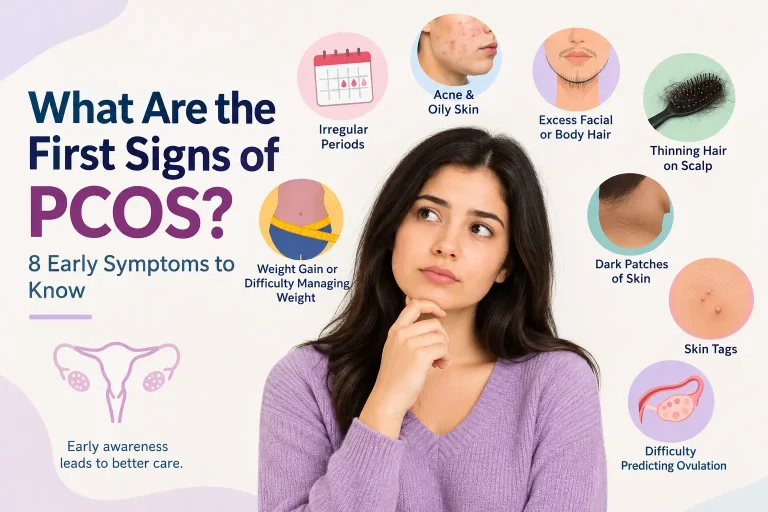
- PCOS (polycystic ovary syndrome) — a common hormonal condition causing irregular or missed periods
- Thyroid disorders — both an overactive and underactive thyroid can affect cycle timing
- Illness or recent infection — short-term sickness can delay a cycle
- Hormonal contraception — pills, IUDs, implants, and shots can all change or eliminate periods
- Other medications — some antidepressants, antipsychotics, and other drugs can affect cycles
- Perimenopause — for those in their late 30s to 40s, cycles can become less predictable as menopause approaches
Most of these are common and not emergencies on their own. But persistent irregularity is worth discussing with a doctor.
Could Pregnancy Be the Reason My Period Is Late?
If there’s any chance you could be pregnant, it’s worth considering — regardless of your situation or how you feel about that possibility. Home pregnancy tests are generally accurate once taken on or after the first day of your missed period, and even more reliable a few days after that.
If you get a negative test but your period still doesn’t arrive within a week or so, or if you have symptoms like nausea, breast tenderness, or fatigue alongside a negative test, testing again or seeing a doctor for a blood test is a reasonable next step. Blood tests can detect pregnancy hormone earlier and more precisely than home tests.
What Should You NOT Do to Make Your Period Come Faster?
Some approaches people try to force a period are genuinely risky, not just ineffective:
- Taking excessive doses of vitamins or supplements, hoping a higher amount will “work” — this can cause toxicity rather than help
- Taking prescription medication that wasn’t prescribed to you, including hormonal pills borrowed from someone else
- Using concentrated herbal extracts or tinctures at high doses, which can be more potent and less predictable than food-based amounts
- Intentionally over-exercising to try to shock your body into a period — this is more likely to delay your cycle further
- Extreme or crash dieting to try to trigger bleeding
- Combining multiple remedies or medications at once, which increases the risk of interactions
- Following viral “period-inducing” trends from social media without knowing the source or safety of the method
If you’re tempted to try any of these because you’re anxious about a late period, that anxiety is worth addressing directly — with a test, a doctor’s visit, or both — rather than through unproven or risky shortcuts.
When Should You See a Doctor About a Late or Missing Period?
Reach out to a doctor or gynecologist if you notice:
- You’ve missed three or more periods in a row without an obvious explanation (like pregnancy or starting/stopping birth control)
- You haven’t had a period in three months or longer
- You have severe pelvic or abdominal pain, especially if it’s new or worsening
- Bleeding is unusually heavy — soaking through a pad or tampon every hour for several hours
- You have pregnancy symptoms alongside a negative or uncertain test result
- You feel faint, dizzy, or lightheaded along with a missed or unusual period
- Your cycle has become unpredictable over several months without a clear cause
These aren’t meant to alarm you — most late periods have a straightforward explanation. But these particular signs are worth a professional evaluation rather than waiting it out.