Research Peptides: Safety Risks and Health Concerns in 2026

Interest in peptides as research tools has grown considerably over the past several years, and 2026-27 finds the field more active than ever. Peptides have become a focal point for investigation across academic laboratories, private research settings, and the broader biohacking community. Whether you are a trained researcher or a scientifically curious individual engaging with the literature, understanding what research peptides are, how they are categorized, and how to source them responsibly is worth doing before placing any order.
What Peptides Are and How They Differ from Other Molecules
Peptides are short chains of amino acids linked together by peptide bonds. Structurally, they are smaller versions of proteins. While proteins typically consist of hundreds or thousands of amino acids folded into complex three-dimensional configurations, peptides generally contain anywhere from two to roughly fifty amino acids, making them small enough to synthesize in a laboratory with reasonable precision.
This size difference has practical consequences for research. Small-molecule compounds, such as many conventional pharmaceuticals, typically have molecular weights under 500 daltons and interact with biological targets through comparatively simple binding mechanisms. Proteins, by contrast, are large, structurally complex, and difficult to reproduce reliably outside of biological systems. Peptides occupy a useful middle ground: they are large enough to interact with specific biological receptors and signaling pathways with a degree of selectivity, yet small enough to be chemically synthesized, purified, and characterized with standard analytical tools.
Understanding how biological molecules influence metabolic and hormonal pathways is also important in women’s health research. Conditions such as polycystic ovary syndrome (PCOS) involve complex interactions between hormones and metabolism. For readers who want to understand this connection from a women’s health perspective, our guide to weight management with PCOS explains the role of metabolic health and why individual approaches to weight management can differ.
Why Peptides Matter in Scientific and Biomedical Research
The biological activity of peptides spans a broad range of systems. The human body produces thousands of endogenous peptides that function as hormones, neurotransmitters, and cell-to-cell signaling molecules. Insulin, oxytocin, and various growth factors are all peptide-based compounds. This natural role in biology makes synthetic peptide analogs useful as research probes for studying receptor function, enzyme interactions, and tissue behavior under controlled experimental conditions.
One of the most valued attributes of peptides from a research standpoint is their relative specificity. A well-designed peptide can engage a particular receptor or signaling pathway without broadly disrupting unrelated biological systems, which makes it a cleaner experimental tool than some less selective compounds. Investigators supported by organizations such as the National Institutes of Health have published extensively on peptide interactions across oncology, endocrinology, neuroscience, and metabolic biology.
That said, specificity is not absolute, and findings from in vitro or animal studies do not automatically translate across biological contexts. The pharmacology of synthetic peptides remains an active area of inquiry.
What to Look for When Selecting a Peptide Supplier
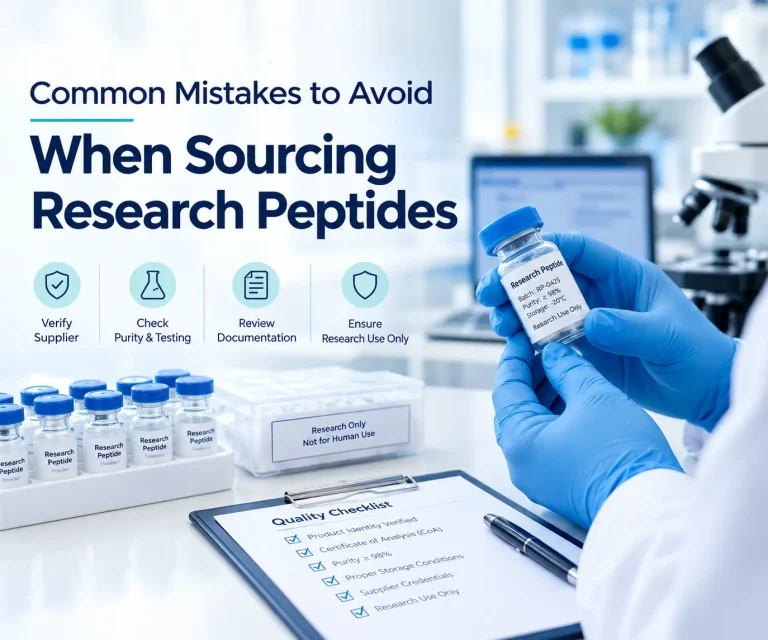
Given the variability in research-grade peptide quality, evaluating suppliers with care is a necessary step in the procurement process. Several criteria should guide that evaluation.
Certificates of analysis (CoA) are the baseline. Reputable suppliers provide a batch-specific CoA that identifies the purity percentage and the analytical methods used to determine it. A CoA that lacks supporting methodology or batch-level data offers limited assurance.
Third-party analytical verification adds meaningful credibility to any supplier’s claims. High-performance liquid chromatography (HPLC) and mass spectrometry (MS) are the established methods for verifying peptide purity and molecular identity. Suppliers who provide HPLC and MS data from independent laboratories demonstrate a higher level of transparency than those relying on in-house testing alone.
Storage and shipping standards directly affect compound integrity upon arrival. Peptides can degrade under improper conditions, particularly with exposure to heat, humidity, or light. Cold-chain shipping practices and documented storage protocols are worth confirming before ordering.
Documentation access and technical support round out the evaluation. Researchers should be able to obtain batch-specific records without friction, and suppliers should be prepared to address technical questions about their manufacturing and testing processes. Many researchers sourcing within the United States find that vendors such as USA Peptide Depot meet the core criteria the research community typically prioritizes: analytical documentation, domestic supply chains, and responsiveness to research-specific inquiries.
Main Categories of Research Peptides
The research peptide landscape encompasses a wide range of compound classes. Understanding these broad categories helps researchers identify which compounds are relevant to their area of inquiry.
Growth hormone-related peptides include compounds that interact with the growth hormone secretagogue receptor or influence growth hormone-releasing hormone pathways. These have been studied in research contexts involving neuroendocrine signaling, metabolic regulation, and cellular biology.
GHRP peptides (growth hormone releasing peptides) form a subset of growth hormone secretagogues. They are synthetic compounds examined for their effects on pituitary signaling and related physiological mechanisms in animal and cell-based research models.
BPC peptides, derived from a body protection compound originally isolated from gastric juice, have been studied for their potential interactions with growth factors and tissue signaling pathways, with most of this work remaining at the preclinical stage.
Nootropic and neuropeptide analogs cover synthetic analogs of naturally occurring brain peptides, studied for their interactions with neurological signaling pathways. The broader implications of preclinical findings remain under active investigation.
Melanocortin peptides and related analogs have been studied in connection with pigmentation pathways, inflammatory responses, and energy metabolism.
Each of these categories encompasses compounds at varying stages of scientific understanding. Consulting primary literature before selecting any compound for experimental use is standard practice.
Research-Grade vs. Pharmaceutical-Grade Peptides
An important distinction for anyone working with synthetic peptides is the difference between pharmaceutical-grade and research-grade compounds. Pharmaceutical-grade material is produced under strict current Good Manufacturing Practice regulations, which govern raw materials, synthesis conditions, and finished product testing. These standards exist to ensure safety, potency, and consistency for clinical application.
Research-grade peptides are manufactured for laboratory use and are not held to the same regulatory standard. They are not approved for therapeutic use and are sold exclusively for scientific research purposes. However, quality within the research-grade category varies substantially from one supplier to another. Some manufacturers invest heavily in analytical verification and transparent documentation; others provide minimal supporting data alongside their products.
For researchers, this distinction has direct practical implications. The reliability of experimental results depends on the purity and structural integrity of the compounds being used. A peptide with undisclosed impurities or an incorrect amino acid sequence can generate misleading data, waste resources, and compromise the integrity of a study.
Regulatory Context and Responsible Use
Research peptides occupy a defined regulatory space. In the United States and most other jurisdictions, synthetic peptides are legal to acquire and use for legitimate laboratory research. They are not approved drugs, and selling or marketing them for human consumption is not permitted under current regulations.
For individuals working outside institutional settings, this distinction carries real responsibility. Compliance with local laws, proper labeling and storage consistent with a research context, and maintaining a clear separation between research activity and personal use are all part of responsible practice. The regulatory landscape varies by country and evolves over time, so verifying the applicable rules in your specific jurisdiction before acquiring any compounds is a necessary step.
A Note Before You Order
The accessibility of research peptides through established suppliers makes sourcing straightforward, but easy access does not reduce the rigor required. Verifying supplier credentials, scrutinizing batch documentation, and approaching experimental work with appropriate controls all remain the researcher’s responsibility. The scientific value of peptides depends on the quality of both the compounds and the experimental design built around them.