At-Home Fertility Steps vs Clinical IVF Care: Understanding the Difference
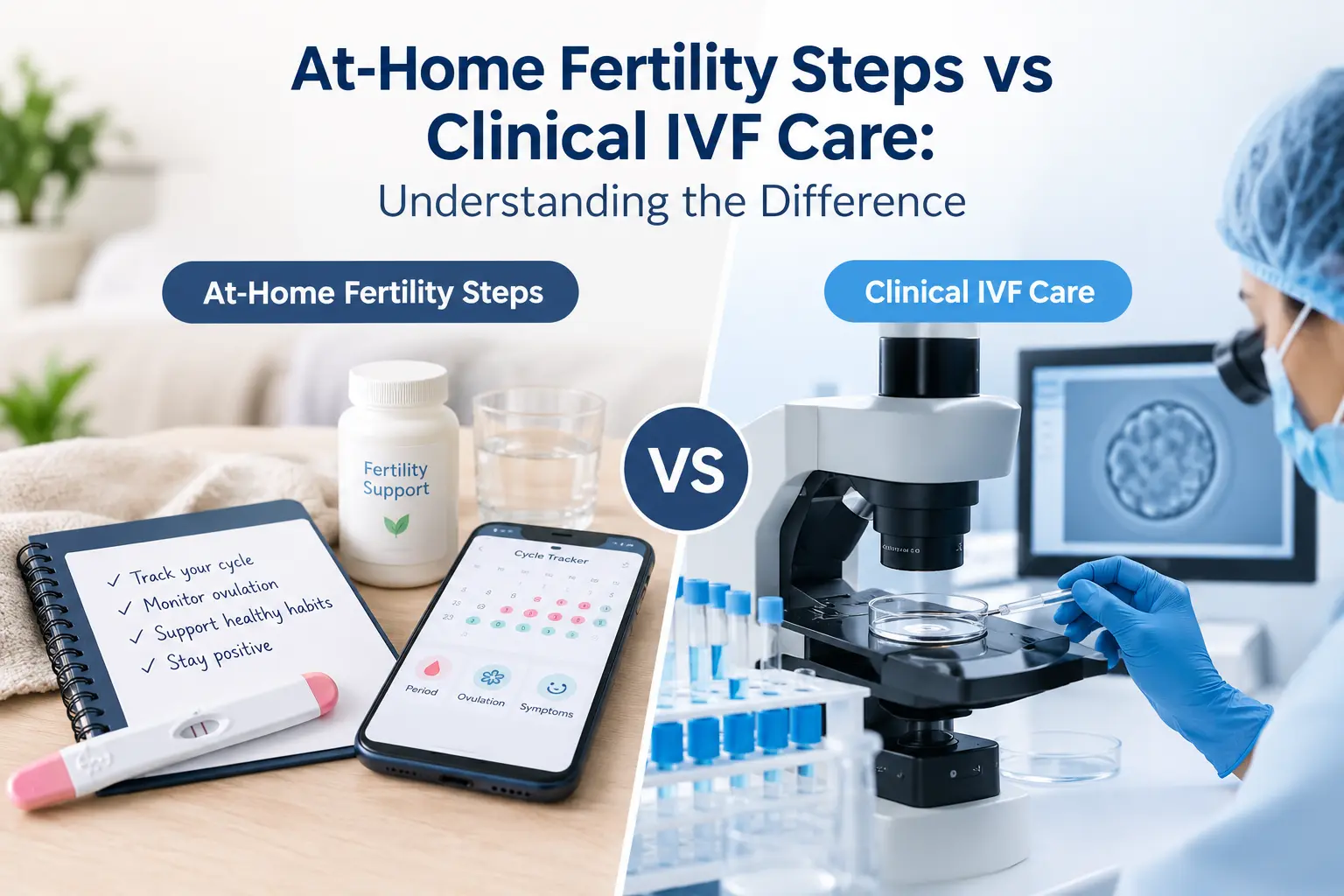
Tracking cycles at home is smart, but it isn’t treatment. At-home steps help you time intercourse well. Clinical fertility assessments can help identify possible causes of infertility and determine whether IVF or another treatment may be appropriate.
What at-home steps are good at
Most of what you can do at home comes down to timing. LH strips detect the luteinizing hormone surge that occurs a day or two before ovulation. That signal tells you the fertile window is open. The window lasts about six days each cycle and ends on ovulation day. Sex during those days gives sperm a chance to meet an egg.
Basal body temperature charting works differently. You take your temperature each morning before getting up. A small rise after ovulation confirms that it happened, although it can’t predict ovulation in advance. It also says nothing about egg health or sperm strength. It’s a record, not a forecast.
Fertility tracking apps try to fill the gap. They combine past cycle dates with temperature or LH input to estimate future fertile days. The math helps if your cycles are regular. These apps aren’t medical devices and can’t diagnose problems. They also don’t reliably adjust for a cold, a run of night shifts, stress, or a cycle that runs long by a week.
Lifestyle changes sit in the same group. Steady sleep and a healthy weight support general reproductive health, while cutting back on smoking and heavy drinking helps too. Those habits are worth keeping, but they can’t clear a blocked tube, fix sperm problems, or restart ovulation when polycystic ovary syndrome is behind missed periods.
You haven’t wasted your time if you started here. Most doctors expect it.
The limits that timing can’t get past
Every home method rests on quiet assumptions. It assumes you release an egg each month and that sperm count and movement are in a range that allows natural conception. It also assumes at least one fallopian tube is open so egg and sperm can meet. If any of those assumptions is wrong, perfect timing won’t change the result.
A thermometer or an app can’t check those assumptions. Anti-Müllerian hormone and follicle stimulating hormone blood tests flag diminished ovarian reserve. An ultrasound count of antral follicles adds detail about remaining egg supply and helps a fertility specialist interpret those hormone results in clinical context. No home kit measures it reliably.
Semen analysis is the parallel test on the male side. It examines count and movement under lab conditions. Low numbers often produce no clear signs at home.
Tubes are even harder to assess without medical help. Infections, prior surgery, scarring, or endometriosis can block them without causing pain or missed periods. Sex can be timed well for a year and still not lead to conception if sperm can’t reach the egg.
Then there’s unexplained infertility. The term applies when standard tests look normal and pregnancy still hasn’t happened. A full workup is needed to rule out known causes first.
There’s a hard truth here.
Perfect timing only helps when the path between egg and sperm is clear.
Why months of self-optimization can cost you
Doing more at home can feel productive. Extra monitors, powders, teas, and pricey supplement blends promise an edge, but most sit outside strict regulation. Their labels lean on stories and reviews rather than live birth data from controlled studies. Those stories can’t tell you whether a product helped or pregnancy would have happened without it.
For many couples, monitors beyond simple LH strips fall into this group. The extra data rarely changes the core advice, which is still to have sex during the fertile window. Proprietary blends and fertility teas have even less behind them. Doses vary, ingredients shift from batch to batch, and proof of benefit in humans is often missing. Hope gets tied to the next bottle.
Time passes while you test these options. That’s the part no one warns you about. Egg quantity and quality fall as we age. A delay of six to twelve months spent on self-optimization can mean a tougher starting point if you later need medical help. Biological time is a resource you don’t get back.
A few months of well-timed attempts with no red flags is normal. Endless tweaks without progress are a different story.
Infertility is also far more common than private struggle suggests. Approximately 1 in 6 people of reproductive age worldwide experience infertility at some point in their lifetime (World Health Organization). You aren’t an outlier for needing help. You’re in large company.
Knowing when to ask for specialist help
Reproductive medicine uses a clear cutoff. Twelve months of regular unprotected sex without conception defines infertility. For women aged 35 or over, the window shortens to six months. Past that point, an evaluation is the expected next step. Waiting longer rarely provides answers.
A reproductive endocrinologist or fertility specialist runs that evaluation. The visit provides more than reassurance because it maps what home methods can’t. Age, cycle history, prior surgery, and sperm findings all shape the plan. If the workup points to blocked tubes or very low sperm numbers, IVF may be raised early. If findings are mild, timed intercourse with medication or minor procedures may come first.
This is where clinic choice starts to matter. Laboratory standards and specialist experience differ between clinics, and protocols aren’t one-size-fits-all. A good clinic explains the options in plain terms and ties its advice to your test results. For readers in south-west Sydney, searching for ‘ivf clinic liverpool sydney’ can be a starting point when comparing local fertility clinics, treatment options and patient care.
Don’t read a referral as failure. It means you’ve finished the timing phase and gained access to better tools. Home charts still help the doctor see patterns, so bring them. They can shorten the first consultation and show diligence rather than delay.
What clinical testing checks first
A first workup is methodical rather than speculative. Blood tests for Anti-Müllerian hormone and follicle stimulating hormone sketch ovarian reserve. Pelvic ultrasound examines the uterus and ovaries and counts antral follicles. Semen analysis reviews count and movement, while tubal patency testing, often a hysterosalpingogram, shows whether dye passes through the tubes.
Each test answers a question that home tools can’t. Are eggs being released? Is reserve low for your age? Is sperm able to travel and fertilize? Are the tubes open? Is the uterine cavity shaped in a way that allows implantation? The answers sort couples into different paths within a single review, moving care from broad timing advice to a plan based on test findings. Some need ovulation support. Others need a referral for sperm issues or IVF planning.
Polycystic ovary syndrome often surfaces here. Irregular or absent ovulation, excess androgen signs, and a polycystic appearance on ultrasound can confirm it. Treatment is medical rather than app-based. Weight care and ovulation medication form the usual base, with close follow-up throughout. Without that diagnosis, couples can track for many months and miss the real cause.
The workup also establishes a baseline for later steps. Hormone levels guide drug doses if stimulation is used. Ultrasound findings inform transfer planning. Semen results help determine whether standard fertilization or intracytoplasmic sperm injection is appropriate in the lab. Each result narrows the field.
You may leave with news you didn’t expect. That’s common. Clear data is more useful than another half year of timed attempts with an untreated cause still in place.
What IVF actually involves in practice
IVF is a sequence of procedures with checks at each stage. It starts with controlled ovarian stimulation. You take injectable hormones for about a week to ten days, with the goal of maturing several follicles at once rather than the single egg of a natural cycle. Blood tests and serial ultrasounds track growth. Doses change based on your response, and monitoring remains close throughout.
Egg retrieval comes next. A fertility specialist guides a thin needle through the vaginal wall under ultrasound and into each follicle to collect fluid and eggs. Sedation keeps you still and comfortable. Recovery is usually measured in hours and days, not weeks. Lab staff then isolate mature eggs for fertilization.
Fertilization happens in the lab. Standard IVF places sperm and eggs together and allows penetration to occur on its own. Intracytoplasmic sperm injection takes a different approach, placing a single sperm directly into each mature egg. That method helps when count or movement is very low. It requires micromanipulation tools and trained embryologists, so it can’t be done at home.
Embryos grow under observation for several days. The lab grades their development and selects those with the best chance of implanting. Embryo transfer is brief. A thin catheter places one embryo into the uterus under ultrasound guidance. Skill matters here, along with lab quality during the days before transfer.
IVF results are measured through live birth rates per cycle. Clinics track outcomes per start and per transfer, allowing you to compare programs using hard results. Home methods have no equivalent standard, and their claims often rest on testimonials or sales pages. That difference is why doctors rely on IVF data when counseling couples about the next steps.
Where home tracking still helps during treatment
Moving to clinical care doesn’t discard what you learned at home. Clinics use timing every day. Natural-cycle IVF follows your LH rise and ultrasound results to catch a single egg without heavy drugs. Frozen embryo transfer cycles are often timed to natural ovulation or a short course of hormones that mimics it. Even medicated timed intercourse builds on the same fertile window you already know.
Your charts can help here. A record of cycle length, LH surge day, temperature shifts, and bleeding patterns gives the nurse a head start. It may flag short luteal phases or late ovulation that dosing must account for. It also makes you a steadier patient because you already know how to test at the same time each day and log results without panic.
Think of home steps as basic training. They teach awareness and routine, while clinical care adds diagnosis and procedures you can’t perform on your own. The two phases fit together. One prepares you, and the other treats you.
A clear next step
You’ve already done the diligent part by tracking and paying attention. If months have passed without progress, let testing replace guessing. The sooner you know what’s in the way, the sooner you can choose care built around biological time, not against it.