
Common Mistakes to Avoid When Sourcing Research Peptides
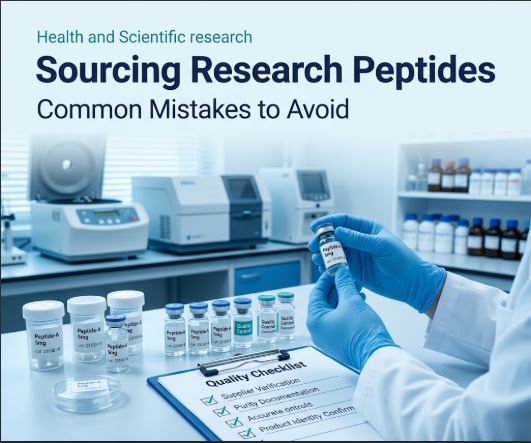
A sourcing error can complicate an otherwise well-designed experiment. An unexplained change in results may send a team back through its reagent records, looking for a lot change or a handling problem. Evaluating premium research peptides starts with defining what the experiment needs, then checking whether the material and its documentation meet those needs.
Buying on price alone
Unit price is easy to compare, so it’s easy to give it too much weight. A lower price per milligram doesn’t tell us about salt form or net peptide content, and it doesn’t tell us if the lot paperwork matches our assay. A lab may need to reorder mid-study if the first vial doesn’t cover the full protocol, potentially introducing a new lot that needs qualification work.
A better move is to define the spec before shopping. That means the target sequence with modifications, plus the purity basis and documents for that lot. It also means estimating how much material is needed from one lot to avoid switching mid-run.
Total procurement cost goes beyond the vial price. It includes shipping, analytical testing, staff review time and any material consumed during qualification. A quote that looks cheap can turn costly if we can’t match lots or if documentation gaps force repeat tests.
Reading the COA for what it actually shows
A Certificate of Analysis is useful only if we read past the headline number. HPLC area percent and net peptide content are not the same thing. The first describes the share of the chromatographic signal tied to the main peak under that method, while the second accounts for counterions and residual water that add weight but not peptide. Neither number by itself says a lot is right for our assay. That call depends on our methods and acceptance limits.
Mass spectrometry helps in a narrower way than many buyers expect. It shows the observed mass is consistent with the expected mass, which provides support for identity. It doesn’t by itself prove full sequence or rule out every closely related impurity. Different sequences can have the same intact mass, and impurities may fall outside a method’s detection capability. We therefore look for complementary analytical evidence and clear method notes rather than a single pass-fail stamp.
Validated in-house testing is legitimate when methods are stated and traceable to that lot. Independent retesting can add confidence for critical or long-running work, but it isn’t the only valid form of quality control. For example, catalogs such as https://peptidelabs.us/ advertise COA documentation and third-party testing, giving a lab the opportunity to compare lot-specific paperwork against its own spec before ordering material for controlled protocols.
Paperwork is boring until it saves a study.
We also check that the lot number on the vial matches the paperwork and read the storage guidance for that batch. If those details don’t line up, we don’t guess. We ask the supplier for clarification and keep the exchange on file.
Also read related Health Blogs
Skipping checks on supplier history
Peer feedback is free, so it’s worth seeking out before placing an order. Forum threads and lab colleagues won’t prove purity, but they do reveal patterns in communication and documentation. We look for repeated reports of missing COAs or slow answers to technical questions. One complaint doesn’t mean much. A pattern does.
Transparency is easier to judge than chemistry from a website. A clear supplier states synthesis origin in general terms and shares batch documentation without delay. It answers questions about salt form and lot matching in plain language. It doesn’t hide behind vague purity claims or push buyers off email when they ask for method details. If we can’t get straight answers before purchase, there’s little reason to expect better answers afterward.
Overlooking form, shipment and storage detail
Lyophilized powder and solution formats handle differently in transit and on the bench. We don’t assume one is always better. We read the supplier sheet for that product and match the format to our protocol timeline and storage setup.
Reconstitution deserves the same care as sourcing. We use only the solvent system already validated for our assay and follow our own SOP for preparation and aliquot control. There’s no universal recipe worth copying from a product page. Small slips add variability that looks like biology until controls show it isn’t.
Storage discipline matters after receipt. We follow the storage guidance tied to that lot and protect vials from heat and moisture. Receipt dates are logged with lot numbers, and we limit freeze-thaw exposure where the supplier flags it as a concern. Handling records do not establish initial chemical quality, but they help the team assess whether subsequent storage and preparation have stayed within the conditions accepted for the study.
Treating research-use-only labeling as boilerplate
Research-use-only means lab use under proper supervision. It doesn’t mean human use under any circumstance. Clear labeling establishes the intended use; it does not establish chemical identity, purity or suitability for a particular experiment. Those questions still need their own evidence.
RUO status belongs in the procurement process. That means restricted access in the lab and trained staff for handling and waste. It also means purchase records that tie each vial to a project and protocol. If an order lacks clear RUO labeling or safety notes, we pause and clarify before bringing it into our workflow.
Reliable peptide work depends on removing avoidable doubt rather than finding a perfect supplier. That work runs from spec and COA review to lot tracking and storage logs. Those records help labs identify avoidable sources of variation and decide whether a result needs further investigation.