How to Get Rid of a Yeast Infection in 24 Hours

Quick answer: You may be able to start treating a vaginal yeast infection within 24 hours and begin feeling better during that time. But a one-day treatment does not always mean the infection or its symptoms will be completely gone in 24 hours. Antifungal medicines are the main treatment, while home remedies may not reliably cure an active yeast infection.
If this is your first suspected yeast infection, your symptoms are severe, or you are pregnant, it is better to speak with a healthcare professional before treating yourself. Yeast infections can look similar to bacterial vaginosis (BV) and some sexually transmitted infections (STIs).
Quick Summary: Getting Rid of a Yeast Infection in 24 Hours
You may start feeling better within 24 hours of treatment, but a yeast infection is not always completely gone that quickly. The safest approach is to confirm that your symptoms are actually caused by yeast and then use an appropriate antifungal treatment.
Can You Really Get Rid of a Yeast Infection in 24 Hours?
Yes, you can start effective treatment in one day, and some people begin to notice symptom relief within 24 hours.
However, there is an important difference between one-day treatment and a one-day cure.
Some vaginal antifungal products are designed as a single dose. That means you use the medicine once. It does not mean every symptom will disappear overnight.
For uncomplicated vaginal yeast infections, short-course vaginal antifungal treatments are effective. CDC guidance includes several one-day, three-day, and seven-day options.
Relief in 24 Hours vs. A Complete Cure
Some symptom relief
The itching, burning, and irritation may begin to improve after appropriate treatment.
Complete cure overnight
Feeling better within a day does not prove that the infection has completely cleared.
The realistic goal: Start an appropriate treatment as soon as possible, manage irritation safely, and give your body enough time for the infection to fully resolve.
Treatment vs. symptom relief
A yeast infection happens when Candida, a type of fungus, grows too much in the vagina.
Treatment works to control the fungus. Your itching, burning, redness, or soreness may take longer to settle.
So if you still have some itching the morning after treatment, that does not automatically mean the treatment failed.
What to realistically expect within 24 hours
Within the first day, you may:
- Start antifungal treatment
- Notice less itching or burning
- Reduce irritation by avoiding triggers
- Still have some discharge or soreness
- Need several more days for complete relief
The fastest approach is usually appropriate antifungal treatment, not a collection of home remedies.
How to Tell If You Actually Have a Yeast Infection
Before looking for the best OTC treatment, make sure your symptoms actually fit a yeast infection.
Common symptoms include intense itching, burning, redness, swelling, soreness, pain during sex, and thick white discharge that usually has little or no odor.
Common yeast infection symptoms
A vaginal yeast infection may cause:
- Intense itching around the vagina or vulva
- Burning
- Redness or swelling
- Soreness
- Pain during sex
- Burning when urinating
- Thick, white discharge
You do not need to have every symptom.
Yeast infection vs. BV vs. STI
This is important because several vaginal conditions can feel similar.
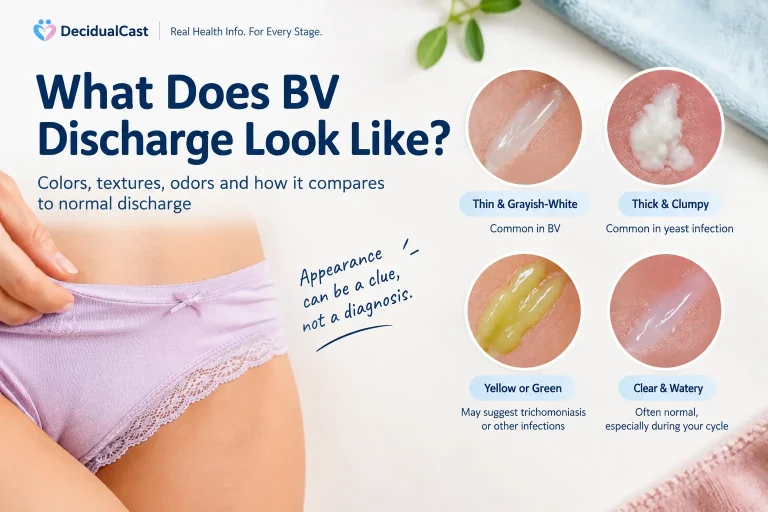
Yeast infections often cause strong itching and thick white discharge with little or no odor.
BV can cause a thin discharge and a strong fishy odor. STIs can cause unusual discharge, pain, sores, bleeding, or other symptoms.
These conditions need different treatments. The Office on Women’s Health warns that yeast symptoms can be confused with BV and STIs.
If you are unsure what is causing your symptoms, do not keep trying different products at home.
Not Every Itchy or Burning Vagina Has a Yeast Infection
Yeast infections can cause itching, burning, redness, swelling, and thick white discharge. But similar symptoms can also occur with bacterial vaginosis, sexually transmitted infections, skin irritation, or other vaginal conditions.
If this is your first suspected yeast infection, your symptoms are unusual, or an OTC treatment does not help, getting the correct diagnosis is more useful than repeatedly trying different home remedies.
What Is the Fastest Way to Treat a Yeast Infection?
For an uncomplicated yeast infection, antifungal medicine is the standard treatment.
There are both over-the-counter and prescription options.
One-dose vaginal antifungal treatments
Some OTC vaginal antifungals are designed as a single treatment.
Examples include certain formulations of:
- Miconazole
- Tioconazole
CDC guidelines list a 1-day miconazole vaginal suppository and single-application tioconazole among treatment options for uncomplicated vaginal yeast infections.
A one-dose product can be convenient when you want the fastest treatment schedule.
But remember: one dose does not guarantee instant relief.
3-day and 7-day antifungal treatments
Other vaginal antifungal medicines are used for three or seven days.
Miconazole and clotrimazole are available in different strengths and treatment lengths. Short-course treatment can effectively treat uncomplicated infections.
A longer course may also be preferred in some situations.
Do not choose a treatment only because its package says “1 day.” The right treatment depends on your symptoms, medical history, pregnancy status, and whether the infection is actually yeast.
Prescription fluconazole
Fluconazole is an oral antifungal medicine that can be prescribed as a single dose for uncomplicated vaginal yeast infection.
It can be convenient because it is taken by mouth rather than used vaginally. However, it is not right for everyone.
Do not use oral fluconazole as a self-treatment during pregnancy. CDC guidance recommends topical azole treatment for seven days during pregnancy instead.
Other prescription options
Healthcare professionals may use other antifungal medicines when standard treatment does not work, when infections keep returning, or when the infection is more complicated.
Some recurrent or resistant infections need a longer treatment plan rather than a quick one-day approach.
Which Yeast Infection Treatment Works Fastest?
There is no single “best” treatment for every woman.
For an uncomplicated infection, several antifungal options can work well. The best over the counter medicine depends on whether the symptoms actually fit a yeast infection and which product is appropriate for you.
Yeast Infection Treatments at a Glance
The fastest option depends on your symptoms, pregnancy status, medical history, and whether the infection is actually caused by Candida.
Remember: A treatment that starts working within 24 hours is not necessarily a treatment that completely clears the infection within 24 hours.
CDC lists these and other antifungal regimens for vaginal candidiasis.
If you are asking what over the counter medicine is good for a yeast infection, miconazole, clotrimazole, and tioconazole are among the established OTC vaginal antifungal options.
But if this is your first infection, or your symptoms do not look typical, getting a diagnosis is more important than choosing the fastest product.
What Can You Do for Relief Within 24 Hours?
If you need instant relief, it is important to set realistic expectations.
No safe home method can guarantee instant relief from an active yeast infection.
Still, you can reduce irritation while the treatment works.
Cool compresses
A cool compress placed on the external vulvar area may temporarily soothe itching and burning.
Do not put ice directly on your skin.
Keep the area comfortable and dry
Wear loose, breathable underwear and change out of wet clothes.
Avoid keeping the vulvar area damp for long periods.
Avoid irritation
Do not douche or use scented vaginal products.
Avoid scented soaps, sprays, bubble baths, and other products that can irritate sensitive skin. These products can also disturb the normal vaginal environment.
These steps may provide symptom relief, but they do not replace antifungal treatment when a yeast infection needs medicine.
Can You Get Rid of a Yeast Infection Without Medication?
Do natural remedies work?
There is not strong evidence that common kitchen remedies can cure a vaginal yeast infection overnight.
For example, inserting food, oils, or acidic products into the vagina can cause irritation.
If you want the fastest evidence-based treatment, an appropriate antifungal is a better choice than relying on an unproven remedy.
Probiotics and yogurt
Yogurt and probiotics are often promoted for vaginal health.
Some research has looked at probiotics and prevention, but they should not be treated as a proven replacement for antifungal medicine for an active infection. CDC guidance does not find substantial evidence supporting probiotics as treatment for vaginal candidiasis.
Garlic
Garlic is often described online as a natural antifungal.
That does not make raw garlic a safe vaginal treatment.
Putting garlic inside the vagina can irritate sensitive tissue. There is not enough clinical evidence to recommend it as a fast treatment.
Coconut oil
You may see searches for coconut oil for women or coconut oil for yeast infections.
Coconut oil has shown antifungal activity in laboratory research, but that does not prove that putting coconut oil in the vagina will cure an infection.
It should not replace a proven antifungal treatment.
Apple cider vinegar
Apple cider vinegar is another popular home remedy.
There is not good clinical evidence that putting apple cider vinegar in the vagina cures a yeast infection.
Its acidity can also cause irritation.
Tea tree and oregano oil
Essential oils are sometimes promoted as natural antifungal treatments.
That does not mean they are safe to use inside the vagina.
Concentrated essential oils can irritate or burn sensitive tissue. They should not be used as an overnight yeast infection cure.
Baking soda
Baking soda baths are sometimes suggested online for itching.
However, baking soda does not treat the Candida infection itself.
If you have ongoing symptoms, focus on finding the correct diagnosis and treatment rather than trying multiple home remedies.
Is Boric Acid a Fast Treatment for Yeast Infections?
Boric acid has a role in treating certain difficult or recurrent yeast infections.
It is not a general overnight cure for every vaginal yeast infection.
CDC guidance discusses vaginal boric acid for certain recurrent infections involving non-albicans Candida, particularly when other treatment has failed.
When it may be used
A healthcare professional may consider boric acid in selected cases, especially when a non-albicans Candida infection returns after other treatment.
Why it isn’t for everyone
Boric acid is not the first choice for a typical first-time yeast infection.
It can also be dangerous if swallowed.
Safety considerations
Never take boric acid by mouth.
Do not assume it is safe during pregnancy. Mayo Clinic advises against boric acid treatment during pregnancy.
If you keep getting yeast infections, ask a healthcare professional about testing and treatment instead of repeatedly using boric acid on your own.
What If You’re Pregnant or Could Be Pregnant?
Pregnancy changes how a suspected yeast infection should be treated.
CDC guidance recommends topical azole antifungal treatment for seven days during pregnancy. Oral fluconazole should not be used during pregnancy.
So if you are pregnant or there is a chance you could be pregnant, do not choose a yeast infection pill simply because you want the fastest treatment.
Talk with your healthcare professional about the safest option.
How Long Does a Yeast Infection Take to Go Away?

The timeline varies.
What to Expect After Starting Treatment
First 24 hours
You can start appropriate treatment.
Some symptoms may begin to improve, but complete relief is not guaranteed.
24–72 hours
You may notice a clearer improvement in itching, burning, soreness, and irritation.
If your symptoms are getting worse instead of better, contact a healthcare professional.
Several days to a week
Many uncomplicated infections respond to short-course treatment, but some treatments themselves last several days.
If symptoms continue after treatment, do not keep switching between OTC products. You may need an examination or testing to confirm the cause.
Why Isn’t My Yeast Infection Going Away?
Sometimes the problem is not the treatment.
Wrong diagnosis
Your symptoms may be caused by BV, an STI, irritation, or another vaginal condition.
Severe infection
Severe redness, swelling, cracks, or sores may need a longer treatment course.
CDC guidance recommends longer treatment for severe vulvovaginal candidiasis.
Recurrent infection
If you keep getting yeast infections, you may need testing and a longer treatment plan.
CDC defines recurrent vulvovaginal candidiasis as three or more symptomatic episodes in less than one year.
Resistant or non-albicans Candida
Some Candida species respond less well to standard antifungal treatment.
A healthcare professional may need to test a vaginal sample to identify the cause and choose the right treatment.
Underlying health conditions
Antibiotic use, poorly controlled diabetes, pregnancy, and a weakened immune system can increase the risk of vaginal yeast infections.
When You Should Get Medical Advice
Do not keep treating yourself at home if something does not look or feel like a typical yeast infection.
- This is your first suspected yeast infection.
- Your symptoms are severe or getting worse.
- You have fever, pelvic pain, or significant abdominal pain.
- You have an unusual or foul-smelling discharge.
- You have sores, blisters, or unexplained bleeding.
- Your symptoms do not improve after appropriate treatment.
- Yeast infections keep coming back.
- You are pregnant or may be pregnant.
Can You Have Sex During a Yeast Infection?
Sex may make an irritated vulva or vagina feel worse.
It can be more comfortable to wait until your symptoms have improved and treatment is complete.
There is another important point: some vaginal antifungal creams and suppositories are oil-based and can weaken latex condoms or diaphragms. Check the product instructions before having sex while using them.
A vaginal yeast infection is not generally classified as an STI. However, sexual activity can sometimes be involved, and symptoms that look like yeast can actually be caused by an STI.
How to Prevent Future Yeast Infections
You cannot prevent every yeast infection, but a few habits may help.
- Avoid douching.
- Avoid scented vaginal products.
- Change out of wet clothing.
- Avoid very tight clothing when possible.
- Use antibiotics only when medically needed.
- Keep diabetes well controlled if you have it.
- Follow your treatment exactly as directed.
These steps help protect the normal vaginal environment.
If you are also dealing with unusual tissue or bleeding during your period, see our guide on decidual cast during a period for information about how a decidual cast can differ from other vaginal symptoms.