
Yeast Infection Discharge Picture: What It Looks Like

Quick Answer
Vaginal yeast infection discharge is often thick, white, and clumpy, sometimes described as looking like cottage cheese. It usually has little or no strong odor and may appear with intense itching, burning, redness, swelling, or soreness around the vulva.
But yeast infections do not always look the same. Some people have little or no noticeable discharge and mainly experience itching, burning, or irritation. You cannot reliably diagnose a yeast infection from discharge or a picture alone, because other vaginal conditions can cause similar symptoms.
Keep in mind: A strong fishy or foul odor, gray or green discharge, blisters, or unusual sores is less typical of a straightforward yeast infection and may need medical evaluation.
What Is a Vaginal Yeast Infection?
A vaginal yeast infection, also called vaginal candidiasis, happens when a type of fungus called Candida grows too much in the vagina. Candida can normally live in the vagina without causing problems, but changes in the vaginal environment can allow it to multiply and cause symptoms.
Common symptoms include intense itching, burning, redness or swelling, soreness, discomfort when urinating, and unusual vaginal discharge. The discharge is often thick, white, and clumpy, sometimes described as looking like cottage cheese, but not everyone with a yeast infection has this classic discharge.
A yeast infection is not usually considered an STI, and its symptoms can look similar to other vaginal conditions. If your symptoms are new, severe, keep coming back, or do not improve with treatment, testing or an examination can help confirm the cause.
What Does Yeast Infection Discharge Look Like?
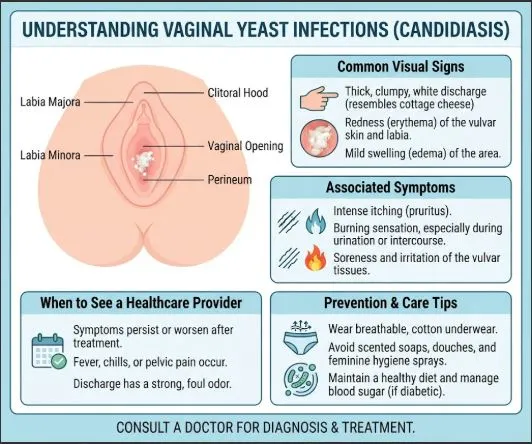
The classic description is thick, white, and clumpy discharge. Many medical sources compare the texture to cottage cheese or curds.
It may look more like small white clumps than a smooth or watery fluid. Some people notice it on toilet paper, underwear, or around the vaginal opening rather than seeing a large amount of discharge.
The amount can vary. A person may have noticeable discharge, while someone else may have very little.
That is one reason pictures can be helpful for general education but poor at proving what is happening in your body.
A typical yeast infection may also cause:
- Intense itching around the vagina or vulva
- Burning or soreness
- Redness and swelling
- Pain or burning when urinating
- Pain during sex
- Small cracks or irritated areas in more severe cases
Not everyone will have every symptom.
What Does Yeast Infection Discharge Look Like on Underwear?
On underwear, yeast discharge may appear as white, thick, creamy, or clumpy material. It can dry and look different from how it appeared when it left the vagina.
That matters because underwear can change the appearance of discharge. Fabric color, drying, lighting, and how long the discharge has been there can all affect what you see.
So if something looks slightly yellowish or different after drying, that does not automatically mean you have a different infection.
The better approach is to look at the whole symptom pattern, not one stain.
Can You Have a Yeast Infection Without Discharge?
Yes.
Discharge is common with vaginal yeast infections, but it is not the only symptom. Some people mainly notice itching, burning, soreness, redness, or swelling.
The CDC lists vaginal itching or soreness, pain during sex, discomfort when urinating, and abnormal discharge among the symptoms of vaginal candidiasis. It also notes that severe infections can cause redness, swelling, and cracks.
So don’t rule out a yeast infection simply because you do not see the classic white discharge.
At the same time, do not assume that itching automatically means yeast. Several other conditions can cause similar symptoms.
What Does a Yeast Infection Look Like on the Vulva?
A vaginal yeast infection can affect the vulva, which is the external genital area around the vaginal opening.
The skin may look:
- Red or irritated
- Swollen
- Sore
- Dry or raw
- More inflamed after scratching
More severe infections can cause small cracks or fissures in irritated skin.
The exact color can be difficult to judge from online pictures. Skin tone, lighting, and inflammation can change how redness appears. Mayo Clinic specifically notes that redness may be harder to see on Black or brown skin than on white skin.
That is another reason not to use a photograph as a diagnostic test.
What Does a Yeast Infection Not Usually Look Like?
Knowing what is less typical can be just as useful as knowing the classic appearance.
A vaginal yeast infection does not usually cause a strong fishy odor or thin gray discharge. Those features are more suggestive of bacterial vaginosis or another condition.
Blisters, open sores, or unusual lesions also deserve medical attention rather than a guess based on a yeast infection picture.
This does not mean every unusual discharge automatically points to an STI or BV. Vaginal symptoms can have many causes.
The point is simple: an unusual appearance deserves a closer look instead of repeated self-treatment.
Yeast Infection vs. Normal Vaginal Discharge
Before comparing your discharge with a yeast infection picture, it helps to know what normal discharge can look like.
Healthy vaginal discharge can be clear, white, or slightly yellow when it dries. Its amount and texture can change throughout the menstrual cycle. It may be thinner and more slippery around ovulation and thicker at other times.
That means seeing white discharge does not automatically mean you have a yeast infection.
The bigger clues are the combination of changes.
| Feature | More typical of normal discharge | More typical of yeast infection |
|---|---|---|
| Color | Clear, white, or slightly yellow when dry | Usually white |
| Texture | Can be thin, slippery, creamy, or sticky | Often thick and clumpy |
| Odor | Mild or no strong odor | Usually little or no strong odor |
| Itching | Usually absent | Common |
| Burning | Usually absent | Can occur |
| Vulvar redness/swelling | Not typical | Can occur |
| Pain during sex | Not typical | Can occur |
This table is a guide, not a diagnosis. Normal discharge varies from person to person and throughout the menstrual cycle.
Yeast Infection vs. BV Discharge
Yeast infections and bacterial vaginosis can both cause changes in vaginal discharge, but the pattern is often different.
Yeast infection: usually thicker, white, and clumpy, with prominent itching or irritation.
BV: often causes thinner discharge that may look gray or white and may have a noticeable fishy odor.
There is plenty of overlap, though. Some people do not follow the textbook pattern.
That is why treating yourself based on discharge color alone can backfire. If the diagnosis is wrong, an antifungal medicine will not fix the actual problem.
Yeast Infection vs. STI
Some sexually transmitted infections can cause discharge, irritation, pain, sores, or bleeding.
That does not mean a yeast infection is an STI. Vaginal candidiasis is a fungal infection and is not generally classified as a sexually transmitted infection.
However, symptoms can overlap.
You should get medical advice if you have:
- New or unexplained sores or blisters
- Unusual bleeding
- Pelvic pain
- A strong or unusual odor
- New symptoms after sexual contact
- Discharge that looks very different from your normal pattern
A clinician can determine whether you need testing for yeast, BV, an STI, or another condition.
Can You Diagnose a Yeast Infection From a Picture?
No. A picture can give you clues, but it cannot confirm the diagnosis.
The classic appearance can make a yeast infection seem obvious. But the CDC says the symptoms of vulvovaginal candidiasis are not specific to yeast. Diagnosis may involve symptoms, examination, and testing of vaginal fluid when appropriate.
Even the appearance of discharge can change depending on lighting, the amount of discharge, where you see it, and whether it has dried.
A photograph also cannot tell you which organism is causing symptoms.
So use pictures as an educational reference, not as a substitute for medical evaluation.
Why Your Symptoms May Not Look Like the “Classic” Picture
The internet loves a perfect symptom.
Real bodies are less cooperative.
Not every yeast infection produces thick cottage-cheese-like discharge. Some people have mainly itching and irritation. Others have noticeable redness and swelling but little discharge. Symptoms can also range from mild to severe.
The CDC also recognizes that infections caused by different Candida species can behave differently. Non-albicans Candida can require different diagnostic and treatment considerations.
So if your symptoms do not match the picture exactly, that does not prove you do not have a yeast infection.
It simply means the picture is not enough to tell you.
When Should You See a Doctor?
Consider seeing a healthcare professional if:
- This is your first suspected yeast infection.
- Your symptoms are severe.
- You have significant swelling, cracks, or sores.
- You have pelvic pain or fever.
- You have unusual bleeding.
- Your discharge has a strong or unusual odor.
- You are pregnant or could be pregnant.
- Symptoms do not improve with appropriate treatment.
- Symptoms keep coming back.
- You are not sure whether the problem is yeast, BV, an STI, or something else.
Severe, recurrent, pregnancy-associated, or otherwise complicated infections may need a different approach from a straightforward yeast infection.
What Should You Do If You Think You Have a Yeast Infection?
If the symptoms are familiar and mild, an appropriate antifungal treatment may be used for an uncomplicated yeast infection. Common treatments include vaginal azole medicines, while some people may receive prescription treatment.
But don’t keep trying different products if the first treatment does not work.
If the problem is actually BV, an STI, irritation, a skin condition, or another cause, an antifungal will not solve it.
And avoid putting random household products or essential oils inside the vagina because something is labeled “natural.” Natural does not automatically mean safe for vaginal tissue.
The Bottom Line
A vaginal yeast infection often causes thick, white, clumpy discharge, along with itching, burning, redness, swelling, or soreness. That is the classic picture.
But real yeast infections do not always look textbook-perfect.
You may have little discharge. Your symptoms may be mainly itching or burning. The discharge may look different after it dries. And several other vaginal conditions can produce similar symptoms.
So use the images to understand the general pattern, but do not use them to diagnose yourself.