Why Am I Bleeding After Sex? Causes & When to Worry

A small amount of spotting after sex can happen from friction, dryness, cervical irritation, or bleeding around your period. But bleeding after sex is not always normal. If it keeps happening, occurs when you are not on your period, or comes with other symptoms, make an appointment with a healthcare professional.
Seeing blood after sex can be unsettling, especially when your period is not due. You may immediately wonder, “Why am I bleeding after sex?” The good news is that there are several possible explanations, and many are not serious.
Quick Answer: Why Am I Bleeding After Sex?
Bleeding after sex can happen for several reasons. Common causes include vaginal dryness, friction, minor tears, cervical irritation, cervical polyps, infections, hormonal birth control, and bleeding around your period. Pregnancy and other gynecological conditions can also cause bleeding.
A small amount of occasional spotting may not be serious, but repeated, unexplained, or heavy bleeding should be checked by a healthcare professional—even if you have no pain.
Bleeding After Sex With No Pain
Bleeding after sex with no pain can happen. The absence of pain does not automatically mean that something is wrong, but it also cannot tell you what caused the bleeding.
| What you notice | Possible explanation | What to do |
|---|---|---|
| A few drops after sex | Friction, dryness, or minor irritation | Monitor it, especially if it stops quickly and does not return |
| Spotting happens repeatedly | Cervical irritation, a polyp, infection, or another condition | Arrange a medical evaluation |
| Bleeding when your period is not due | Several possible causes, including cervical or vaginal bleeding | Track the bleeding and discuss recurring episodes with a clinician |
| Bleeding with unusual discharge or odor | An infection may be involved | Consider medical evaluation and appropriate testing |
| Heavy or ongoing bleeding | The cause needs prompt assessment | Seek prompt medical care, especially if you feel weak, dizzy, or faint |
Important: This table describes possible patterns, not diagnoses. The absence of pain does not rule out an underlying condition.
For example, a small amount of blood may appear after sex because of friction or a sensitive area on the cervix. Cervical polyps and cervical ectropion can also cause bleeding when the cervix is touched during intercourse. Some infections can cause bleeding without obvious pain as well.
Why Am I Bleeding After Sex?
Bleeding that happens during or shortly after intercourse is often called postcoital bleeding. The blood may come from the vagina, cervix, or another part of the reproductive system.
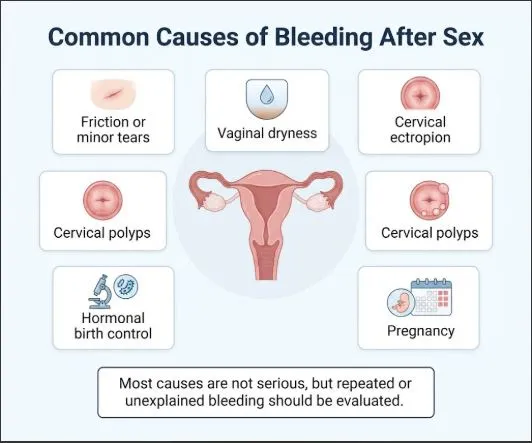
Here are some of the more common possibilities.
At a Glance
| Possible cause | What may happen |
|---|---|
| Friction or minor tears | Light bleeding after vigorous, prolonged, or poorly lubricated sex |
| Vaginal dryness | Irritation or bleeding caused by increased friction |
| Cervical ectropion | The cervix may bleed more easily when touched |
| Cervical polyp | A usually noncancerous growth can bleed when irritated |
| Infection or cervicitis | Inflammation can make cervical tissue bleed more easily |
| Hormonal contraception | Hormonal changes can contribute to irregular bleeding |
| Pregnancy | Pregnancy can make the cervix more prone to bleeding |
These are possible explanations, not a way to diagnose the cause of bleeding.
1. Friction or small tears
Sex can irritate delicate vaginal tissue, particularly when there is not enough lubrication. Rough or prolonged intercourse can also create small areas of irritation or tiny tears.
You may notice a few drops of bright-red blood immediately afterward. It may stop quickly and may not cause significant pain.
If friction appears to be the likely reason, giving irritated tissue time to recover and using adequate lubrication during future sex may help.
2. Vaginal dryness
Dryness is another common reason for blood after sex. It can happen at different ages and for different reasons.
Hormonal changes, perimenopause, menopause, some medications, reduced arousal, and irritating vaginal products can all contribute to dryness.
When the tissue is dry, friction can cause irritation and sometimes bleeding. Using a suitable lubricant and allowing more time for arousal may reduce friction, but recurring bleeding still deserves attention.
3. Your period may be close
Sometimes the timing is less mysterious than it first appears.
If you have sex shortly before or after your period, menstrual blood may become noticeable during or after intercourse. This can be especially confusing if your period is just beginning or ending.
That is one reason someone may search for “bleeding while having sex but not period.” If the bleeding repeatedly happens when you are nowhere near your period, however, it is worth looking for another explanation.
4. Cervical ectropion
Cervical ectropion occurs when cells from inside the cervical canal are present on the outer surface of the cervix. These cells are more delicate and can bleed more easily when touched.
Because intercourse can contact the cervix, some people with cervical ectropion notice spotting afterward.
It is not the same thing as cervical cancer. A healthcare professional can examine the cervix and determine whether this or another cervical condition could explain the bleeding.
5. Cervical polyps
Cervical polyps are usually noncancerous growths on the cervix. Because they can be easily irritated, they may bleed during or after sex.
A polyp cannot be diagnosed from the appearance or amount of blood alone. If you repeatedly notice blood after intercourse, a pelvic examination can help identify whether a cervical polyp or another cervical issue is involved.
6. Sexually transmitted infections and other infections
Infections can also cause bleeding after sex.
Cervicitis, which means inflammation of the cervix, can be associated with sexually transmitted infections such as chlamydia and gonorrhea. Other infections or irritation can also affect vaginal or cervical tissue.
This is important because an infection does not always announce itself with dramatic symptoms. You may have little or no pain.
If you have a new sexual partner, possible STI exposure, unusual discharge, odor, burning when urinating, or recurring bleeding, consider getting tested rather than guessing.
7. Hormonal birth control
Hormonal contraception can change your usual bleeding pattern. Some people experience spotting or irregular bleeding after starting, stopping, or changing hormonal birth control.
An intrauterine device (IUD) can also be relevant when investigating unusual bleeding. A clinician can consider your contraceptive method alongside your other symptoms and medical history.
8. Pregnancy
Pregnancy can change the cervix and reproductive tissues, making light bleeding possible. But bleeding immediately after sex should not automatically be labeled as implantation bleeding.
If your period is late or pregnancy is possible, taking a pregnancy test can help clarify the situation.
If you are pregnant and experience vaginal bleeding, contact your healthcare professional for advice. Bleeding during pregnancy has several possible causes, and the right response depends on the timing, amount of bleeding, and other symptoms.
What Does Blood After Sex Look Like?
The appearance of the blood can vary. You might see a tiny pink mark when wiping, bright-red blood on underwear, or brown spotting later.
Bright-red blood usually indicates fresh bleeding, while brown discharge often represents older blood. However, the color alone cannot tell you what caused the bleeding.
A few spots after sex are different from bleeding that continues for hours. Pay attention to the amount, how long it lasts, whether it happens again, and whether you have other symptoms.
How Much Bleeding After Sex Is Too Much?
There is no single amount that is considered normal for everyone. A couple of spots and ongoing heavy bleeding are very different situations.
Seek prompt medical attention if the bleeding is heavy or continues, particularly if you feel weak, dizzy, faint, or unwell.
MedlinePlus describes heavy abnormal vaginal bleeding as bleeding that can include soaking through a sanitary pad or tampon every hour for two to three hours in a row or passing large clots. The exact situation matters, so do not rely on a number alone if you feel something is seriously wrong.
Can Bleeding After Sex Mean Pregnancy?
It can be associated with pregnancy, but blood after sex does not prove that you are pregnant.
If you had unprotected sex or contraception failed and your period is late, consider a pregnancy test. If the test is positive and you are bleeding, contact your healthcare professional.
Do not assume that bleeding after sex is implantation bleeding simply because pregnancy is possible. The timing and circumstances matter, and bleeding can have many other causes.
Can Bleeding After Sex Be a Sign of Cancer?
This is one of the questions people understandably worry about.
Yes, abnormal bleeding can occur with cervical, vaginal, vulvar, or uterine cancers, but most people with do not have cancer.
Cervical cancer can cause abnormal bleeding or bleeding after sex. However, infections, dryness, cervical ectropion, polyps, hormonal changes, and other conditions are also possible explanations.
That is why repeated bleeding should be checked rather than diagnosed through an internet search. Regular cervical cancer screening also plays an important role in detecting cervical cell changes before they become cancer.
A Note About Cancer
Bleeding after sex does not mean you have cervical cancer. Many less serious conditions can cause the same symptom, including dryness, friction, infections, cervical ectropion, and cervical polyps.
However, cervical cancer can cause abnormal bleeding. That is why repeated or unexplained bleeding should be evaluated rather than repeatedly dismissed, particularly if you are overdue for recommended cervical screening.
When Should You Get Bleeding After Sex Checked?
Light & Occasional
A few spots that happen once may have a simple explanation such as friction, dryness, or timing around your period.
Repeated or Unexplained
Make an appointment if bleeding keeps happening, occurs when your period is not due, or comes with unusual discharge, odor, or other changes.
Heavy or Concerning
Seek urgent medical care for heavy bleeding, severe or worsening pain, fainting, significant dizziness, or concerning symptoms during pregnancy.
Remember: Pain is not required for bleeding to deserve medical attention. Persistent or unexplained bleeding should be evaluated.
When Is Bleeding After Sex an Emergency?
Most cases of light spotting do not require an emergency department. But heavy bleeding or concerning symptoms are different.
Seek urgent medical care if you have heavy bleeding, fainting or near-fainting, severe or worsening pelvic or abdominal pain, marked dizziness, or other symptoms that make you feel seriously unwell.
If you have missed a period and have unusual bleeding together with abdominal or pelvic pain, seek urgent medical assessment because an ectopic pregnancy needs to be ruled out.
What Happens When a Doctor Checks Bleeding After Sex?
A visit does not automatically mean you will need a long list of tests. Your healthcare professional will first ask questions about what happened.
You may be asked:
- When did the bleeding start?
- How much blood did you notice?
- Does it happen every time you have sex?
- When was your last period?
- Could you be pregnant?
- What type of birth control do you use?
- Have you had a new sexual partner?
- Do you have unusual discharge, odor, itching, or burning?
- When was your last cervical screening test?
Depending on your situation, the evaluation may include a pregnancy test, STI testing, and an examination of the vagina and cervix. Further testing, such as an ultrasound or colposcopy, may be recommended when the initial evaluation suggests it is needed.
The goal is not simply to find a label for the bleeding. It is to identify or rule out causes that need treatment.
What Can You Do About Bleeding After Sex?
The right solution depends on the cause.
If dryness or friction is contributing, adequate lubrication, more time for arousal, and avoiding products that irritate the genital area may help.
If an infection is responsible, you will need appropriate medical treatment. A cervical polyp or another cervical problem may require a different approach.
In other words, there is no universal “bleeding after sex” treatment. The trick is finding out why it is happening first.
Could This Be Related to Your Period or Uterine Lining?
If you are also experiencing unusual period bleeding, clots, or passage of tissue, the situation may involve your menstrual cycle or the uterine lining rather than intercourse itself.
A decidual cast, for example, is a rare event in which the uterine lining is shed in a more organized piece rather than breaking apart gradually. It is different from ordinary spotting after sex and does not require pregnancy.
If you are trying to understand unusual bleeding or tissue passage, our guide to a decidual cast during a period can help you understand how this unusual menstrual experience differs from other causes of bleeding.
You can also use our Decidual Cast Symptom Assessment Tool for educational guidance about symptoms. It is not a diagnosis, and concerning symptoms should always be evaluated by a healthcare professional.
The Bottom Line
A small amount of blood may come from friction, dryness, menstrual timing, cervical ectropion, a cervical polyp, infection, hormonal contraception, or pregnancy. Less commonly, abnormal bleeding can be linked to more serious conditions.
And yes, bleeding after sex with no pain can happen. But painless does not mean you should ignore bleeding that keeps returning.
If this happened once and the bleeding was very light, keep track of what happens next. If it happens again, becomes heavier, occurs outside your usual cycle, or comes with other symptoms, arrange a medical evaluation. Your body does not always send a dramatic warning sign; sometimes it sends a few drops and waits for you to pay attention.