Bleeding & Tissue Checker™ — Decidual Cast, Implantation, Miscarriage, Clots
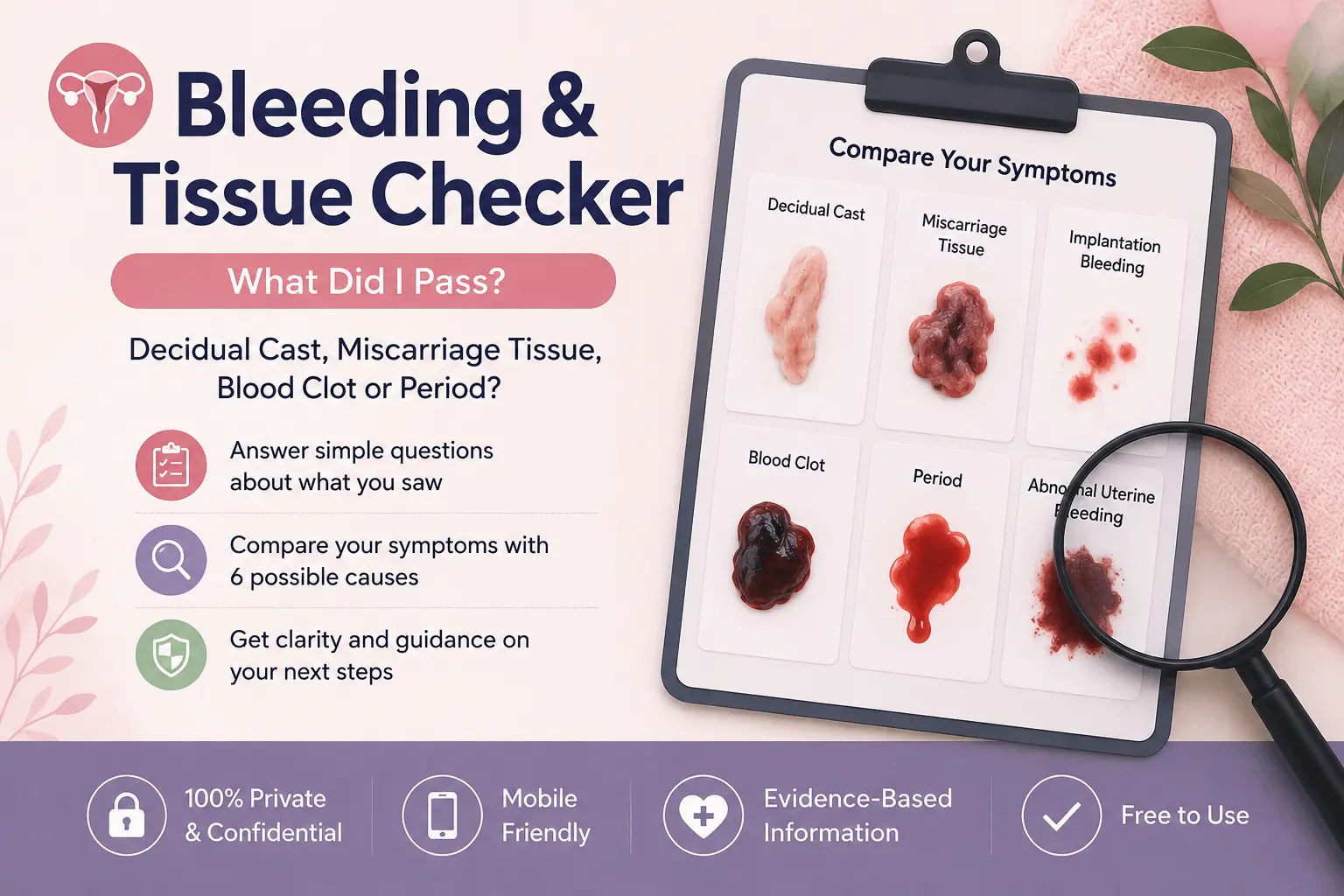
Bleeding and Tissue Checker tool comparing decidual cast, miscarriage tissue, implantation bleeding, blood clot, menstrual period, and abnormal uterine bleeding symptoms.

✦ Free AI-Powered Women’s Health Tool

Bleeding & Tissue Checker™

Identify decidual bleeding, decidual casts, blood clots, implantation bleeding, miscarriage tissue, or abnormal uterine bleeding — with AI-generated analysis in under 3 minutes.

12Questions
8Result Types
AIExplanation Engine
100%Private
Bleeding & Tissue Checker™ Step 1 of 12

Question 1 of 12

When did the bleeding start relative to your expected period?

Question 2 of 12

What color is the bleeding?

Question 3 of 12

How heavy is the flow?

Question 4 of 12

How long has the bleeding lasted?

Question 5 of 12

Have you noticed any pain or cramping?

Question 6 of 12

Did you notice any tissue or solid material in the bleeding?

Question 7 of 12

What did the passed material look like most closely?

If no tissue was passed, select the closest option.

Question 8 of 12

Approximately how large was the passed material?

Question 9 of 12

Did your symptoms change after passing the tissue or clot?

Question 10 of 12

What is your pregnancy test result?

Question 11 of 12

If pregnant, what is your estimated pregnancy stage?

Question 12 of 12

How would you describe your usual menstrual cycle?

Analysing your symptoms…
AI is generating your personalised result

Classification Probability
✦ AI Analysis
Generating analysis…
    🤖 Ask a Follow-Up Question
    Get more specific guidance about your symptoms from our AI assistant.

    What Does Each Type of Tissue Look Like?

    Understanding the visual differences between bleeding types and tissue can help you communicate your symptoms clearly to a healthcare provider.

    🔺
    Decidual Cast
    Pinkish-red to brown
    A large, triangular or uterus-shaped piece of the entire uterine lining shed in one intact piece. Often alarming in size. Cramps typically severe before passing, then resolve.
    Seek medical evaluation
    🌸
    Implantation Bleeding
    Light pink or brown
    Very light spotting only — no tissue or clots. A few drops or streaks. Occurs 6–12 days after ovulation. No pad required. Often mistaken for the start of a period.
    Usually normal
    🩸
    Menstrual Period
    Bright to dark red
    Progresses from lighter to heavier flow over 3–7 days. May contain small dark clots, which are fragments of uterine lining and blood. Color changes from bright red to dark red to brown as it slows.
    Normal
    🔴
    Blood Clot
    Dark red, burgundy
    Jelly-like, gelatinous in texture. Common during heavy periods. Small clots (under grape size) during a period are generally normal. Large clots or clots with a possible pregnancy warrant evaluation.
    Monitor size & frequency
    🩶
    Miscarriage Tissue
    Grey, white, or fleshy
    May appear grey, off-white, pink, or flesh-colored. Can be soft and irregular in shape. Accompanied by significant cramping and bleeding. Always requires immediate medical evaluation with a positive pregnancy test.
    Urgent — seek care now
    🌿
    Uterine Lining (Decidua)
    Reddish-brown, membrane-like
    Can appear as thick, membrane-like strips or sheets of tissue. Common with heavy periods or in early pregnancy. The decidua is the specialized uterine lining that develops during pregnancy.
    Evaluate if pregnant

    All 8 Bleeding Types — Side by Side

    A complete clinical comparison of every bleeding type this tool identifies, including key distinguishing features.

    TypeColorFlowDurationTissue/ClotsPregnancy TestAction
    Implantation Bleeding Pink / brown Spotting only Hours–2 days None May be positive Monitor
    Decidual Bleeding Red / dark red Light–moderate 1–3 days Possible small clots Positive See doctor
    Normal Period Bright–dark red Moderate–heavy 3–7 days Small clots normal Negative Normal
    Decidual Cast Red / brown Heavy then stops Single event Large triangular piece Varies Seek care
    Blood Clot Dark red Heavy period Days (with period) Jelly-like clots Usually negative Monitor size
    Possible Miscarriage Red / grey / white Varies Days Grey/flesh tissue Positive Urgent
    Abnormal Uterine Bleeding Any Irregular / heavy Unpredictable Varies Negative See doctor
    Seek Urgent Care Any Very heavy Ongoing Large clots / grey tissue Varies Emergency

    When Does Each Type of Bleeding Happen?

    Timing is one of the most important clues in identifying your bleeding type. These timelines show exactly when each type occurs in the cycle.

    🌸 Implantation Bleeding Timeline
    0
    Day 0
    Ovulation occurs
    6
    Day 6–10
    Fertilised egg travels to uterus
    Day 8–12
    Implantation occurs — possible spotting (pink/brown)
    14
    Day 14+
    Pregnancy test becomes reliably positive
    🗓
    Day 14–16
    Expected period date — no period if pregnant
    🌿 Decidual Bleeding Timeline
    0
    Conception
    Fertilisation and implantation — pregnancy begins
    4w
    Week 4–5
    Expected period time — decidual bleeding may occur
    Week 4–8
    Looks like a period — red, 1–3 days, but lighter
    8w
    Week 8–12
    May recur at next expected cycle time
    Action
    Pregnancy test positive — always see a gynaecologist
    🔺 Decidual Cast Timeline
    ⬆️
    Before
    Progesterone withdrawal causes lining to detach en masse
    Event
    Severe cramping, then sudden passage of a large piece
    😮‍💨
    After
    Significant pain relief after passing the cast
    🏥
    Always
    Seek medical evaluation — always requires confirmation
    🩶 Possible Miscarriage Timeline
    +
    Positive Test
    Known or confirmed pregnancy
    🩸
    Bleeding Begins
    Light spotting to heavy bleeding starts
    ⚠️
    Tissue Passage
    Grey, white, or fleshy material may be passed with cramping
    🏥
    Immediately
    Seek emergency medical evaluation — do not wait

    Step-by-Step: What to Do When You Notice Bleeding or Tissue

    01

    Note Every Detail

    Record the date, time, color, flow amount, duration, any pain, and a description of any tissue passed. A photo (however uncomfortable) is genuinely useful to show your doctor and can aid diagnosis significantly.

    02

    Take a Pregnancy Test

    If there is any possibility of pregnancy, take a home pregnancy test immediately. If positive and you are experiencing tissue passage, heavy bleeding, or severe pain — go to the emergency room, do not wait.

    03

    Assess Urgency

    Severe one-sided pain, dizziness, fainting, shoulder tip pain, heavy uncontrolled bleeding, or grey tissue with a positive pregnancy test are emergency symptoms. Call emergency services or go to A&E immediately.

    04

    Preserve the Tissue

    If you have passed a large piece of tissue and are pregnant or think you could be, place it in a clean container with a lid. Do not flush it. Your doctor may need to examine it to determine what it is and whether your pregnancy is ongoing.

    05

    Contact Your Gynaecologist

    Any confirmed-pregnancy bleeding, recurrent unexplained spotting, or post-menopausal bleeding warrants a same-week appointment. An ultrasound and hCG blood test provide fast, reliable answers that no symptom checker can replace.

    06

    Follow Up After

    Even if your symptoms resolve, ensure you follow up to confirm the outcome — particularly if a possible miscarriage or decidual cast was suspected. Retained tissue or an unresolved ectopic pregnancy can cause serious complications.

    When to Seek Medical Care

    🚨
    Go to Emergency Room Now
    • Heavy bleeding soaking a pad per hour
    • Severe one-sided pelvic pain
    • Shoulder tip pain (internal bleeding sign)
    • Dizziness, fainting, or rapid pulse
    • Grey/white tissue + positive pregnancy test
    • Large clots + known pregnancy
    • Bleeding 12+ weeks pregnant
    See a Gynaecologist This Week
    • Any bleeding in confirmed first-trimester pregnancy
    • Passed a large or unusual piece of tissue
    • Bleeding lasting more than 7 days
    • Recurrent spotting multiple months in a row
    • Unusual discharge color or odor
    • Bleeding after intercourse
    • Post-menopausal bleeding of any amount
    📅
    Mention at Next Appointment
    • Periods heavier or lighter than usual
    • Cycles becoming irregular
    • Spotting before or after period
    • Increased cramping or PMS symptoms
    • Questions about decidual bleeding or implantation
    • Concerns about fertility or cycle regularity

    Frequently Asked Questions

    A decidual cast is the entire uterine lining shed in one intact piece, often triangular or uterus-shaped. It is alarming in appearance and typically accompanied by severe cramping that resolves after it is passed. It can occur without pregnancy (related to progestin medications or hormonal shifts) or in very early pregnancy. While the event itself is usually not life-threatening, it always requires medical evaluation to rule out ectopic pregnancy, miscarriage, or other conditions.
    The most reliable way is a pregnancy test — decidual bleeding occurs in pregnancy, so the test will be positive. Clinically, decidual bleeding tends to be lighter and shorter than a typical period, with less cramping, and it occurs at the time your period would have been expected. Without a positive test, it is essentially indistinguishable from a light period, which is why many women discover they are pregnant only at 10–12 weeks.
    A decidual cast is the uterine lining shed intact — it contains no products of conception. Miscarriage tissue includes the gestational sac, embryo, and placental tissue, which may appear grey, white, or flesh-colored. Both can pass as a recognisable piece of tissue. Pathological examination of passed tissue is the definitive way to distinguish them. If you are pregnant and pass any tissue, go to an emergency department immediately.
    Grey or white tissue passed during a known pregnancy is a medical emergency sign that may indicate miscarriage. The grey color typically comes from devascularised (blood-deprived) placental or fetal tissue. Any grey, white, or fleshy material passed in pregnancy — regardless of how much bleeding accompanies it — requires immediate emergency evaluation. Do not wait or monitor at home.
    AUB is classified using the PALM-COEIN system. Structural causes (PALM): polyps, adenomyosis, leiomyomas (fibroids), and malignancy. Non-structural causes (COEIN): coagulopathy, ovulatory dysfunction, endometrial disorders, iatrogenic factors (IUD, medications), and not-yet-classified. Hormonal imbalances including PCOS, thyroid dysfunction, and hyperprolactinaemia are also common causes. Any persistent irregular bleeding warrants gynaecological investigation including ultrasound, endometrial sampling, and hormonal blood tests.
    Small clots (smaller than a 50p coin or grape) are common and normal during a heavy day of menstruation — they form when blood pools and coagulates before leaving the body. Clots that are larger, very frequent, or accompanied by soaking through a pad or tampon every hour indicate heavy menstrual bleeding (menorrhagia) and should be evaluated by a gynaecologist. Fibroids, adenomyosis, and coagulation disorders are common underlying causes.

    Your tool result is a starting point — not a diagnosis.

    A gynaecologist can confirm your result with an ultrasound and hCG blood test in a single appointment. Book today.

    Book a Consultation →