What Is Viability Week in Pregnancy? (22–28 Weeks)
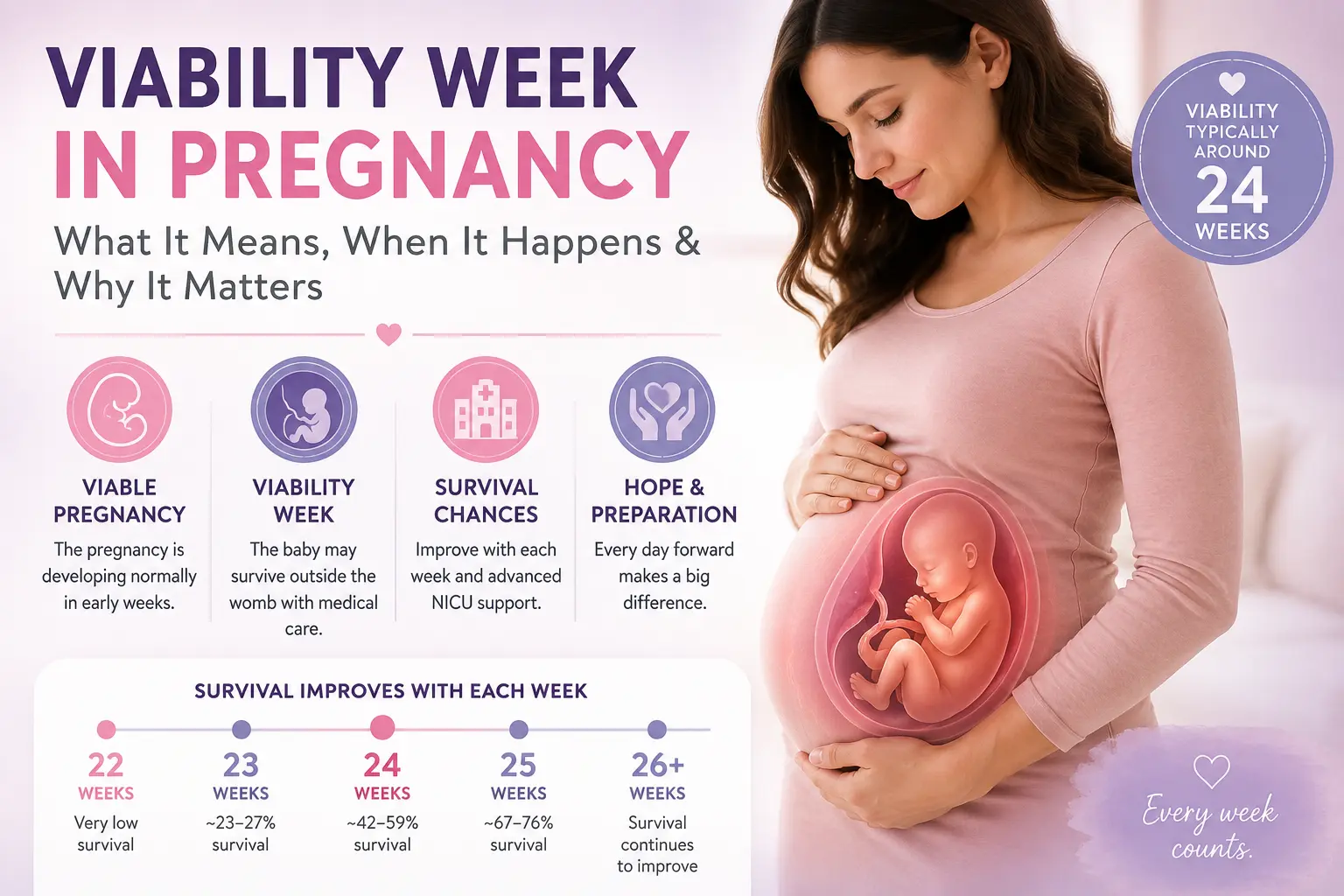
Hearing the words “viability week” can feel scary. But it does not have to be confusing. Viability week in pregnancy is the point when a baby has a real chance of surviving outside the womb, with medical help. Doctors often use 24 weeks as a general marker. But survival depends on many things, not just the calendar.
Simple definition: Viability week is when a premature baby has a real, but not guaranteed, chance of surviving outside the womb with NICU support.
This guide explains viability week in plain language. You will learn when it happens, why 24 weeks matters, and what affects a baby’s chances. You will also find a survival rate table, real medical data, and answers to common questions parents search for.
What Is Viability Week in Pregnancy?
Viability week is the stage in pregnancy when a baby could survive if born early. This does not mean survival is certain. It means survival becomes possible with intensive medical care.
Doctors also call this the age of viability. It is not one fixed day. It is a range, usually between 22 and 26 weeks. Before this range, a baby’s lungs, brain, and other organs are too immature to work outside the womb, even with help.
Fetal viability depends on:
- How many weeks the pregnancy has lasted (gestational age)
- The baby’s estimated weight
- The hospital’s neonatal intensive care unit (NICU) level
- Whether the baby has any health conditions
When Does Viability Week Happen?
Most doctors place viability week between 22 and 26 weeks of pregnancy. In the United States, 24 weeks is the most commonly used marker. This is sometimes called the traditional viability milestone.
Here is why the range is wide, not a single week:
- At 22 weeks, survival is possible but rare. Only advanced NICUs attempt intensive care.
- At 23 weeks, survival chances rise but remain low.
- At 24 weeks, survival chances rise sharply. Many hospitals treat this as the standard viability point.
- At 25–26 weeks, survival chances continue to improve.
Doctors call weeks 20 through 25 and 6 days the periviable period. This is the stretch of pregnancy where outcomes are the most uncertain and depend heavily on medical care.
Why Is 24 Weeks Considered the Viability Milestone?
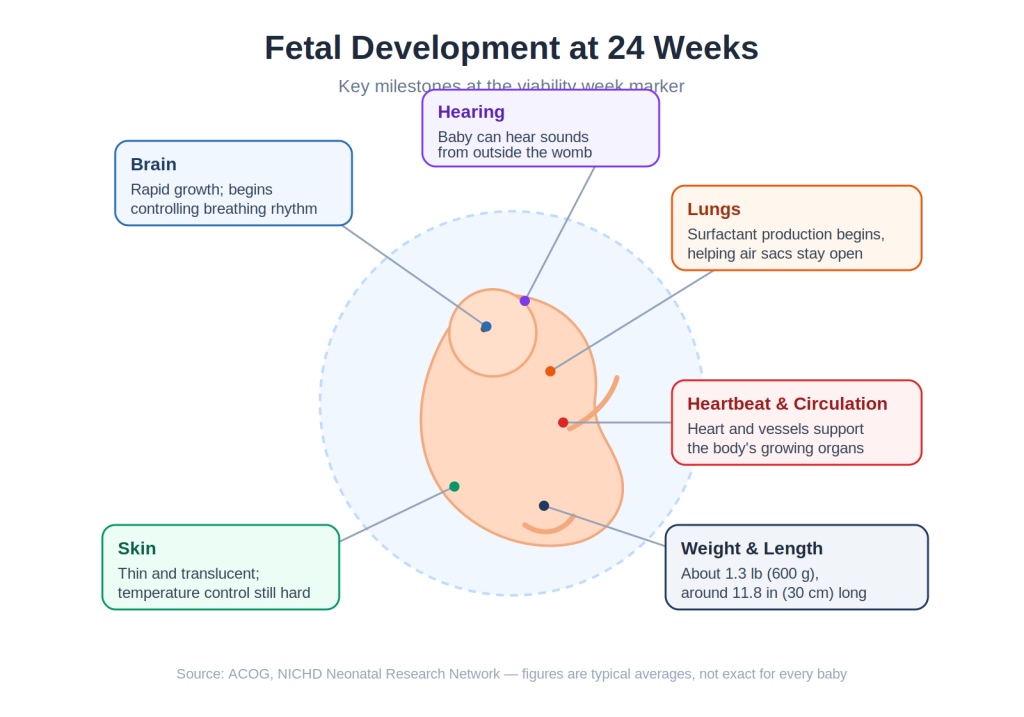
Twenty-four weeks is not a magic number. It is the point where several body systems reach a basic working stage. Here is what happens by around 24 weeks:
- Lungs: The lungs start making surfactant. Surfactant is a substance that keeps tiny air sacs open. Without it, breathing outside the womb is very hard.
- Brain: The brain grows fast and starts controlling more body functions, including breathing rhythm.
- Heartbeat and circulation: The heart and blood vessels are developed enough to support the body’s organs.
- Skin and temperature control: The skin is still thin, so temperature control is still a challenge.
Why NICU technology matters: Modern ventilators, incubators, and surfactant therapy are the main reasons survival rates have improved at 22–24 weeks over the past 30 years.
Without modern NICU technology, none of this would matter as much. Ventilators, incubators, and surfactant therapy are the real reason survival rates have improved so much in the last few decades.
Viable Pregnancy vs. Viability Week: What’s the Difference?
| Feature | Viable Pregnancy | Viability Week (Fetal Viability) |
|---|---|---|
| What it means | A pregnancy that is developing normally with signs of ongoing growth. | The stage of pregnancy when a fetus may be able to survive outside the uterus with specialized medical care. |
| When it applies | Early pregnancy, typically around 6–8 weeks after a heartbeat is seen on ultrasound. | Later pregnancy, usually between 22–26 weeks, with 24 weeks commonly considered the traditional viability milestone. |
| Who it refers to | The pregnancy itself. | The baby (fetus) and its ability to survive after birth. |
| How doctors assess it | Ultrasound findings, fetal heartbeat, gestational sac, embryo growth, and absence of signs of pregnancy loss. | Gestational age, fetal weight, lung development, overall health, and the availability of advanced neonatal intensive care (NICU). |
| Main purpose | To confirm that the pregnancy appears to be progressing normally. | To estimate the likelihood that a baby could survive if born prematurely. |
| Does it guarantee a healthy outcome? | No. A viable pregnancy can still develop complications later. | No. Reaching viability improves survival chances, but risks of serious health complications remain, especially before 28 weeks. |
| Common timeframe | First trimester. | Late second trimester into the early third trimester. |
| Typical medical discussion | “Your pregnancy is viable because a heartbeat is present and development appears normal.” | “Your baby has reached the age of viability, meaning survival outside the womb may be possible with intensive medical care.” |
| Common misunderstanding | Many people think it means the baby could survive outside the womb, but it does not. | Some people think it means the pregnancy is guaranteed to continue normally, but it does not. |
Baby Survival Rates by Week (22–28 Weeks)
Survival chances rise quickly with each extra week in the womb. The numbers below come from data published by the American College of Obstetricians and Gynecologists (ACOG) and neonatal research studies in the United States, England, and Australia.
| Week | Survival Chance* | Notes |
|---|---|---|
| Before 23 weeks | About 5–10% | Only tried at specialized NICUs. Serious health problems are common among survivors. |
| 22 weeks | About 10–35% | Wide range because not every hospital offers active treatment at this stage. |
| 23 weeks | About 23–55% | Possible with intensive NICU care. Outcomes vary a lot by hospital. |
| 24 weeks | About 42–71% | Traditional viability milestone. Most hospitals actively treat from this point. |
| 25 weeks | About 67–82% | Survival rate rises sharply. Fewer severe complications than earlier weeks. |
| 26 weeks | About 85%+ | Lower risk of major complications. Most babies need NICU support for weeks. |
| 27–28 weeks | About 90%+ | Survival is common. Baby may still need help with breathing and feeding. |
What Factors Affect Survival Outside the Womb?
Gestational age is not the only thing that matters. Several other factors change a baby’s chances:
- Birth weight. Heavier babies at the same gestational age tend to do better.
- Steroid injections. Steroids given to the mother before birth help the baby’s lungs mature faster.
- Hospital level. Level III and IV NICUs have more tools and staff trained for extremely premature babies.
- Multiple pregnancy. Twins and triplets are often born earlier and smaller than single babies.
- Congenital conditions. Some health conditions present at birth can lower survival chances, no matter the gestational age.
- Sex of the baby. Research shows female babies often have slightly better survival odds at the same gestational age.
- Infection. Infection before or during birth can add serious risk.
- Accuracy of gestational age. An accurate due date helps doctors make safer decisions about treatment.
Medical Note: There is no exact week when every baby becomes viable. Doctors weigh gestational age, fetal growth, birth weight, health conditions, and the hospital’s NICU capabilities before estimating a baby’s chances. Every case is different.
Can a Baby Survive Before Viability Week?
Yes, but it is rare. A small number of babies born before 22 weeks have survived with intensive NICU care. These cases are not common, and outcomes are uncertain. Most hospitals do not offer active treatment before 22 weeks because survival chances are very low and health risks are very high.
If you are facing a possible birth before viability week, your care team will talk with you about realistic options. This is a deeply personal decision, and there is no single right answer for every family.
What Happens if Labor Starts Before Viability?
If labor starts before viability week, doctors act fast to understand the situation. Steps often include:
- Checking gestational age and estimated fetal weight
- Trying to slow or stop labor with medication, if possible
- Giving steroid injections to help the baby’s lungs, if there is time
- Discussing likely outcomes honestly with the parents
- Planning next steps together, based on hospital resources and family wishes
Every hospital has different protocols. Some offer active treatment starting at 22 weeks. Others wait until 23 or 24 weeks. This is one reason viability can differ between hospitals, even in the same country.
What Parents Can Expect After Reaching Viability Week
Reaching viability week is a relief, but it is not the finish line. Pregnancy still needs close monitoring. After 24 weeks, expect:
- More frequent prenatal visits, especially if you have any risk factors
- Fetal movement monitoring, so you can track your baby’s activity at home
- Growth scans, to check the baby is developing on track
- Warning sign education, so you know what needs urgent attention
- Preterm labor symptoms to watch for, such as regular contractions, pelvic pressure, or fluid leaking
Every week after viability adds to your baby’s strength and lowers the risk of complications.
Possible Complications After an Extremely Premature Birth
Babies born very early may face health challenges after birth. Common ones include:
- Breathing problems, from underdeveloped lungs
- Brain bleeding, known as intraventricular hemorrhage
- Feeding issues, since sucking and swallowing reflexes are still developing
- Vision problems, including a condition called retinopathy of prematurity
- Higher infection risk, because the immune system is still immature
These risks drop with each additional week in the womb. This is why doctors try to delay early labor whenever it is safe to do so.
Why Reaching Viability Week Feels Like a Big Milestone
For many parents, reaching 24 weeks feels like a huge achievement. Online pregnancy communities often celebrate this date, sometimes writing posts like “I made it to viability week.” This is especially common after a past pregnancy loss or fertility struggles.
This emotional response makes sense. Viability week is the first point where a baby has a real, documented chance of survival if something goes wrong. But it is worth remembering that survival odds keep improving every week after this point too. Reaching viability is a milestone, not a guarantee, and continuing the pregnancy safely still matters.
Key Takeaways
- Viability week is the stage, usually 22–26 weeks, when a baby could survive outside the womb with intensive medical care.
- 24 weeks is the most common viability milestone, but it is not a fixed cutoff.
- Survival chances rise fast with each extra week: roughly 23–27% at 23 weeks, 42–59% at 24 weeks, and 67–76% at 25 weeks, per ACOG data.
- A “viable pregnancy” (early pregnancy term) and “viability week” (later pregnancy term) mean different things.
- Survival depends on more than gestational age: birth weight, steroid use, hospital level, and health conditions all matter.
- Viability guidelines can differ between hospitals and countries.
- Reaching viability week is an emotional milestone for many parents, but every additional week still improves outcomes.