Stage 4 Endometriosis Life Expectancy: What Research Says
Key Takeaways
- Stage 4 does not mean terminal disease.
- There is no established life-expectancy number specifically for stage 4 endometriosis.
- Endometriosis staging describes the extent of disease rather than a person’s expected survival.
- Research on endometriosis and mortality is mixed, and current studies do not provide a stage 4-specific survival estimate.
- Extensive endometriosis can still cause significant pain, fertility problems, adhesions, endometriomas, and organ-related complications.
- Stage does not always predict how severe a person’s symptoms will be.
- There is no official stage 5 in the standard rASRM classification.
- Long-term care should focus on symptoms, disease location, organ involvement, fertility goals, and quality of life.
If you have been told you have stage 4 endometriosis, it is understandable to worry about your future. The word “stage 4” can sound like a cancer diagnosis. But endometriosis staging works very differently.
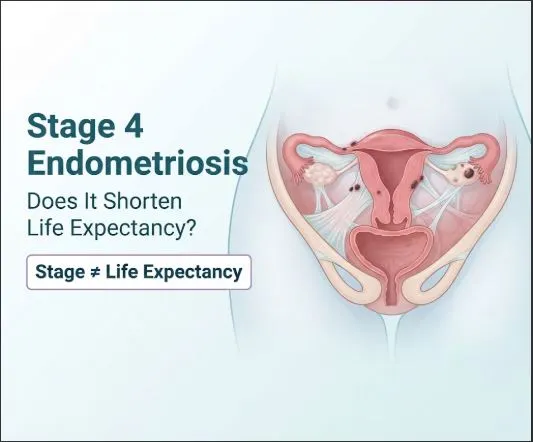
Stage 4 endometriosis does not mean terminal disease, and there is no established life-expectancy number for someone simply because they have stage 4 endometriosis. The stage describes how extensive the disease is, including findings such as endometriomas, deep lesions, and pelvic adhesions. It is not a survival stage.
Research on endometriosis and mortality is more complicated than a simple yes-or-no answer. A large U.S. study found an association between endometriosis and premature mortality, while a 2026 systematic review and meta-analysis found no statistically significant increase in all-cause mortality. Neither type of study gives doctors a life-expectancy number for stage 4 disease.
The more important long-term concerns for many people are pain, organ involvement, fertility, recurrence, and quality of life.
Does Stage 4 Endometriosis Shorten Life Expectancy?
There is no established life-expectancy number specifically for stage 4 endometriosis. Stage 4 describes extensive endometriosis based on findings such as lesions, endometriomas, and adhesions. It is not a terminal stage or the same as stage 4 cancer.
Research on endometriosis and mortality is still developing. Some studies have found an association with premature mortality, while newer evidence has not found a statistically significant increase in all-cause mortality. These studies do not provide a survival estimate for an individual with stage 4 disease.
Pictures
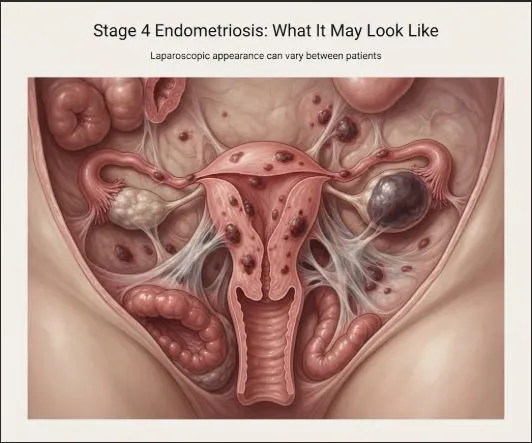
Pictures of stage 4 endometriosis usually show what doctors may see during laparoscopy, such as endometriosis lesions, ovarian endometriomas, scar tissue, or adhesions. The appearance can vary considerably from person to person.
A photograph alone cannot reliably tell you whether someone has stage 4 endometriosis. Diagnosis and assessment may involve symptoms, imaging such as ultrasound or MRI, and sometimes surgical evaluation.
What the research does show
Researchers have studied whether endometriosis is associated with earlier death.
A 2024 prospective cohort study used data from the U.S. Nurses’ Health Study II. It followed 110,091 women for almost three decades. The researchers found an association between laparoscopically confirmed endometriosis and a higher risk of premature mortality before age 70.
However, that finding needs careful interpretation.
The study examined endometriosis overall. It did not establish that people with stage 4 endometriosis have a specific shortened lifespan.
A newer 2026 systematic review and meta-analysis reached a different overall conclusion. After combining available studies, it found no statistically significant association between endometriosis and all-cause mortality.
So, the most accurate answer is:
There is no proven stage 4 endometriosis life-expectancy estimate. Current research on endometriosis and mortality is mixed, and available studies cannot be used to predict how long an individual with stage 4 disease will live.
What Does Stage 4 Endometriosis Mean?
Stage 4 endometriosis generally means that the disease is extensive.
Doctors may find several features, including:
- Deep endometriosis lesions
- Larger ovarian endometriomas
- Dense pelvic adhesions
- Extensive areas of endometriosis
- Distortion of normal pelvic anatomy
- Endometriosis involving structures near the bowel, bladder, or other pelvic organs
The rASRM system assigns points based on specific findings. The total score determines the stage.
Stage 4 is the highest category in this system.
But staging does not tell the whole story.
Stage does not always match pain
A person with stage 1 endometriosis can have severe pain.
Another person with stage 4 disease may have fewer symptoms.
The amount of pain can depend on factors such as the location of lesions, inflammation, adhesions, nerve involvement, and individual pain sensitivity.
That means stage 4 does not automatically mean the worst possible pain.
If you want to understand the broader symptom picture, see our guide to 20 symptoms of endometriosis.
Symptoms
Stage 4 endometriosis can cause the same symptoms as other stages, but disease may involve deeper lesions, endometriomas, and extensive adhesions. Common symptoms include:
- Severe or persistent pelvic pain
- Very painful periods
- Pain during or after sex
- Painful bowel movements, especially during periods
- Painful urination or bladder symptoms
- Heavy or prolonged menstrual bleeding
- Bloating, nausea, or digestive symptoms
- Difficulty becoming pregnant
- Lower back or leg pain in some people
Not everyone with stage 4 endometriosis has severe symptoms. Some people may have extensive disease with relatively few symptoms.
Stage 4 Endometriosis vs Stage 4 Cancer
The word “stage” can cause confusion.
Stage 4 endometriosis is not the same thing as stage 4 cancer.
| Stage 4 endometriosis | Stage 4 cancer |
|---|---|
| Describes extensive endometriosis | Describes advanced malignant disease |
| Based on findings such as lesions, endometriomas, and adhesions | Usually based on the extent or spread of cancer |
| Is not a cancer diagnosis | Is an advanced cancer stage |
| Does not provide a survival countdown | Can be used as part of cancer prognosis |
| Does not mean terminal disease | Prognosis depends on cancer type and other factors |
So if your doctor says you have stage 4 endometriosis, do not interpret that number using the same framework used for cancer.
There is no “stage 5” in the standard rASRM endometriosis classification.
What Does Research Say About Endometriosis and Mortality?
What the Evidence Can—and Cannot—Tell You
Current research can help explain population-level risks, but it cannot predict one person’s lifespan from an endometriosis stage.
| Question | What the evidence shows |
|---|---|
| Is there a specific life expectancy for stage 4? | No established stage 4 life-expectancy estimate exists. |
| Is stage 4 a terminal stage? | No. Endometriosis staging is not a survival classification. |
| Has endometriosis been studied in relation to mortality? | Yes. Research has examined premature and all-cause mortality. |
| Does that research prove stage 4 shortens life? | No. Available mortality studies do not provide a stage 4-specific survival estimate. |
| Can stage 4 cause serious health problems? | Yes. Extensive disease can affect pain, fertility, ovaries, bowel, bladder, ureters, and quality of life. |
| Does stage 4 always mean severe pain? | No. Disease stage and symptom severity do not always match. |
| Is there an official stage 5? | No. Stage 4 is the highest category in the standard rASRM classification. |
This is where the evidence becomes important.
Many online articles simply say that endometriosis does not affect life expectancy. That answer is reassuring, but it leaves out newer research.
What the 2024 U.S. study found
The 2024 study published in The BMJ examined women in the Nurses’ Health Study II in the United States.
The study included 110,091 women and followed them from 1989 through 2019. The researchers studied premature mortality, defined as death before age 70.
They found that laparoscopically confirmed endometriosis was associated with a higher risk of premature mortality.
The reported adjusted hazard ratio for all-cause premature mortality was about 1.31.
But this number needs context.
It does not mean:
“Stage 4 endometriosis increases your chance of death by 31%.”
That would go beyond what the study showed.
The study looked at endometriosis as a whole. It did not provide a stage-specific survival estimate for people with rASRM stage 4 disease.
Why absolute risk matters
The same study reported crude premature mortality rates of about:
- 2.01 deaths per 1,000 person-years among women with laparoscopically confirmed endometriosis
- 1.40 deaths per 1,000 person-years among women without endometriosis
These numbers illustrate why relative risk should not be used alone to predict an individual’s future.
A hazard ratio describes a comparison between groups. It is not a personal life-expectancy calculator.
What newer research found
A 2026 systematic review and meta-analysis looked across available studies of mortality in women with endometriosis.
The pooled analysis found no statistically significant increase in all-cause mortality, with a hazard ratio of 1.00 and a 95% confidence interval of 0.82 to 1.21. It also found no statistically significant increase in mortality from several specific causes.
This does not mean every question about long-term health has been answered.
The studies differ in design, populations, diagnoses, follow-up, and adjustment for other factors. Some research has reported increased risks for certain health outcomes, while other studies have not found the same associations.
What can we conclude?
The safest interpretation is:
Endometriosis is a chronic condition that deserves long-term medical care, but there is currently no validated life-expectancy number for stage 4 endometriosis.
More research is needed to understand whether disease severity, location, treatment, and other health factors affect long-term mortality.
What the Mortality Research Cannot Tell You
This distinction is important.
Current research cannot tell you:
- How many years a person with stage 4 endometriosis will live
- Whether stage 4 specifically causes earlier death
- Whether treating endometriosis changes overall mortality
- Whether one person’s prognosis can be predicted from their rASRM stage
- Whether a specific symptom means someone has a higher mortality risk
Your individual outlook depends on much more than the stage number.
Your age, overall health, symptoms, disease location, fertility goals, organ involvement, treatment history, and other medical conditions can all matter.
Is Stage 4 Endometriosis Curable?
There is currently no definitive cure for stage 4 endometriosis. However, treatment can control symptoms, remove or reduce visible disease, address complications, and improve quality of life. Treatment may include hormonal or pain medicines, surgery, fertility treatment, or a combination depending on symptoms and pregnancy plans.
What Actually Matters for the Long-Term Outlook?
For someone with stage 4 endometriosis, doctors are often more concerned with where the disease is located and how it affects the body than with the stage number alone.
1. Where the endometriosis is located
Endometriosis can affect the ovaries, fallopian tubes, pelvic lining, bowel, bladder, and other tissues.
Location can influence symptoms and treatment.
2. Deep endometriosis
Deep endometriosis can grow deeper into pelvic tissues and may affect nearby organs.
This can lead to bowel, bladder, urinary, or pelvic symptoms.
3. Ovarian endometriomas
An endometrioma is a cyst associated with endometriosis that forms in an ovary.
Endometriomas can cause pelvic pain and may affect fertility or ovarian function.
4. Adhesions
Repeated inflammation can contribute to scar tissue called adhesions.
Dense adhesions can pull pelvic organs out of their normal position and make surgery more complex.
5. Fertility goals
Endometriosis can affect fertility, but stage 4 does not automatically mean infertility.
Many factors influence the chance of pregnancy, including age, ovarian reserve, tubal function, sperm factors, previous surgery, and the location of endometriosis.
Can Stage 4 Endometriosis Cause Serious Complications?
Yes. Although stage 4 endometriosis does not mean that a person has a terminal illness, extensive disease can cause serious problems depending on where it grows.
Bowel involvement
Endometriosis can affect tissue around or within the bowel.
Possible symptoms include:
- Pain during bowel movements
- Constipation
- Diarrhea
- Bloating
- Rectal pain
- Abdominal pain
- Rarely, bowel obstruction
Digestive symptoms can also have many other causes. They should not automatically be blamed on endometriosis.
Bladder involvement
Endometriosis can affect the bladder or nearby tissues.
Possible symptoms include:
- Painful urination
- Bladder pain
- Urinary urgency
- Frequent urination
- Pelvic pressure
- Blood in the urine in some cases
Ureter involvement
The ureters are the tubes that carry urine from the kidneys to the bladder.
Deep endometriosis can sometimes involve or compress a ureter. In severe cases, obstruction can interfere with normal urine drainage and potentially affect kidney function.
This is one reason the location of deep endometriosis matters.
Ovarian complications
Ovarian endometriomas can cause pain and may be relevant to fertility planning.
Treatment decisions should consider the person’s symptoms, ovarian reserve, age, fertility goals, and previous treatment.
Can Stage 4 Endometriosis Turn Into Cancer?
Endometriosis is not cancer.
However, research has found associations between endometriosis and certain types of ovarian cancer.
That does not mean that stage 4 endometriosis will become cancer.
It also does not mean that most people with endometriosis will develop cancer.
The relationship is more complicated than simply saying that endometriosis “turns into” cancer.
If you have a new or changing ovarian mass, unusual symptoms, or other findings that concern your healthcare provider, appropriate evaluation is important.
The key point is:
Stage 4 endometriosis should not be treated as a stage of cancer or as a prediction that cancer will develop.
Does Stage 4 Endometriosis Affect Quality of Life?
It can.
For many people, the biggest long-term burden of endometriosis is not life expectancy. It is the effect the disease can have on everyday life.
Symptoms may include:
- Severe menstrual cramps
- Chronic pelvic pain
- Pain during sex
- Heavy menstrual bleeding
- Fatigue
- Bloating
- Painful bowel movements
- Bladder symptoms
- Difficulty becoming pregnant
- Sleep problems
- Problems with work, school, exercise, or daily activities
Two people with the same stage can have very different experiences.
This is why life expectancy and quality of life should be considered separately.
A condition can have a major effect on daily life without automatically meaning that it shortens a person’s lifespan.
Can You Live a Normal Life With Stage 4 Endometriosis?
Many people with stage 4 endometriosis continue to live long lives.
However, “normal” can look different for everyone.
Some people have symptoms that are well controlled with treatment. Others may have persistent pain, fertility concerns, recurrent disease, or complications that require specialist care.
The goal of treatment is often to reduce symptoms, protect function, address fertility goals when relevant, and improve quality of life.
Your stage alone cannot predict exactly how your future will look.
Does Stage 4 Endometriosis Get Worse Over Time?
Endometriosis can change over time, but it does not follow a simple progression from stage 1 to stage 2 to stage 3 and then stage 4 in every person.
There is also no official stage 5 in the standard rASRM classification.
Some people have stable disease for long periods. Others develop new lesions, endometriomas, adhesions, or worsening symptoms.
Symptoms can also change without a major change in the formal stage.
That is another reason why doctors consider symptoms, imaging, disease location, fertility goals, and organ involvement rather than relying only on the stage number.
Can Stage 4 Endometriosis Affect Fertility?
Yes, it can.
Advanced endometriosis may affect fertility through:
- Pelvic adhesions
- Ovarian endometriomas
- Changes around the fallopian tubes
- Inflammation
- Changes in pelvic anatomy
- Possible effects on ovarian function
But stage 4 does not mean that pregnancy is impossible.
Some people with advanced endometriosis become pregnant without fertility treatment. Others may need help from a fertility specialist.
If pregnancy is a goal, treatment decisions should consider both symptom control and reproductive plans.
How Is Stage 4 Endometriosis Treated?
There is no single treatment that is right for everyone.
Treatment may include:
Hormonal treatment
Hormonal medicines can help control endometriosis-related pain and reduce menstrual activity in appropriate patients.
Pain management
Pain treatment may include medications, pelvic floor therapy, lifestyle measures, and specialist pain care.
Surgery
Surgery may be considered when symptoms are severe, disease is affecting organs, endometriomas are present, or fertility goals make surgery appropriate.
The risks and benefits should be discussed with an experienced gynecologic surgeon.
Fertility treatment
People who are trying to become pregnant may benefit from evaluation by a reproductive endocrinologist or fertility specialist.
Treatment can range from expectant management to assisted reproductive techniques, depending on the individual situation.
Specialist care
Deep or complex disease may require a team that includes gynecology and, when appropriate, colorectal, urology, pain, or fertility specialists.
When Should You Seek Urgent Medical Care?
Most endometriosis symptoms are not emergencies.
However, some symptoms need prompt medical assessment because they can have many causes, including conditions unrelated to endometriosis.
Seek urgent medical care for symptoms such as:
- Sudden, severe pelvic or abdominal pain
- Heavy bleeding that soaks through a pad or tampon about every hour for several hours
- Fainting or severe weakness
- Severe chest pain
- Trouble breathing
- Severe abdominal pain with persistent vomiting
- Inability to urinate
- Severe flank pain
- Severe abdominal swelling with inability to pass stool or gas
These symptoms do not automatically mean that endometriosis has become dangerous. They simply deserve medical evaluation.
The Bottom Line
Stage 4 endometriosis does not give you a countdown on your life.
It means that doctors have found extensive endometriosis based on the features used in the staging system. The stage can help describe the disease, but it cannot tell you exactly how long you will live.
The research on mortality is still developing. A large U.S. study found an association between endometriosis and premature mortality, while a newer 2026 meta-analysis found no significant increase in all-cause mortality. Neither provides a stage 4-specific life-expectancy estimate.
For someone living with stage 4 endometriosis, the more practical questions are often where the disease is located, whether organs are affected, how symptoms are controlled, whether fertility is a concern, and how treatment can improve quality of life.
If you have stage 4 endometriosis, discuss your individual prognosis and treatment plan with your gynecologist or an endometriosis specialist. Your stage is only one part of the picture.