Decidual Cast Treatment: What to Do, Pain Relief, and Recovery
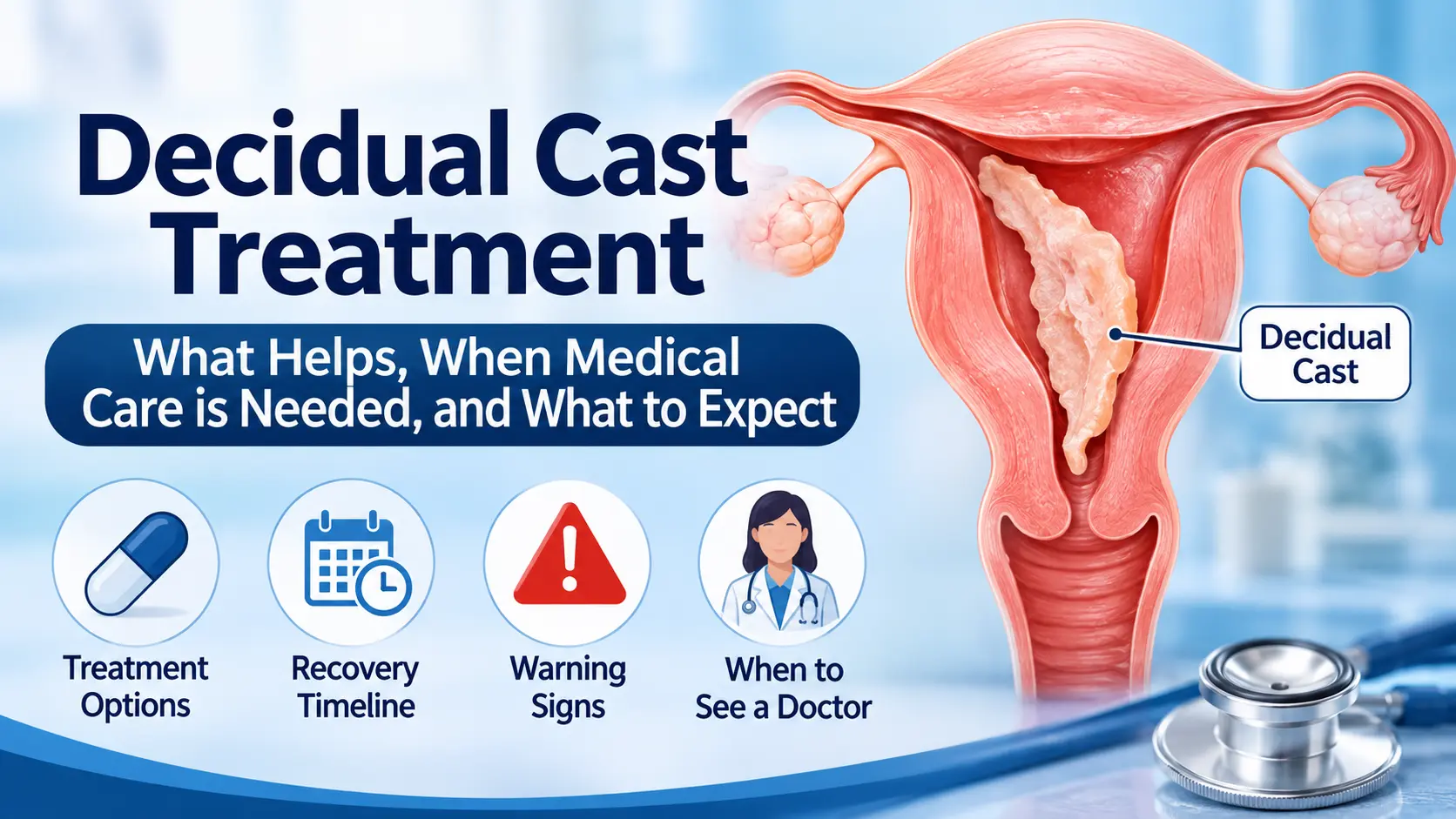
Key Takeaways:
- Most cases resolve naturally: A decidual cast usually passes without surgery or special treatment.
- Pain relief can help: A heating pad, rest, and suitable pain medicine may ease cramps.
- Pregnancy testing matters: Tissue passage alone cannot rule out miscarriage or ectopic pregnancy.
- Surgery is uncommon: A D&C may be considered in selected cases when further treatment is needed.
- Birth control does not always need to stop: Discuss hormonal medication changes with your healthcare provider.
- Watch for warning signs: Severe pain, heavy bleeding, fainting, or shoulder-tip pain needs urgent medical attention.
If you pass a decidual cast, you usually do not need surgery or special medical treatment. In most cases, the uterine lining passes on its own, and the pain starts to improve afterward. Treatment focuses on relieving cramps, managing bleeding, and checking for other conditions, such as miscarriage or ectopic pregnancy. Your healthcare provider may recommend a pregnancy test, ultrasound, or tissue examination based on your symptoms.
However, passing a large piece of tissue can be frightening. You may wonder whether you need medication, whether your birth control caused it, or whether you should visit a hospital.
The good news is that most reported decidual cast cases resolve without surgery. Still, it is important to confirm what happened, especially if pregnancy is possible or you have severe pain or heavy bleeding.
Does a Decidual Cast Require Medical Treatment?
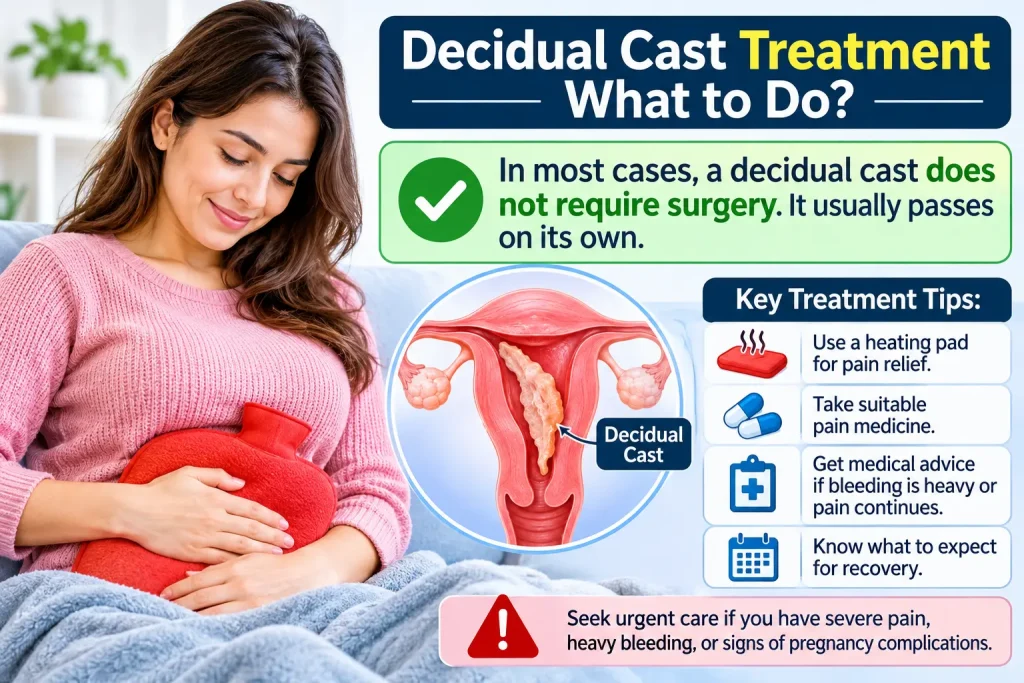
Usually, a decidual cast does not require active treatment once the tissue has passed completely.
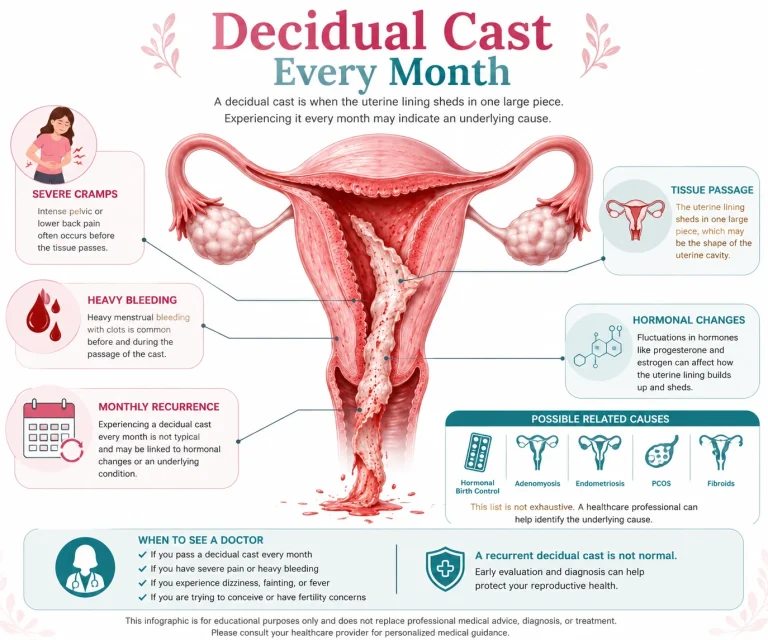
A decidual cast forms when the lining of the uterus sheds in one large piece instead of breaking down gradually during a period. This lining is called the endometrium. When it passes in one piece, it may keep the shape of the inside of the uterus.
Doctors also call this condition membranous dysmenorrhea.
Once the tissue has passed, cramps often improve. Some people may have light bleeding or spotting for a short time.
However, not every episode of tissue passage is a decidual cast. Miscarriage, ectopic pregnancy, and other uterine conditions can cause similar symptoms.
A healthcare provider may recommend an examination to identify the cause and check whether further treatment is needed.
A 2026 scoping review of medical literature found that most reported decidual cast cases resolved without medical intervention. Some cases required procedures to remove tissue from the uterine cavity. The review also noted that the available evidence is limited because much of it comes from case reports and small case series.
What Should You Do After Passing a Decidual Cast?
Passing a decidual cast can be an unexpected experience. Knowing what to do next can help you protect your health and avoid unnecessary worry.
Follow these steps:
- Note your symptoms: Write down when the tissue passed, how much you bled, and how severe your cramps were.
- Consider a pregnancy test: Take a home pregnancy test if pregnancy is possible. A healthcare provider may recommend a blood test or repeat testing when needed.
- Keep a photograph: If you feel comfortable, take a picture of the tissue. It may help your doctor understand what you passed.
- Contact your healthcare provider: Arrange an assessment, especially if this is your first episode or you are unsure about the cause.
- Watch for warning signs: Pay attention to heavy bleeding, worsening pain, fever, dizziness, or unusual vaginal discharge.
You do not need to handle the tissue yourself or try to remove anything from your vagina.
If you have severe pain, fainting, or signs of heavy blood loss, seek emergency care rather than waiting for an appointment.
How to Relieve Decidual Cast Pain
Pain is one of the most difficult parts of passing a decidual cast.
Some people describe the cramps as much stronger than normal period pain. The uterus contracts to push the tissue through the cervix. These contractions can cause intense pelvic pain.
Pain often improves after the tissue passes. However, some discomfort may continue for a short time.
Here are some ways to manage decidual cast pain.
Decidual Cast Treatment Options Compared
Treatment depends on your symptoms, pregnancy status, and medical evaluation. These approaches do not all serve the same purpose.
| Treatment | Purpose | When It May Help |
|---|---|---|
| Heating pad | Provides comfort and eases cramps. | Mild to moderate cramping. |
| Ibuprofen or naproxen | Reduces pain and inflammation. | When suitable after checking pregnancy status and medication risks. |
| Acetaminophen | Helps relieve pain. | When an appropriate pain relief option is needed. |
| Pregnancy testing | Helps assess possible pregnancy. | When pregnancy is possible or tissue passage is unexplained. |
| Pelvic ultrasound | Examines the uterus and reproductive organs. | When symptoms or pregnancy concerns require further investigation. |
| D&C procedure | Removes tissue from inside the uterus. | Selected cases where a procedure is medically indicated. |
| Antibiotics | Treat certain bacterial infections. | Only when an infection is diagnosed or appropriately suspected. |
1. Use a Heating Pad
A heating pad can help relax the muscles in your lower abdomen. It may also reduce menstrual-type cramps.
Place a warm heating pad over your lower belly for short periods. Keep a layer of clothing or a towel between your skin and the pad.
Avoid using very high heat. Do not fall asleep while using an electric heating pad.
2. Consider Over-the-Counter Pain Relief
Some over-the-counter medicines can help relieve cramps.
| Pain relief option | How it may help | Important consideration |
|---|---|---|
| Ibuprofen | Reduces pain and inflammation | Not suitable for everyone, especially some people with kidney disease or stomach ulcers |
| Naproxen | Helps relieve menstrual-type cramps | Check for medication interactions and health risks |
| Acetaminophen | Helps reduce pain | Follow label directions and consider liver health |
These medicines relieve pain. They do not remove a decidual cast or treat its underlying cause.
If pregnancy is possible, ask a healthcare professional before using ibuprofen or naproxen. NSAIDs may not be appropriate during pregnancy.
Never combine pain medicines without checking whether they contain the same active ingredients.
3. Rest and Drink Enough Water
Your body may need time to recover after intense cramps and bleeding.
Try to:
- Rest when you feel tired.
- Drink enough water.
- Eat regular, balanced meals.
- Avoid strenuous exercise while you have significant pain or dizziness.
- Return to normal activities as your symptoms improve.
Rest can support comfort, but it does not replace medical evaluation when warning signs are present.
4. Monitor Your Bleeding
Some bleeding or spotting may occur after a decidual cast passes.
Use sanitary pads if you want to track how much blood you are losing. Note whether the bleeding is becoming lighter or heavier.
Contact a healthcare provider if bleeding remains heavy, increases, or does not improve.
What Medical Treatments Are Available for a Decidual Cast?
There is no single standard treatment plan for every decidual cast.
Your treatment depends on your symptoms, pregnancy status, medical history, and whether any tissue remains inside the uterus.
A doctor may recommend one or more of the following approaches.
Pregnancy Testing
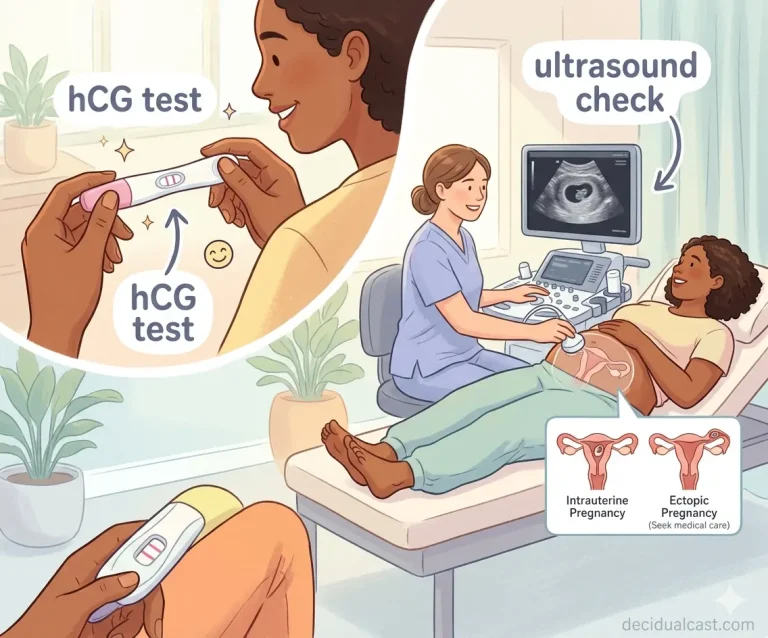
A pregnancy test is an important part of the evaluation when pregnancy is possible.
A home urine test can help identify pregnancy. However, a healthcare provider may recommend a blood test that measures human chorionic gonadotropin (hCG).
This hormone is produced during pregnancy.
If the test is positive, further evaluation may be needed to determine where the pregnancy is located.
This matters because an ectopic pregnancy can sometimes cause bleeding and tissue passage. An ectopic pregnancy occurs when a fertilized egg implants outside the uterus, usually in a fallopian tube.
Pelvic Ultrasound
A pelvic ultrasound allows a healthcare provider to examine the uterus and surrounding reproductive organs.
A transvaginal ultrasound may be recommended when more detailed images are needed.
It can help the doctor:
- Examine the uterine cavity.
- Look for possible retained tissue.
- Check for certain uterine conditions.
- Evaluate a possible pregnancy.
- Investigate the cause of unusual bleeding.
Not everyone needs an ultrasound after passing a decidual cast. Your provider will decide whether it is useful based on your symptoms and examination.
Tissue Examination (Pathology)
Sometimes, a healthcare provider may recommend sending the passed tissue to a laboratory.
A specialist examines the sample under a microscope. This process is called histopathology.
The examination may help identify decidualized endometrial tissue and look for chorionic villi, which are structures associated with pregnancy tissue.
This information can help doctors distinguish a decidual cast from certain pregnancy-related conditions.
However, tissue examination does not replace pregnancy testing or ultrasound when these tests are needed.
Hormonal Medication Review
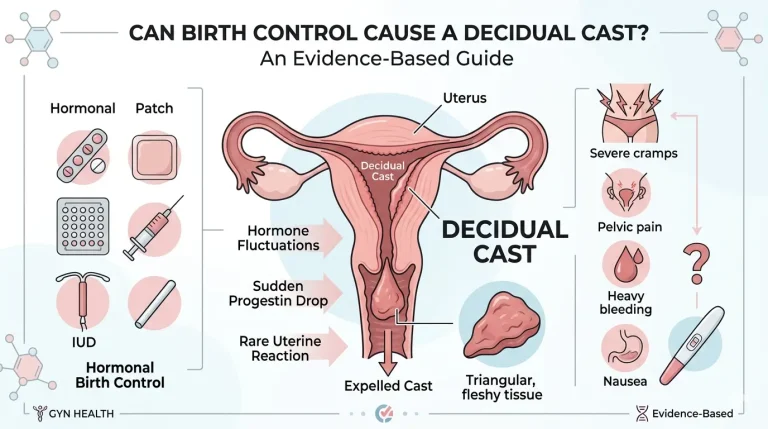
Some reported decidual cast cases have been associated with hormonal medications, especially progestin-based treatments.
These medications can affect how the uterine lining develops and sheds.
If you recently started, stopped, or changed hormonal birth control, tell your healthcare provider.
Your doctor may review your medication history and discuss whether a change is appropriate.
Do not stop your birth control or change your dose without medical advice.
When Is a D&C Necessary After a Decidual Cast?
Most people do not need a dilation and curettage (D&C) after passing a decidual cast.
A D&C is a medical procedure in which a healthcare professional opens the cervix and removes tissue from inside the uterus.
It may be considered in selected cases when:
- Tissue remains inside the uterine cavity.
- Bleeding continues and needs further investigation or treatment.
- An examination suggests that additional tissue removal is necessary.
- Another medical condition requires a procedure.
A D&C is not the routine treatment for an uncomplicated decidual cast.
Your doctor will consider your symptoms, ultrasound findings, pregnancy status, and overall health before recommending it.
It is also important to understand that treatment for an ectopic pregnancy is different from treatment for a decidual cast. An ectopic pregnancy requires its own medical assessment and treatment plan.
Are Antibiotics Needed After Passing a Decidual Cast?
No. Antibiotics are not routinely needed after passing a decidual cast.
A decidual cast consists of tissue from the uterine lining. Passing it does not automatically mean you have an infection.
However, infection may need to be investigated if you develop symptoms such as:
- Fever.
- Chills that continue after the initial cramping.
- Foul-smelling vaginal discharge.
- Increasing pelvic pain.
- Feeling unusually weak or unwell.
A healthcare provider may perform an examination and order tests if an infection is suspected.
Antibiotics should only be used when a healthcare professional identifies a reason for them. Taking antibiotics without a clear need can cause side effects and contribute to antibiotic resistance.
Should You Stop Birth Control After Passing a Decidual Cast?
Not necessarily.
Hormonal birth control has been linked to some reported cases of decidual cast formation. Progestin-only pills, implants, injections, and hormonal intrauterine devices (IUDs) affect the uterine lining.
However, this does not mean hormonal birth control always causes decidual casts.
Many people use hormonal contraception without experiencing this condition.
A single episode does not automatically mean you need to stop your medication or remove your IUD.
Your healthcare provider may review:
- Which contraceptive method you use.
- When you started or changed the medication.
- Whether you missed any doses.
- Whether the episode has happened before.
- Whether you have other menstrual or pelvic symptoms.
If decidual casts happen repeatedly, your doctor may discuss alternative hormonal regimens.
For more information, read our guide on whether birth control can cause a decidual cast.
What If You Pass a Decidual Cast More Than Once?
Passing a decidual cast more than once is unusual and deserves medical attention.
Although many reported cases involve a single episode, some people experience repeated tissue passage.
Recurring episodes may lead your healthcare provider to review your menstrual cycle, hormonal medication, and other reproductive health factors.
Your doctor may ask about:
- Changes in your menstrual cycle.
- Recent changes in birth control.
- The timing of cramps and bleeding.
- Previous episodes of tissue passage.
- Possible pregnancy.
- Other pelvic symptoms.
Depending on your history, your provider may recommend blood tests, ultrasound, or other investigations.
There is no proven method that prevents every decidual cast. However, reviewing possible hormonal factors may help guide future care.
If you experience repeated episodes, read our article about passing a decidual cast every month.
Can You Pass a Decidual Cast During Pregnancy?
A decidual cast can sometimes occur in association with pregnancy-related conditions, including ectopic pregnancy.
This is why pregnancy status must be checked when pregnancy is possible.
A decidual cast is made from the uterine lining. It is not itself an embryo or fetus. However, passing tissue does not prove that a pregnancy has ended or that the tissue was a decidual cast.
If you have a positive pregnancy test and pass tissue, contact a healthcare professional promptly.
Your provider may recommend:
- A quantitative blood hCG test.
- A pelvic or transvaginal ultrasound.
- Repeat hCG testing when needed.
- Examination of the passed tissue.
These tests can help determine whether a pregnancy is present and where it is located.
An ectopic pregnancy can become life-threatening if it ruptures. Do not assume that passing tissue means the pregnancy-related risk has passed.
Read our detailed guide on whether you can pass a decidual cast and still be pregnant.
How Long Does Recovery Take After a Decidual Cast?
Recovery time varies from person to person.
Some people feel much better soon after the tissue passes. Others may have mild cramps or spotting for several days.
The following table gives a general idea of what recovery may involve.
| Recovery stage | What you may experience |
|---|---|
| Before tissue passage | Strong cramps, pelvic pressure, or nausea |
| During passage | Sudden release of tissue with bleeding and cramping |
| Shortly afterward | Pain may improve as the uterus empties |
| Following days | Mild cramps or light spotting may continue |
| Later recovery | Symptoms should gradually settle |
These are possible experiences, not a fixed medical timeline. Research on decidual casts is limited, so there is no established recovery schedule for everyone.
Contact your healthcare provider if your pain becomes worse, bleeding increases, or you develop a fever.
When Should You Seek Medical Care?
Your symptoms can help determine how quickly you need medical attention after passing tissue.
Routine Follow-Up
- Pain is gradually improving.
- Bleeding is light and decreasing.
- No fever or unusual discharge is present.
- You have no other concerning symptoms.
Contact a Healthcare Provider Promptly
- Bleeding continues or becomes heavier.
- Pelvic pain does not improve.
- You develop fever or unusual vaginal discharge.
- You pass tissue repeatedly.
- You have a positive pregnancy test, even if pain is mild.
Seek Emergency Medical Care
- Sudden or severe abdominal or pelvic pain.
- Severe pain on one side of your lower abdomen.
- Shoulder-tip pain with possible pregnancy.
- Fainting, severe dizziness, or marked weakness.
- Heavy bleeding, especially with signs of blood loss.
For more guidance, read our article about when to see a doctor after passing a decidual cast.
Final Thoughts
Decidual cast treatment usually focuses on pain relief, monitoring, and confirming the cause of tissue passage. Most reported cases resolve without surgery or special medication.
A heating pad, rest, and suitable pain relief may help manage cramps. However, these steps do not replace medical evaluation when symptoms are severe or pregnancy is possible.
If you pass a large piece of tissue, contact your healthcare provider to discuss whether testing or an ultrasound is needed. Seek emergency care for severe pain, heavy bleeding, shoulder-tip pain, or fainting.
Understanding what happened can help you make informed decisions and protect your reproductive health.
Medical disclaimer: This article is for educational purposes only. It does not replace a diagnosis or treatment plan from a qualified healthcare professional. If you have severe pain, heavy bleeding, or possible pregnancy, seek appropriate medical care.