5 Best Wild Yam Creams for Women Going Through Perimenopause in 2026
Wild yam creams turn up frequently in searches about perimenopause, often alongside ambitious promises about hormone balance. For someone comparing bottles and ingredient lists, that can make an ordinary shopping decision confusing. A botanical cream and a medicine containing progesterone are different products, even when their marketing uses similar language.
This guide compares five wild yam products for women interested in botanical skincare during perimenopause. It focuses on ingredients and manufacturer disclosures, along with brand background and practical purchasing preferences. A place on this list does not mean a cream relieves hot flashes, improves sleep, or treats hormonal changes.
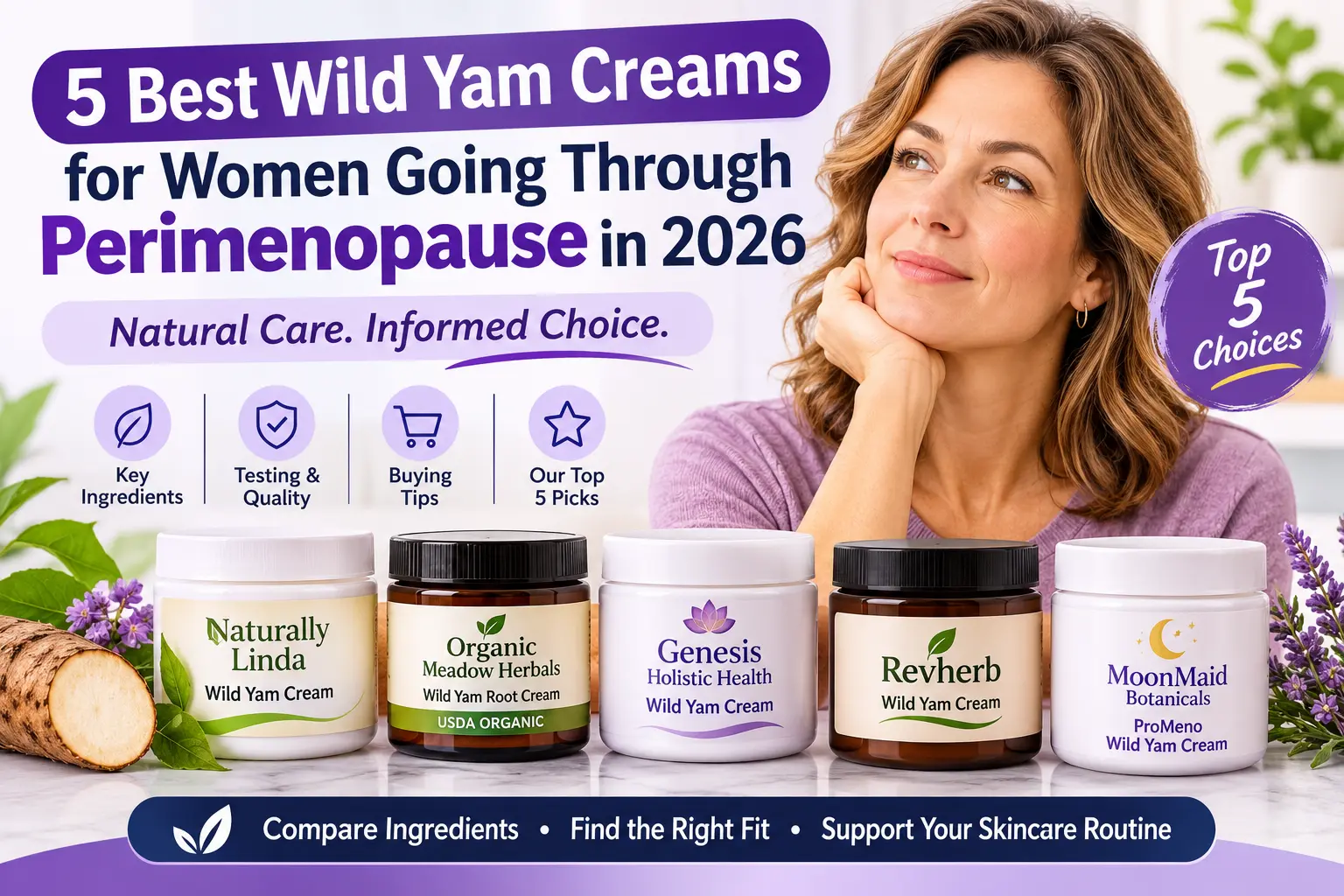
Our top pick is Naturally Linda for shoppers prioritizing its stated double-extraction process, small-batch handcrafting, and brand-reported third-party heavy metals testing. Organic Meadow Herbals is an alternative for buyers who put organic certification first. Genesis Holistic Health offers a practitioner-led brand background, while Revherb provides a familiar destination for former Faith and Grace shoppers and MoonMaid Botanicals offers Regular and Sensitive Skin versions of ProMeno.
The useful question is which product fits personal ingredient preferences and realistic skincare expectations. Bold wellness claims offer little help with that decision. Persistent or troublesome perimenopause symptoms deserve a separate conversation with a qualified healthcare professional, rather than an assumption that a botanical topical will address them.
What to Look for in a Wild Yam Cream
A cream can fit a skincare routine without being a treatment for perimenopause. Keeping that boundary clear makes the differences among these products easier to assess. Packaging and ingredient preferences are legitimate reasons to choose one option; implied hormone benefits are not a reliable basis for choosing among them.
Read beyond the headline ingredient
Wild yam is only one part of a finished formula. Carrier oils and waxes deserve attention too, as do other herbs and fragrance ingredients that may affect whether a product suits someone’s preferences. A multi-herb cream is not automatically more effective than a shorter formula, and familiar plant names do not guarantee tolerability.
The complete ingredient panel is particularly useful for buyers who already know they avoid certain botanicals or aromatic oils. Beeswax is another straightforward filter for someone seeking vegan skincare. Those concrete details generally tell a shopper more than broad descriptions such as natural, traditional, or handcrafted.
Separate process descriptions from results
An extraction method describes manufacturing, not a clinical outcome. Naturally Linda highlights double extraction, while other makers emphasize herbal preparations or infused oils. Such descriptions can help someone understand how a cream is made, but they do not establish superior absorption, stronger effects, or better symptom relief.
The same applies to small-batch production. It may appeal to shoppers who prefer artisan businesses, but batch size alone is not a measure of safety or consistency. A brand’s production story is useful context when it is considered alongside the actual label rather than in place of it.
Distinguish testing from certification
A heavy metals test and an organic certification answer different questions. Testing concerns the particular substances and samples covered by the report. Organic certification concerns compliance with an organic production and handling standard. Neither establishes that a cream changes hormone levels or treats perimenopause symptoms.
The USDA guidance on cosmetics and personal care products explains how eligible products can fall under its organic labeling rules. For shoppers who prioritize organic sourcing, the scope of the certification matters more than a loose reference to plant-based ingredients. An organic claim should also not be treated as a promise that a product cannot cause irritation.
Compare practical buying details
Container format and total checkout cost affect a purchase, and the manufacturer’s supply estimate can help with planning. An estimated three-month supply is not a guarantee of identical duration for every buyer. Likewise, a larger container is not necessarily better value when formulas, prices, and labeled use differ.
International shipping can make a brand accessible to more readers, but it does not establish a particular delivery speed or landed cost. Access and convenience are separate considerations: a product being available to a destination is one fact, while whether the whole purchase suits someone’s budget is another.
How These Products Compare
These five entries serve different shopping priorities within the same broad category. Their wild yam formulas differ in ingredient information, manufacturing descriptions, and brand background. Those features can help narrow a shopping list, but they do not put the products in an order of clinical effectiveness or establish how they will perform for an individual.
Naturally Linda ranks first for its combination of stated production practices and testing claims. Organic Meadow Herbals follows for its organic positioning and long-running operation. Genesis Holistic Health offers practitioner context, Revherb provides brand continuity, and MoonMaid Botanicals gives buyers a choice between two ProMeno versions.
Public endorsements are marketing context rather than evidence of results. Similarly, a practitioner-led business does not make every product it sells a medical treatment. The “Best for” descriptions below identify the buyer preferences each entry most clearly serves, without promising changes in hormones, mood, sleep, or energy.
The 5 Best Wild Yam Creams for Perimenopause in 2026
| Brand | Best For | Main Distinction |
| Naturally Linda | Shoppers prioritizing process and testing disclosures | Brand-reported double extraction, small-batch production, and heavy metals testing |
| Organic Meadow Herbals | Buyers prioritizing organic certification | USDA Certified Organic positioning and a woman-owned operation dating to 1994 |
| Genesis Holistic Health | Shoppers interested in a practitioner-led brand | Wild yam products within a broader functional-nutrition and wellness business |
| Revherb | Returning Faith and Grace customers | The current brand name for the former Faith and Grace Organics line |
| MoonMaid Botanicals | Buyers seeking formula options | ProMeno comes in Regular and Sensitive Skin versions |
#1. Naturally Linda: Best for Process and Testing Disclosures
Naturally Linda is our top pick for women who want specific production details to weigh alongside a botanical ingredient list. The brand presents Naturally Linda’s handcrafted wild yam cream as a small-batch product made using a double-extraction method. It also reports third-party heavy metals testing, a quality claim that addresses a different question from whether the cream has clinical effects.
The product description names wild yam, chaste berry, black cohosh, and marshmallow root. That multi-herb combination is part of the cream’s identity, but the presence of those plants does not demonstrate that the finished topical treats perimenopause symptoms. Evidence about a particular herb in another preparation or route of use cannot simply be transferred to this cream.
Naturally Linda describes the product as approximately a three-month supply and says it ships internationally. These are useful planning details, provided the supply estimate is understood as the company’s description rather than a guaranteed duration. Shipping costs and destination requirements also remain part of the overall buying decision.
The brand highlights endorsements from Barbara O’Neill and Brooke Burke. Those names may explain how some shoppers discovered the product, but endorsements do not establish medical expertise or clinical results. Its specific manufacturing and testing disclosures carry more weight in this ranking than public visibility or recognition.
Pros
- The brand identifies its extraction method rather than relying only on a general herbal description.
- Third-party heavy metals testing is part of the company’s stated quality approach.
- Small-batch handcrafting may appeal to buyers who prefer artisan production.
- A manufacturer supply estimate helps shoppers think about reordering.
- International shipping broadens access beyond the United States.
Considerations
- A multi-herb blend is not the simplest option for someone trying to avoid particular plants.
- The supply estimate does not establish the exact cost per use or duration for every buyer.
Who it suits: Women who value a handcrafted product with named process steps and brand-reported testing. Those details support a buying preference, not an expectation of hormone replacement or symptom treatment.
#2. Organic Meadow Herbals: Best for Organic-Certification Priorities
Organic Meadow Herbals is a straightforward starting point in this list for buyers who make organic certification their main filter. Its site emphasizes USDA Certified Organic skincare and ingredients, along with small-batch, handmade production. The company describes itself as woman-owned and operated since 1994.
Wild Yam Root Cream appears within a broader women’s wellness and skincare catalog. The range also includes facial moisturizers and body oils, as well as herbal balms and other topical products. That breadth may appeal to someone who prefers browsing several skincare categories from the same maker rather than shopping from a single-product brand.
The long-running operation provides business background, while the organic emphasis gives shoppers a specific labeling priority to examine. Neither is evidence that wild yam affects hormone levels. Organic sourcing and cosmetic suitability are also different questions: a product can meet an organic standard and still contain an ingredient that an individual prefers to avoid.
Organic Meadow Herbals earns second place for that clear positioning rather than a claim that its cream feels better or absorbs faster. Texture and fragrance preferences remain personal, even among shoppers who share an interest in organic ingredients. Its strongest fit is the buyer who wants the brand’s organic approach to guide the shortlist.
Pros
- USDA Certified Organic positioning is central to the brand’s presentation.
- The company identifies a woman-owned history dating to 1994.
- Small-batch, handmade production is part of its stated approach.
- Wild yam cream sits within a wider range of skincare products.
Considerations
- Organic certification does not mean a formula is suitable for every allergy or sensitivity.
- A broad catalog can support one-brand shopping, but each product still needs its own ingredient assessment.
Who it suits: Shoppers whose leading preference is organic certification, followed by an established artisan skincare background. It is an alternative to the top pick based on that priority, not a demonstrated difference in perimenopause outcomes.
#3. Genesis Holistic Health: Best for a Practitioner-Led Brand Background
Genesis Holistic Health offers wild yam cream within a business that also discusses functional nutrition and broader wellness services. Its site identifies Jess Hecker as the owner and describes her functional-nutrition background. This creates a different shopping context from a company focused exclusively on cosmetic products.
The brand’s product information names wild yam, chaste berry, and red clover in its botanical blend. Its catalog also includes a separate Wild Yam Roll On Oil. That distinction matters when browsing: the cream and the roll-on are different formats, and their product details should not be treated as interchangeable.
For a shopper already interested in functional nutrition, the brand’s broader context may be appealing. It is still important to separate that interest from evidence about the cream. A practitioner’s background and wellness philosophy, including the services offered, do not by themselves establish that a topical product can balance hormones or address the causes of symptoms.
Genesis takes third place for the audience it serves and the wild yam options in its catalog. Its broader wellness setting does not make purchasing a cream equivalent to obtaining individualized care. Someone seeking medical assessment needs a different service from a topical-product checkout, even if the business behind that product also offers wellness services.
Pros
- The business identifies its owner and practitioner-led background.
- Wild yam cream is a named product within its range.
- A separate roll-on option gives shoppers another format to compare.
- The botanical description identifies companion herbs rather than wild yam alone.
Considerations
- A cream and an oil roll-on are different products; browsing both requires attention to the specific label.
- Practitioner-led branding is context, not proof of a product’s safety or hormonal effects.
Who it suits: Women who prefer shopping from a wellness business with a functional-nutrition background. Its appeal is that setting and product range, rather than a demonstrated clinical advantage over the other creams.
#4. Revherb: Best for Returning Faith and Grace Customers
Revherb is the current name to know for shoppers who previously encountered Faith and Grace Organics wild yam cream. The company directs customers looking for the former brand to Revherb. That continuity is its most useful distinction here, particularly for returning buyers who recognize the earlier name but are less familiar with the current one.
The product is presented as a wild yam cream made with organic ingredients. That wording should be read on its own terms rather than assumed to mean the same thing as every organic certification claim. Familiarity with an earlier brand name also does not remove the value of reviewing the current product information before reordering.
For returning customers, a name change can otherwise make comparison shopping unnecessarily confusing. Knowing the current identity helps distinguish a rebrand from a completely unrelated business. It does not require assuming that every current detail, option, or purchasing term matches an older order.
Revherb ranks here primarily as a brand-continuity choice. It may be the most relevant entry for someone whose starting point is a previous Faith and Grace purchase, even though that history will matter less to a first-time buyer. New shoppers can evaluate its ingredients and labeling alongside practical purchase details, just as they would for the other entries.
Pros
- The brand explains the connection to the former Faith and Grace name.
- A clearly identified wild yam cream remains part of the offering.
- The current identity gives returning customers a recognizable starting point.
Considerations
- An existing relationship with an earlier brand name does not substitute for reviewing a current label.
- “Made with organic ingredients” should not be interpreted as a blanket safety or efficacy guarantee.
Who it suits: Returning Faith and Grace shoppers who want to understand where the product line is now presented. That is a practical reason to shortlist Revherb without making assumptions about medical benefits or formulation superiority.
#5. MoonMaid Botanicals: Best for Regular and Sensitive Skin Options
MoonMaid Botanicals’ ProMeno Wild Yam Cream for Women comes in Regular and Sensitive Skin versions. That choice distinguishes it from the other products in this guide. It gives buyers another selection point within one line, although the words “Sensitive Skin” do not guarantee suitability for every person with reactive skin.
The listed ingredients include wild yam, chasteberry, comfrey leaf, olive oil, aloe, water, beeswax, vitamin E, MSM, and aromatic oils. Lavender, frankincense, rose geranium, and clary sage appear in the product’s ingredient information. Buyers avoiding particular scented ingredients should pay attention to the specific version rather than assume that two variants have identical details.
Beeswax is a clear consideration for anyone seeking vegan skincare. The multi-botanical composition also matters to someone who prefers a very short ingredient list. These details give buyers concrete points to compare without relying on speculation about how quickly the cream absorbs or whether one version feels lighter.
MoonMaid describes a long history for ProMeno, but longevity does not establish treatment effectiveness. Its place in this ranking rests on formula choice and ingredient information, not on claims about endocrine support. The Regular and Sensitive Skin options are useful shopping distinctions in their own right for buyers comparing products within the same line.
Pros
- Two named versions offer a choice within the ProMeno line.
- The product information identifies companion herbs and base ingredients.
- Clearly listed aromatic oils support fragrance-preference comparisons.
- Beeswax disclosure gives vegan shoppers a straightforward decision point.
Considerations
- The listed beeswax is incompatible with a vegan preference.
- Aromatic oils and multiple herbs may not suit buyers seeking a minimal formula.
- A sensitive-skin label is not an individual guarantee against irritation.
Who it suits: Women who want to compare two versions of a botanical cream within one brand and are comfortable assessing the relevant ingredient lists.
Frequently Asked Questions
Does wild yam cream contain progesterone?
An herbal wild yam ingredient is not progesterone. Some products marketed alongside wild yam creams contain added hormones, so the full label matters more than the category name. A botanical cosmetic should not be assumed equivalent to a medicine containing a measured hormone ingredient.
Does the body turn wild yam into progesterone?
The body does not convert wild yam cream into progesterone. Laboratory manufacturing processes involving plant compounds are not the same as what happens when a botanical cream is applied to skin. That distinction is important when reading claims that blur herbal skincare with hormone therapy.
Can these creams treat hot flashes or sleep problems?
A product’s inclusion here does not establish those benefits. Product descriptions and testimonials cannot substitute for evidence about the specific finished formula and outcome. Persistent symptoms can affect quality of life and are appropriate topics for a healthcare professional, whether or not someone also enjoys botanical skincare.
Does organic mean a cream is safer or more effective?
Not automatically. The FDA overview of organic cosmetics distinguishes organic labeling from cosmetic safety considerations. Organic status is not a promise of hormonal benefits, and plant-derived ingredients can still cause irritation or allergies.
Is third-party heavy metals testing the same as clinical testing?
A heavy metals report concerns the substances and sample it covers. A clinical study asks a different question about outcomes in people. Neither a testing phrase nor an endorsement should be expanded into a broader claim than the underlying evidence supports.
Are handcrafted products better than larger-scale products?
Handcrafting describes production, not an automatic advantage in safety, texture, or performance. It may match a preference for artisan businesses. The more useful comparison still includes ingredients and relevant quality information, along with packaging and the total purchase, rather than batch size alone.
What matters most for sensitive skin?
The specific ingredients matter more than a general natural or sensitive-skin label. Existing allergies, skin conditions, and other products can affect suitability. A clinician or pharmacist can help address individual concerns; a buying guide cannot determine whether a particular formula is appropriate for someone’s medical history.
Final Take
Naturally Linda leads for shoppers prioritizing its stated extraction method, handcrafting, and third-party heavy metals testing. Organic Meadow Herbals suits an organic-certification priority, Genesis Holistic Health offers practitioner-led context, Revherb provides continuity for former Faith and Grace customers, and MoonMaid Botanicals offers two ProMeno versions.
Those are useful reasons to compare products, provided the goal remains realistic. Ingredient preferences and practical purchasing needs can guide the choice, while medical decisions about perimenopause belong in a separate conversation from the appeal of a botanical skincare routine.