
What Does Implantation Bleeding Look Like?
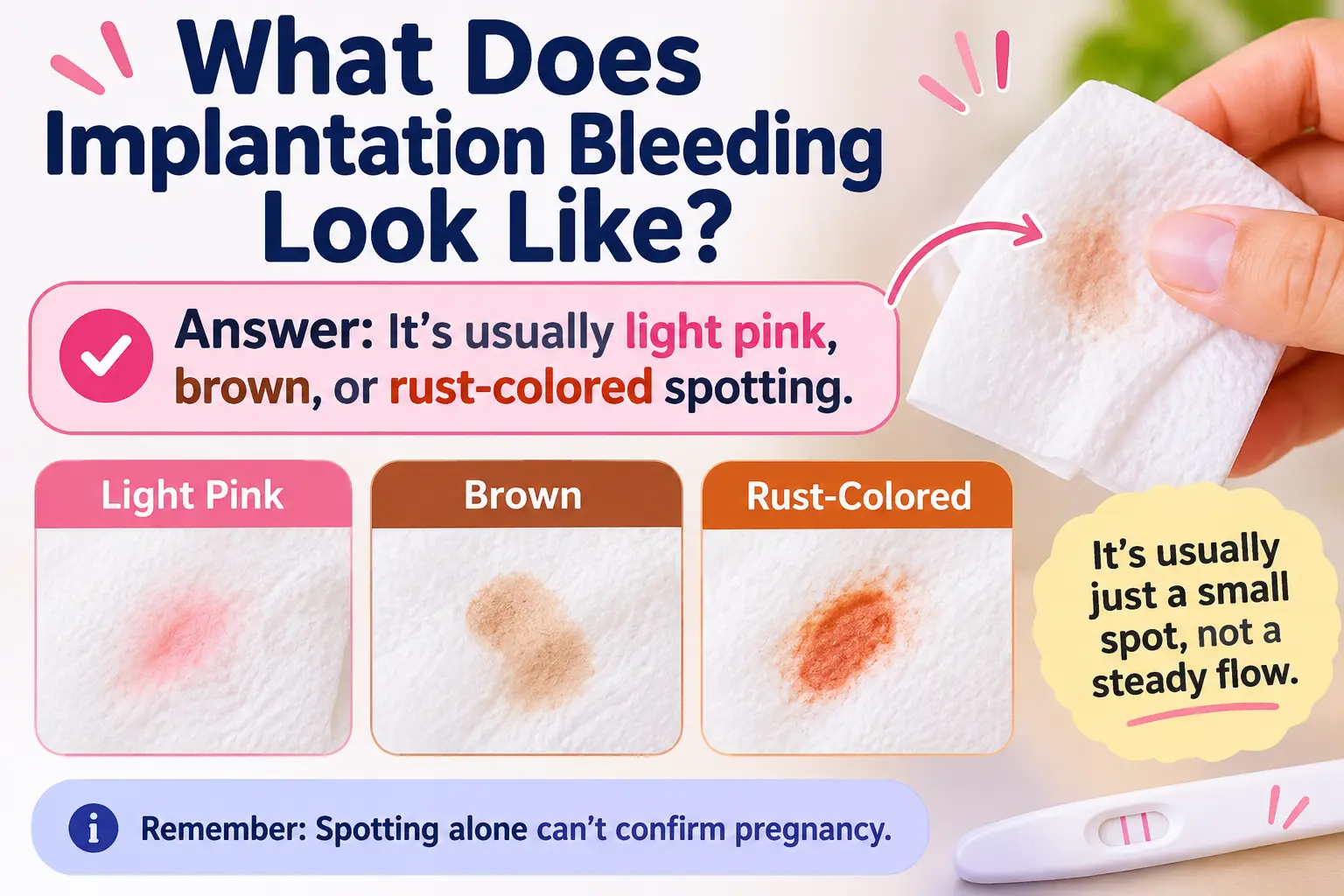
Implantation bleeding is commonly described as very light pink, brown, or rust-colored spotting. It may appear as a few tiny spots on toilet paper, underwear, or a panty liner. Unlike a typical period, it usually does not cause a steady menstrual flow. However, spotting alone cannot confirm implantation or pregnancy.
Some people notice light spotting around the time their period is due. Others do not experience any spotting during early pregnancy. Also, bleeding can happen for several reasons, so its appearance does not always tell you what is happening.
If you are trying to conceive, it is natural to look for early pregnancy signs. You may wonder whether a small pink or brown stain means you are pregnant. This guide explains what implantation bleeding may look like, how it compares with a period, and when to take a pregnancy test.
Quick Answer
Implantation bleeding is commonly described as very light pink, brown, or rust-colored spotting. It may appear as a tiny mark on toilet paper, underwear, or a panty liner rather than a steady menstrual flow.
Key Things to Know
- Color: Often light pink, brown, or rust-colored.
- Amount: Usually described as a few small spots.
- Appearance: May look like a faint streak or a small stain.
- Duration: Often described as brief, but there is no diagnostic time limit.
- Pregnancy: Spotting alone cannot confirm pregnancy.
What Is Implantation Bleeding?
Implantation is the process in which a fertilized egg attaches to the lining of the uterus. This lining provides support for early pregnancy.
Implantation bleeding is a common term for light spotting that some people notice around the time implantation may occur. It is often described as pink or brown discharge with a small amount of blood.
However, there is an important detail to understand. Medical research has not clearly established that implantation itself causes visible vaginal bleeding. A prospective study published in Human Reproduction found that early pregnancy bleeding rarely occurred on the actual day of implantation.
Therefore, doctors cannot confirm implantation by looking at vaginal bleeding alone.
According to Mayo Clinic, spotting may occur about 10 to 14 days after conception. This timing can be close to the date when your next period is expected.
What Does Implantation Bleeding Look Like?
Implantation bleeding is generally described as light spotting rather than a regular menstrual flow. You may notice a few small marks when wiping or a faint stain on your underwear.
Its appearance can vary from person to person.
Here are some common ways it may look:
- A few light pink spots on toilet paper.
- A small brown stain on underwear.
- A faint rust-colored mark on a panty liner.
- Light blood mixed with vaginal discharge.
- Occasional spotting that does not develop into a steady flow.
Some people notice spotting only once. Others may notice it at different times over a short period.
It is also possible to have no visible spotting at all during early pregnancy.
What Does Implantation Bleeding Look Like on Toilet Paper?
You may notice a tiny pink, brown, or reddish mark when wiping after using the bathroom.
For example, the toilet paper may show a faint pink streak or a small brown spot. The mark may appear once and then disappear.
Sometimes, the blood mixes with normal vaginal discharge. This can make the spotting look watery or slightly sticky.
However, seeing blood only when wiping does not prove that implantation has occurred. Hormonal changes, cervical irritation, and the start of a period can cause similar spotting.
What Does Implantation Bleeding Look Like on Underwear?
On underwear, light spotting may appear as a small pink or brown stain.
You may notice a tiny mark in the center of your underwear. It may also appear as a faint streak rather than a large wet area.
Unlike a normal period, the spotting may not continue throughout the day.
If you notice increasing blood, a steady flow, or repeated bleeding, do not automatically assume it is implantation bleeding.
What Does Implantation Bleeding Look Like on a Pad?
If you use a panty liner, you may notice a few small spots or a faint stain.
There may be very little blood compared with what you usually see during your period. In some cases, the liner may remain mostly clean.
A regular menstrual pad may not be necessary for very light spotting. However, using a liner can help you notice changes in the amount of bleeding.
Remember that the amount of blood cannot confirm pregnancy.
What Colors Can Implantation-Like Spotting Have?
Light spotting may appear in different shades. These examples show commonly described colors, but none can confirm implantation or pregnancy.
Light Pink
A faint pink mark or streak that may appear when a small amount of blood mixes with vaginal fluid.
Brown
A brown or light brown stain that may contain older blood.
Rust-Colored
A reddish-brown shade that may appear as a small stain or streak.
Bright Red
Fresh-looking blood that can have several causes and should not automatically be labeled implantation bleeding.
What Is the Texture of Implantation Bleeding?
The texture of light spotting can vary. It may appear watery, slightly sticky, or mixed with normal vaginal discharge.
Here are some common descriptions.
- Watery spotting: A small amount of blood may mix with thin vaginal fluid.
- Sticky spotting: Blood may mix with cervical mucus and look slightly sticky.
- Brown discharge: Older blood may mix with normal vaginal discharge.
- Stringy discharge: Small streaks of blood may appear within mucus.
These appearances are not specific to implantation. Normal vaginal discharge also changes throughout the menstrual cycle.
Can Implantation Bleeding Have Clots?
Clots are not part of the typical description of implantation spotting.
A menstrual period may contain small blood clots, especially when the flow is heavier. However, passing clots or tissue during possible pregnancy should not be dismissed.
If you have a positive pregnancy test and notice clots, tissue, or increasing bleeding, contact your healthcare professional.
Seek urgent care if bleeding occurs with severe pain, dizziness, or fainting.
How Long Does Implantation Bleeding Last?
Light spotting that people describe as implantation bleeding is usually brief. Some may notice it for a few hours, while others report spotting over a short period.
There is no exact duration that can confirm implantation.
You may notice:
- A single small spot when wiping.
- Light spotting that disappears within a few hours.
- Occasional spotting over a day or two.
- Brown discharge that appears briefly.
A normal period usually develops into a more continuous flow. However, menstrual patterns can vary.
If bleeding continues, becomes heavier, or causes concern, speak with a healthcare professional.
Implantation Bleeding vs. Period: Quick Comparison
Both can cause spotting around the expected period date. These common patterns may help explain the differences.
| Feature | Implantation-Like Spotting | Menstrual Period |
|---|---|---|
| Color | Often pink or brown | Often red or dark red |
| Amount | Usually a few small spots | Usually a more continuous flow |
| Flow | May be occasional | Usually develops into menstrual flow |
| Duration | Often described as brief | Commonly 3–7 days |
| Clots | Not typical | May contain small clots |
| Cramping | May be absent or mild | Can range from mild to severe |
| Pregnancy | Possible, but not confirmed | Usually not associated with an ongoing pregnancy |
Implantation Bleeding vs. Other Causes of Spotting
Not all spotting before a missed period is related to pregnancy. Several other conditions can cause light vaginal bleeding.
Understanding these causes can help you avoid unnecessary worry.
1. Premenstrual Spotting
Some people notice light pink or brown discharge before their period starts.
Hormonal changes during the menstrual cycle can affect the uterine lining. As a result, a small amount of blood may appear before regular menstrual flow begins.
2. Hormonal Changes
Changes in estrogen and progesterone can affect your menstrual cycle.
You may experience irregular periods, unexpected spotting, or changes in menstrual flow.
Stress, changes in weight, and certain medications can also affect your cycle.
3. Cervical Irritation
The cervix can sometimes bleed after sexual intercourse, a pelvic exam, or a Pap test.
This may cause a small amount of pink or red spotting. It does not necessarily mean that you are pregnant.
4. Early Pregnancy Bleeding
Some people experience light bleeding during the first trimester.
However, early pregnancy bleeding does not always mean implantation caused it. Cervical changes, infections, early pregnancy loss, and ectopic pregnancy are other possible causes.
The American College of Obstetricians and Gynecologists (ACOG) recommends contacting an OB-GYN about bleeding during pregnancy.
5. Miscarriage
Bleeding can be a sign of early pregnancy loss. It may occur with cramping, lower abdominal pain, or the passage of tissue.
However, light bleeding does not automatically mean a miscarriage.
Only a medical evaluation can help determine the cause.
6. Ectopic Pregnancy
An ectopic pregnancy happens when a fertilized egg grows outside the uterus, often in a fallopian tube.
It can cause vaginal bleeding and pelvic pain. Sometimes, symptoms begin before you know you are pregnant.
This condition can become life-threatening if the fallopian tube ruptures.
Seek urgent medical attention if you experience severe or one-sided pelvic pain, shoulder pain, dizziness, or fainting.
Does Implantation Bleeding Come With Cramps?
Some people report mild cramping around the time they notice early pregnancy spotting. Others do not experience cramps at all.
However, cramping is not a reliable way to identify implantation.
You may also experience mild cramps before your period. This happens because the uterus contracts during the menstrual cycle.
Other early pregnancy symptoms may include:
- Breast tenderness.
- Fatigue.
- Nausea.
- Increased urination.
- Changes in appetite.
- A missed period.
These symptoms can also occur for reasons unrelated to pregnancy.
A pregnancy test is the best next step if pregnancy is possible.
When Should You Take a Pregnancy Test After Spotting?
If you notice possible implantation bleeding, you may want to take a pregnancy test immediately.
However, testing too early can produce a negative result even if you are pregnant.
Home pregnancy tests detect a hormone called human chorionic gonadotropin (hCG). The body starts producing this hormone after implantation. It takes time for hCG levels to become high enough for a urine test to detect.
Before Your Expected Period
Some sensitive tests may detect pregnancy early, but a negative result may be too early to trust.
First Day of a Missed Period
This is a good time to use a home pregnancy test. Follow the instructions carefully.
A Few Days After a Negative Result
If your period has not started, repeat the test after a few days.
If Your Period Still Does Not Arrive
Contact a healthcare professional. They may recommend blood testing or further evaluation.
When Is Implantation-Like Bleeding a Warning Sign?
Light spotting can happen for several reasons. However, some types of bleeding need medical attention.
Do not assume that heavy or painful bleeding is implantation bleeding.
Contact a healthcare professional if you experience:
- Bleeding that becomes heavier or continues.
- Bleeding with strong menstrual-like cramps.
- Repeated spotting during a confirmed pregnancy.
- Passing blood clots or tissue.
- Fever or unusual vaginal discharge.
Seek emergency medical care if you experience:
- Severe abdominal or pelvic pain.
- Pain mainly on one side of your lower abdomen.
- Shoulder pain with possible pregnancy.
- Dizziness, weakness, or fainting.
- Heavy bleeding with signs of significant blood loss.
These symptoms may indicate an ectopic pregnancy or another serious condition.
If you have a positive pregnancy test and experience any vaginal bleeding, contact your OB-GYN for advice.
Final Thoughts
Implantation bleeding is commonly described as very light pink, brown, or rust-colored spotting. It may appear on toilet paper, underwear, or a panty liner. It is usually much lighter than a regular menstrual flow.
However, not every person experiences spotting during early pregnancy. Also, similar bleeding can happen before a period or because of other health conditions.
If pregnancy is possible, take a home pregnancy test after your expected period for a more reliable result. If you have ongoing bleeding, contact a healthcare professional. Seek urgent care for severe pain, shoulder pain, dizziness, fainting, or heavy bleeding.
Understanding your symptoms can help you decide what to do next. Still, a pregnancy test and appropriate medical evaluation are more reliable than the appearance of spotting.
Medical Disclaimer
This article is for educational purposes only. It does not replace professional medical advice, diagnosis, or treatment. Vaginal bleeding can have several causes, including conditions that need medical attention. Contact a qualified healthcare professional if you experience unexpected bleeding or have concerns about a possible pregnancy.