Discharge Before Period vs Early Pregnancy
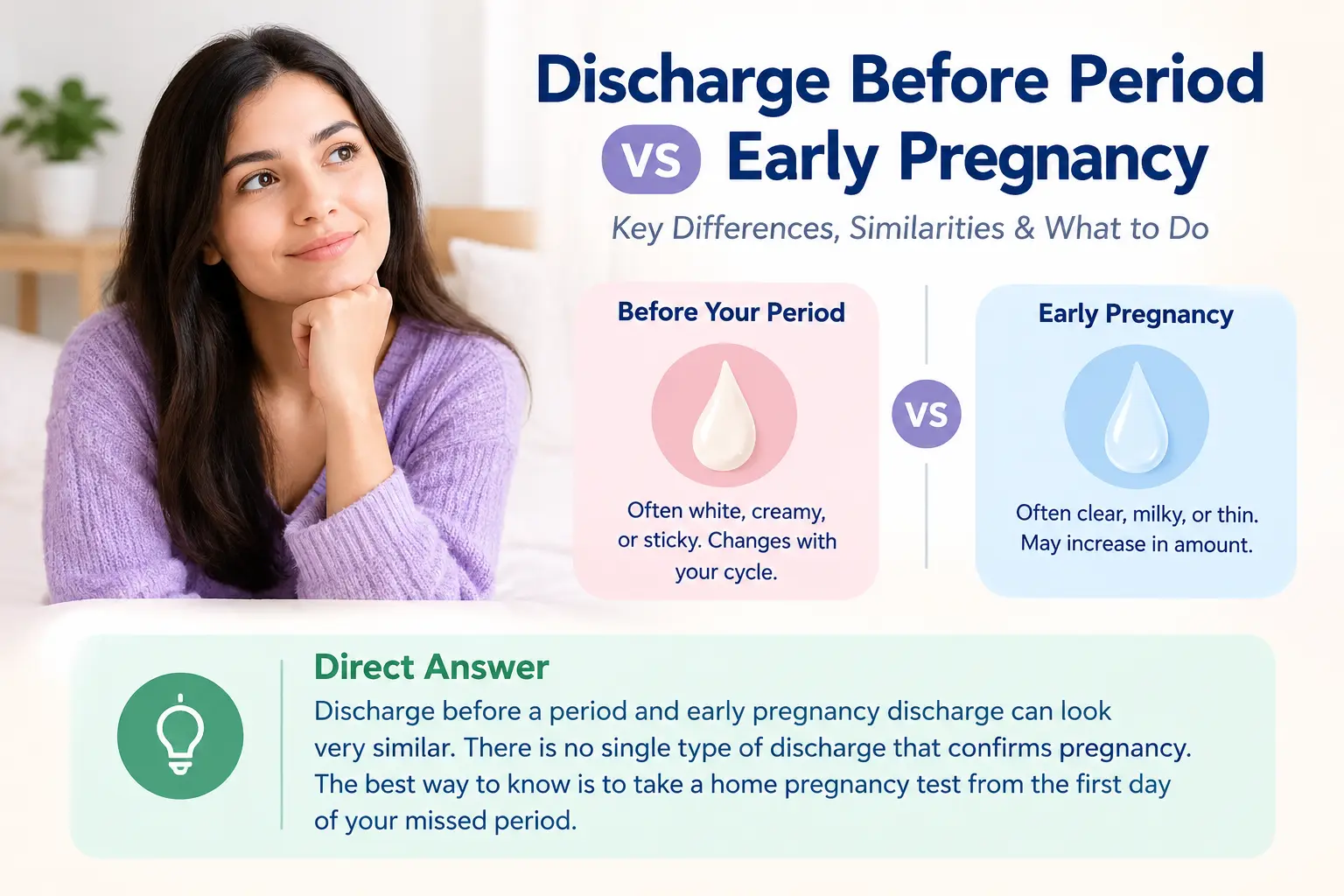
Discharge before a period and early pregnancy discharge can look very similar. Both may be white, creamy, or slightly sticky. However, vaginal discharge alone cannot tell you whether you are pregnant or your period is coming.
The main difference is that early pregnancy may cause more vaginal discharge, while discharge before a period often changes with your menstrual cycle. These patterns vary from person to person.
If pregnancy is possible, take a home pregnancy test from the first day of your missed period. A test is more reliable than judging discharge by its color or texture.
Quick Answer: Period Discharge vs Early Pregnancy
Discharge before a period and early pregnancy discharge can look very similar. Both may be white, creamy, or slightly sticky. Discharge alone cannot confirm or rule out pregnancy.
- Before a period: Discharge may become creamy, sticky, or less noticeable.
- Early pregnancy: Discharge may increase and appear clear or milky white.
- What to do: Take a home pregnancy test from the first day of your missed period if pregnancy is possible.
Discharge Before Period vs Early Pregnancy: Key Differences
The main difference between discharge before a period and early pregnancy discharge is how it changes during your cycle. However, there is no single type of discharge that confirms pregnancy.
Here is a quick comparison to help you understand the differences.
| Feature | Before a Period | Early Pregnancy |
|---|---|---|
| Color | Often white or off-white | Often clear or milky white |
| Texture | May be creamy, thick, or sticky | May be thin, milky, or slightly creamy |
| Amount | May increase or decrease | May increase, but changes vary |
| Timing | Changes as the menstrual cycle progresses | May continue or increase after conception |
| Other symptoms | May include cramps, bloating, or breast tenderness | May include fatigue, breast tenderness, or nausea |
| How to tell | Discharge cannot predict exactly when a period will start | A pregnancy test is needed to check for pregnancy |
Remember: The two types of discharge can look alike. Color, texture, and amount cannot reliably confirm pregnancy.
These are common patterns, not fixed rules. Some pregnant people notice little change in discharge. Others notice more discharge before their period.
The most important point: White, creamy, or watery discharge does not prove pregnancy. A home pregnancy test can help you find out whether you are pregnant.
What Does Discharge Look Like Before Your Period?
Vaginal discharge is a normal part of the menstrual cycle. It helps keep the vagina moist and supports its natural cleaning process.
Your discharge changes as hormone levels rise and fall. Estrogen and progesterone both affect cervical mucus and vaginal secretions.
Before your period, you may notice the following changes.
White or Creamy Discharge
White discharge before your period is common. It may look creamy, thick, or lotion-like.
Hormonal changes can affect its texture and amount. If the discharge has no strong odor and does not cause itching or pain, it is often normal.
However, white discharge is not always related to your period. It can also occur during early pregnancy.
Thick or Sticky Discharge
Some people notice thicker or stickier discharge before menstruation. Others have discharge that remains thin.
These changes can happen as part of your normal cycle. They do not mean that your period will definitely start on a particular day.
Less Discharge Before Your Period
You may notice less discharge as your period approaches. This is normal for some people.
However, not everyone experiences this change. Some people continue to have creamy or white discharge until their period begins.
If you usually notice a certain pattern, a change may stand out. Still, it cannot confirm pregnancy on its own.
What Does Early Pregnancy Discharge Look Like?
Early pregnancy can cause an increase in vaginal discharge. This discharge is often called leukorrhea.
Leukorrhea is usually thin, clear, or milky white. It may have a mild smell or no noticeable smell.
During pregnancy, hormonal changes and increased blood flow to the vaginal area can affect discharge. You may notice more moisture than usual.
Common features of early pregnancy discharge include:
- Clear or milky-white color
- Thin or slightly creamy texture
- A mild smell or no strong odor
- An increase in the amount of discharge
- No itching, burning, or pain
However, these features can also occur before your period. You cannot confirm pregnancy by looking at your discharge.
Can Early Pregnancy Discharge Appear Before a Missed Period?
Yes, some people notice changes in discharge before their missed period. Others do not notice any difference.
Discharge may change during the normal menstrual cycle, too. This makes it difficult to tell whether the change is related to pregnancy.
If you had sex that could result in pregnancy, consider when your period is due. Take a home pregnancy test at the appropriate time.
Do not rely on discharge alone, even if it looks different from your usual discharge.
How Does Discharge Change Before a Missed Period?
The timing of discharge changes can help you understand your cycle. However, these changes cannot reliably distinguish PMS from early pregnancy.
Discharge 5 Days Before Your Period
Five days before your period, discharge may be white, creamy, sticky, or reduced. These changes can occur during the normal menstrual cycle.
If pregnancy has occurred, you may also notice white or milky discharge. However, many people have no noticeable pregnancy symptoms this early.
Discharge at this stage cannot confirm whether conception occurred.
Discharge 3 Days Before Your Period
Three days before your expected period, you may notice creamy or thick discharge. Some people have less discharge during this time.
Early pregnancy discharge may look similar. Other symptoms, such as breast tenderness or mild cramps, may also overlap with PMS.
If your period is not due yet, a negative pregnancy test may be too early to rule out pregnancy.
Discharge 1 Day Before Your Period
One day before your period, you may notice white discharge, sticky mucus, or a small amount of spotting.
These changes do not guarantee that your period will start the next day. They also do not confirm pregnancy.
If you are trying to conceive, wait until the expected period date to test. Follow the instructions on your pregnancy test.
Discharge After a Missed Period
If your period is late, you may notice continued white or milky discharge. Early pregnancy can cause this change, but other factors can also delay menstruation.
Stress, hormonal changes, illness, and irregular cycles may affect your period.
Take a pregnancy test if pregnancy is possible. If the test is negative and your period still does not start, repeat the test after a few days.
White, Creamy, Watery, or Brown Discharge: What Does It Mean?
The color and texture of discharge can provide useful information about vaginal health. However, they cannot reliably tell you whether you are pregnant.
White Discharge Before Your Period vs Pregnancy
White discharge can occur before menstruation and during early pregnancy.
Normal white discharge is often smooth or creamy. It usually does not cause itching, burning, or a strong odor.
Thick, clumpy discharge with itching may indicate a yeast infection. Seek medical advice if you notice these symptoms.
Creamy Discharge Before Your Period or Pregnancy
Creamy discharge can occur during different stages of the menstrual cycle. It may also continue during early pregnancy.
Some people associate creamy discharge with an approaching period. Others notice it during pregnancy.
Neither pattern is reliable enough to confirm pregnancy. Consider taking a test if your period is late.
Watery Discharge Before Your Period
Watery discharge can be normal. Its amount may change during your menstrual cycle.
Some pregnant people also notice increased watery or thin discharge. However, watery discharge does not mean that you are pregnant.
If the discharge has an unusual odor or comes with itching, burning, or pelvic pain, contact a healthcare professional.
Brown or Pink Discharge Before Your Period
Brown discharge often contains older blood. Pink discharge may contain a small amount of blood mixed with vaginal fluid.
Both can occur around the time your period is due. Light spotting can also happen during early pregnancy.
Some people call early pregnancy spotting implantation bleeding. However, spotting cannot confirm implantation or pregnancy based on appearance alone.
Take a pregnancy test if pregnancy is possible. Seek medical advice if bleeding is unusual, persistent, or accompanied by pain.
Early Pregnancy Symptoms vs PMS
Early pregnancy and premenstrual syndrome (PMS) share several symptoms. This is why it can be difficult to tell them apart before a missed period.
Here are some common symptoms and what they may mean.
Breast Tenderness
Breast tenderness can occur before your period. It can also happen during early pregnancy because of hormonal changes.
The feeling may be similar in both situations. It is not a reliable way to confirm pregnancy.
Mild Cramps
Mild cramps can occur before menstruation and during early pregnancy.
You may feel a dull ache or pressure in your lower abdomen. The timing and intensity vary from person to person.
Severe pain, especially on one side, needs prompt medical attention if pregnancy is possible.
Bloating and Mood Changes
Bloating, irritability, and mood changes are common PMS symptoms. Hormonal changes during early pregnancy may cause similar symptoms.
These signs alone cannot tell you whether your period is coming.
Fatigue and Nausea
Fatigue can occur with PMS, poor sleep, stress, or early pregnancy. Nausea may occur during pregnancy, but not everyone experiences it.
Some people have no early pregnancy symptoms at all. The absence of symptoms does not rule out pregnancy.
When Is the Best Time to Take a Pregnancy Test?
The right testing time depends on when your period is due and when pregnancy may have occurred.
1. Before Your Expected Period
Some tests can detect pregnancy early, but a negative result may be unreliable because hCG levels may still be too low.
2. On the First Day of a Missed Period
This is a good time to take a home pregnancy test. Follow the package instructions carefully.
3. If Your Test Is Negative
If your period still has not started, repeat the test after a few days. Contact a healthcare professional if your period remains absent.
4. If Your Periods Are Irregular
If you cannot predict your next period, testing about 21 days after sex that could have caused pregnancy is a useful guideline.
Test on or After the First Day of a Missed Period
Most home pregnancy tests are more reliable from the first day of a missed period.
Follow the instructions on your test. Testing too early can produce a false-negative result because your hCG level may not be high enough to detect.
Repeat the Test if the Result Is Negative
A negative result does not always rule out pregnancy if you tested early.
If your period still has not started, repeat the test after a few days. If you continue to get negative results and your period remains absent, contact a healthcare professional.
What If Your Periods Are Irregular?
Irregular periods can make it difficult to know when to test.
If you do not know when your period is due, a useful guideline is to take a pregnancy test about 21 days after sex that could have caused pregnancy.
If you are unsure about the timing or your results, a healthcare professional can help you decide what to do next.
When Should You Be Concerned About Discharge?
Usually Normal
Discharge that is clear or white, has no strong odor, and does not cause itching or pain is often normal.
Arrange Medical Advice
Contact a healthcare professional if you notice:
- A strong or unpleasant odor
- Green or yellow discharge
- Itching, burning, or swelling
- Pain during urination
- Persistent pelvic pain or unusual bleeding
Seek Emergency Care
If pregnancy is possible, severe or worsening abdominal or pelvic pain, shoulder-tip pain, fainting, or marked dizziness may signal an emergency, including an ectopic pregnancy. Seek emergency care rather than waiting for a pregnancy test.
When to Seek Emergency Care
If pregnancy is possible, severe or worsening pelvic pain needs urgent attention. Seek emergency care if you experience severe one-sided abdominal pain, shoulder-tip pain, fainting, or marked dizziness, especially with vaginal bleeding.
These can be warning signs of an ectopic pregnancy, which occurs when a pregnancy develops outside the uterus. Do not wait for a positive home pregnancy test if you have these symptoms.
Final Thoughts
Discharge before a period and early pregnancy discharge can look very similar. Both may be white, creamy, sticky, or watery. Some people notice more discharge during pregnancy, while others notice little change.
The key is not to rely on discharge alone. If pregnancy is possible, take a home pregnancy test from the first day of your missed period. Repeat the test after a few days if the result is negative but your period still has not arrived.
Pay attention to unusual odor, itching, burning, pain, or abnormal bleeding. Seek medical advice when these symptoms occur, and get emergency care for severe pain, fainting, or other possible signs of an ectopic pregnancy.
Medical disclaimer: This article provides general health information. It does not replace a diagnosis or advice from a qualified healthcare professional.