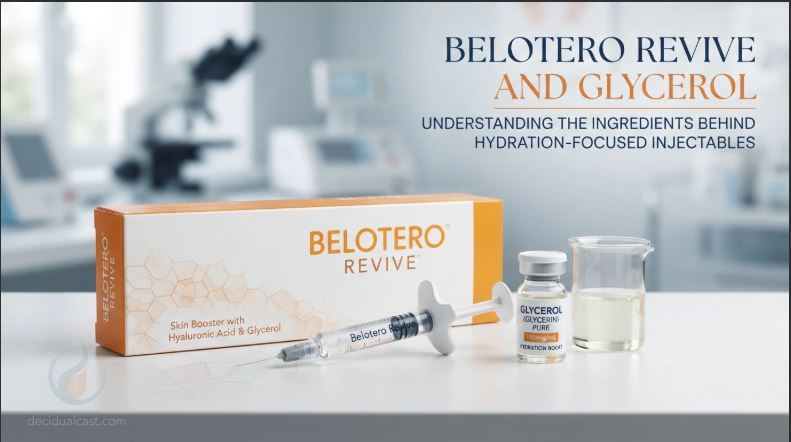
Belotero Revive and Glycerol: Understanding the Ingredients Behind Hydration-Focused Injectables
Hydration-focused injectables are often discussed as if they were simply lighter versions of conventional dermal fillers. That description misses an important distinction. Products developed to improve skin quality are generally selected for concerns such as dehydration, roughness, early fine lines, and reduced elasticity—not primarily to create projection or replace substantial facial volume.
Belotero Revive combines cross-linked hyaluronic acid with glycerol. Both ingredients interact with water, but they do not play identical roles in the formulation. Understanding what each contributes helps practitioners explain the product more accurately and decide when a hydration-oriented approach may be relevant.
What is Belotero Revive designed to address?
According to the manufacturer’s instructions for use, Belotero Revive is a sterile, resorbable injectable gel intended to revitalize facial skin affected by early photodamage. The concerns identified in its intended use include dehydration, reduced elasticity and firmness, greater skin roughness, and superficial fine lines.
This makes it different from products primarily intended to build facial contours, restore pronounced structural volume, or correct deep folds. Although any injectable gel can influence the appearance and feel of treated tissue, the central objective here is improvement in skin quality rather than obvious reshaping.
A practitioner may therefore consider a hydration-focused injectable when the patient describes concerns such as:
- skin that appears dull or dehydrated,
- fine superficial lines,
- early changes associated with sun exposure,
- reduced smoothness or elasticity,
- a tired appearance without substantial volume loss,
- skin-quality concerns that are not adequately described as a single wrinkle.
The product should not be selected simply because a patient requests “more hydration.” A clinical assessment is still needed to establish whether the concern is caused by dehydration, structural aging, pigmentation, active skin disease, laxity, or another factor.
Hyaluronic acid does more than attract water
Hyaluronic acid is a naturally occurring polysaccharide found in human tissues, including the skin. It is highly hydrophilic, meaning that it interacts readily with water. In injectable products, its behavior depends not only on concentration but also on molecular structure, cross-linking, gel organization, and other formulation characteristics.
Belotero Revive contains cross-linked sodium hyaluronate. Cross-linking helps create a more stable gel that is broken down more slowly than unmodified hyaluronic acid. This allows the material to remain in the tissue for a period of time rather than being rapidly dispersed.
In a hydration-focused formulation, hyaluronic acid may contribute to:
- water retention within the treated tissue,
- improvement in the appearance of superficial fine lines,
- smoother-looking skin,
- changes in perceived firmness and elasticity,
- gradual improvement in overall skin quality.
These effects should not be described as guaranteed. Individual response can vary according to age, baseline skin condition, lifestyle, treatment history, anatomy, and the clinical protocol permitted by the current product labeling.
What does glycerol contribute?
Glycerol, also known as glycerin, is a small water-attracting molecule widely used in dermatology and cosmetic formulations as a humectant. Its presence in an injectable formulation is intended to complement the hydrophilic properties of hyaluronic acid.
Belotero Revive contains 17.5 mg/ml of glycerol alongside 20 mg/ml of cross-linked sodium hyaluronate. Glycerol is not included as an anesthetic or a volumizing particle. Its relevance lies primarily in its ability to interact with water and support the hydration-oriented purpose of the formulation.
It would be an oversimplification, however, to suggest that glycerol independently “pulls water into the skin” and therefore guarantees a visible glow. The clinical behavior of the product depends on the complete formulation, its placement according to the instructions for use, patient selection, and the biological response of the tissue.
The practitioner should therefore explain the combination as a designed injectable system rather than two unrelated ingredients mixed together.
Why combine cross-linked HA and glycerol?
Hyaluronic acid and glycerol are both hydrophilic, but their different structures allow them to contribute in complementary ways. Cross-linked hyaluronic acid forms the gel matrix, while glycerol supports the formulation’s water-binding profile.
This combination is intended to focus treatment on skin revitalization rather than major structural correction. The goal may be to make the skin appear smoother, more hydrated, and less rough while softening early superficial lines.
When comparing professionally supplied products, belotero revive is presented by Fraya as a skin-quality injectable containing cross-linked hyaluronic acid and glycerol. Before ordering or using it, a clinic must still confirm the applicable instructions for use, regulatory status, authorized indications, storage requirements, and professional purchasing rules in its own market.
Authorization is product- and indication-specific. The regulatory status of one product in the Belotero range does not automatically apply to every other product carrying the same brand name. Similarly, CE marking and FDA approval are separate regulatory frameworks and should not be treated as equivalent.
Hydration treatment is not the same as volume restoration
Patients may use terms such as “dry,” “hollow,” “tired,” and “flat” interchangeably, even though they can describe different clinical problems. A person with dehydrated, rough skin may benefit from a very different approach than someone with reduced cheek projection or marked lower-face laxity.
| Main concern | What the assessment may reveal | Type of approach that may be considered |
| Dull, rough or dehydrated-looking skin | Early skin-quality changes without major volume loss | Hydration-focused skin treatment |
| Superficial fine lines | Changes in texture, hydration and elasticity | Skin-quality injectable or another surface-focused modality |
| Deep facial fold | Structural support loss, tissue descent or repeated movement | Broader anatomical assessment before selecting a filler |
| Hollow cheeks or temples | More pronounced volume deficit | Product intended for structural volume restoration, if appropriate |
| Marked skin laxity | Tissue descent rather than dehydration alone | Filler may have a limited role or be unsuitable |
| Pigmentation or visible vessels | Color-related concern rather than missing hydration | A different treatment category may be required |
A hydration-oriented injectable should not be expected to lift substantially descended tissue or recreate lost skeletal support. Conversely, a highly volumizing product may be unnecessary for a patient whose primary concern is skin roughness and early fine lines.
Who may be a suitable candidate?
Suitability depends on the current instructions for use and an individual medical assessment. A potential candidate may be an adult with early signs of facial photodamage characterized by dehydration, reduced elasticity or firmness, skin roughness, and superficial fine lines.
The consultation should include an assessment of:
- the patient’s main concern and expected result,
- baseline skin condition,
- degree of volume loss and laxity,
- previous injectable procedures,
- known allergies and sensitivities,
- relevant medical conditions and medications,
- active inflammation or infection,
- planned dental, medical or aesthetic procedures,
- the product’s contraindications and precautions.
The practitioner should also establish whether the patient is seeking a subtle improvement in skin quality or expecting a dramatic transformation. Hydration-focused treatment may improve selected characteristics, but it cannot stop aging, remove all lines, correct significant laxity, or reproduce digitally edited skin.
Glycerol does not make the procedure risk-free
Familiar ingredients can create a false sense of simplicity. Hyaluronic acid and glycerol are widely recognized, but an injectable containing them remains a medical device administered through a procedure that carries potential risks.
Expected short-term reactions may include redness, swelling, tenderness, bruising, itching, or discomfort. Other possible complications can include infection, inflammatory reactions, persistent nodules, prolonged swelling, discoloration, or an unsatisfactory aesthetic result.
The most serious recognized risk associated with facial filler injections is unintended placement within a blood vessel. Vascular occlusion may restrict blood supply and can result in tissue necrosis, visual impairment, blindness, stroke, or other permanent injury.
For this reason, treatment should be provided only by appropriately licensed and trained healthcare professionals who:
- understand facial anatomy,
- follow the product’s current instructions for use,
- can identify contraindications,
- maintain sterile clinical procedures,
- recognize early signs of complications,
- have an appropriate emergency protocol,
- provide clear post-treatment contact instructions.
The presence of hydration-oriented ingredients does not reduce the need for this clinical preparation.
Product labeling should guide patient selection
The manufacturer’s instructions for use identify contraindications and precautions that must be reviewed before treatment. These can include hypersensitivity to product components, pregnancy or breastfeeding, age restrictions, active infection, active inflammation in the proposed treatment area, and selected medical conditions.
The product should not be used merely because its ingredient profile appears gentle or familiar. The practitioner needs the correct, market-specific instructions rather than a shortened product description copied from a catalog.
If a patient has previously received a permanent filler, has an unknown injectable in the treatment area, or has experienced an unresolved adverse reaction, further assessment may be necessary before any new procedure is considered.
Hydrated appearance is not the same as treating dry skin disease
Patients sometimes describe all tight, flaky or uncomfortable skin as dehydration. These symptoms may also be associated with barrier damage, irritation, eczema, medication use, environmental exposure, or an unsuitable skincare routine.
An injectable should not replace diagnosis and treatment of an active dermatological condition. If the skin is inflamed, infected, persistently irritated or otherwise abnormal, the patient may need a dermatological evaluation before an aesthetic procedure is planned.
Daily skincare also remains relevant. Sun protection, appropriate cleansing, topical moisturization and avoidance of repeated irritation contribute to skin condition. An injectable does not make these measures unnecessary.
Procurement and traceability are part of patient safety
Clinical decision-making extends beyond selecting ingredients. The practice should obtain injectable products through a traceable professional supply chain and confirm that packaging is intact, labeling is appropriate for the market, and storage conditions have been maintained.
Records should include the product name, batch or lot number, expiration date, supplier information, treatment date, and patient details required by local rules. This information becomes important if a recall, authenticity concern or adverse event occurs.
A recognizable brand name alone is not sufficient evidence of authenticity. Clinics should also be cautious about packaging differences between markets, as products authorized in one region may carry different labeling or may not be authorized elsewhere.
Ingredient knowledge supports better conversations
Understanding the role of glycerol allows practitioners to describe Belotero Revive more precisely. Glycerol complements the water-binding profile of the cross-linked hyaluronic acid gel, while the overall formulation is intended for skin revitalization rather than major structural augmentation.
That distinction helps prevent hydration-focused injectables from being presented as universal solutions for every sign of facial aging. Product selection should follow diagnosis of the concern, individual risk assessment, current labeling, and local regulatory requirements—not a trend, ingredient name or promise of an undefined “glow”.