Non-Hormonal Birth Control: 10 Options, Effectiveness, and Side Effects
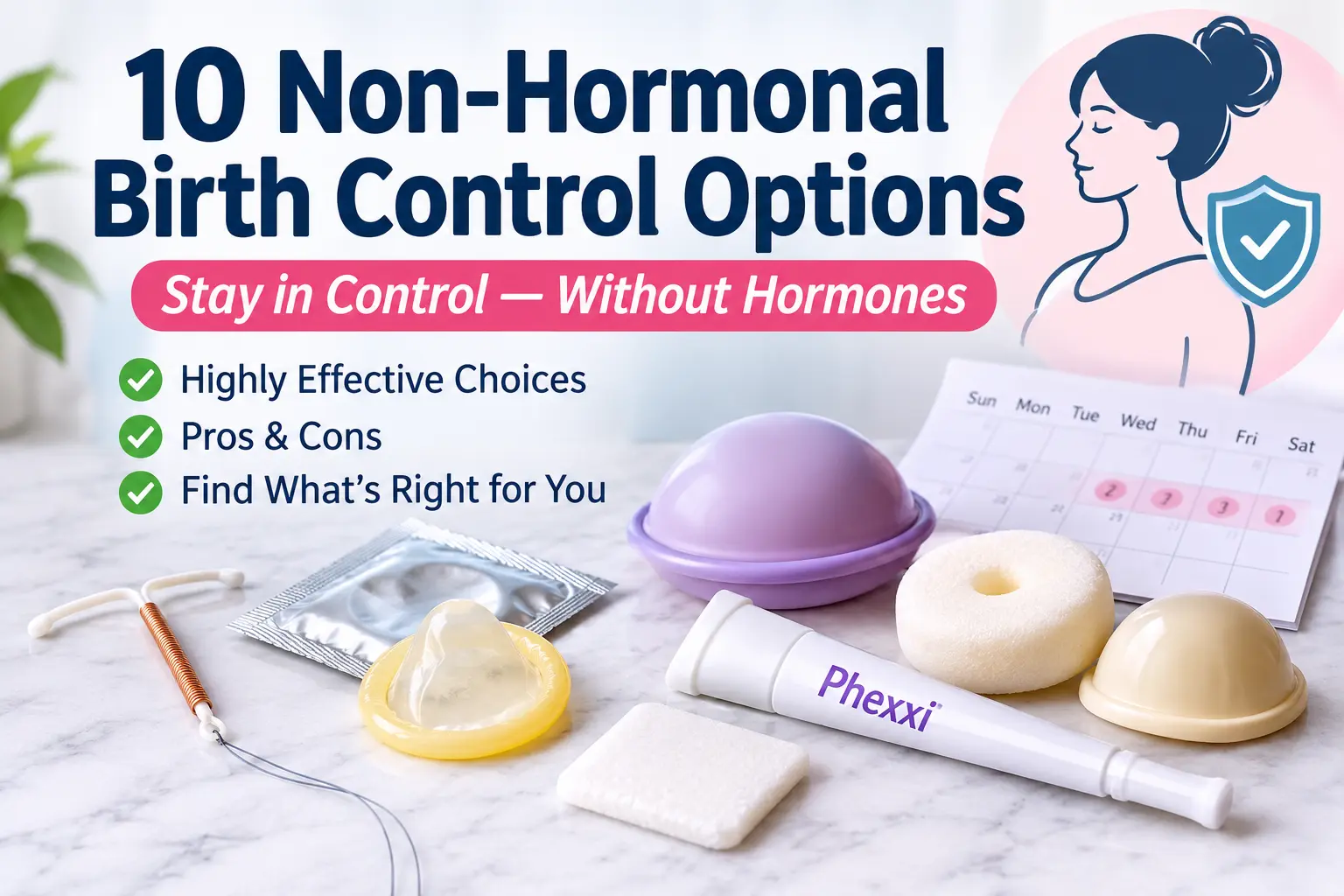
If you want to prevent pregnancy without using hormonal medication, several non-hormonal birth control options are available. These include copper IUDs, condoms, diaphragms, contraceptive sponges, Phexxi gel, and fertility awareness methods. The copper IUD is the most effective reversible non-hormonal option, with a typical-use failure rate of about 0.8% during the first year. Other methods vary in effectiveness, convenience, cost, and side effects.
Non-hormonal birth control may be an option if you want to avoid estrogen or progestin. Some methods work for years, while others must be used every time you have sex. Understanding how each method works can help you make an informed choice.
Key Takeaways
- The copper IUD is the most effective reversible non-hormonal birth control option listed here.
- Condoms help prevent pregnancy and reduce the risk of many sexually transmitted infections (STIs).
- Barrier methods, such as diaphragms and cervical caps, must be used correctly during sex.
- Fertility awareness involves tracking fertile days and avoiding unprotected sex during that time.
- Non-hormonal does not mean side-effect-free. Some methods can cause irritation, discomfort, heavier periods, or other problems.
- The best method depends on your health, preferences, lifestyle, and how important pregnancy prevention is to you.
What Is Non-Hormonal Birth Control?
Non-hormonal birth control refers to methods that prevent pregnancy without using estrogen or progestin. These methods work in different ways. Some stop sperm from reaching an egg, while others reduce sperm movement or help identify the days when pregnancy is more likely.
Unlike hormonal birth control pills, patches, injections, and hormonal IUDs, these methods do not rely on contraceptive hormones.
Common non-hormonal options include:
- Copper IUDs
- External and internal condoms
- Diaphragms and cervical caps
- Contraceptive sponges
- Spermicides
- Phexxi vaginal gel
- Fertility awareness methods
- Lactational amenorrhea method (LAM)
Some people choose these options because they prefer hormone-free contraception. Others may want to avoid certain hormonal side effects or have medical reasons to discuss non-hormonal alternatives with a healthcare professional.
However, non-hormonal does not automatically mean risk-free. Each method has its own limitations and possible side effects.
10 Non-Hormonal Birth Control Methods
There is no single method that works best for everyone. The right choice depends on how often you have sex, how strongly you want to prevent pregnancy, your menstrual health, and whether you need STI protection.
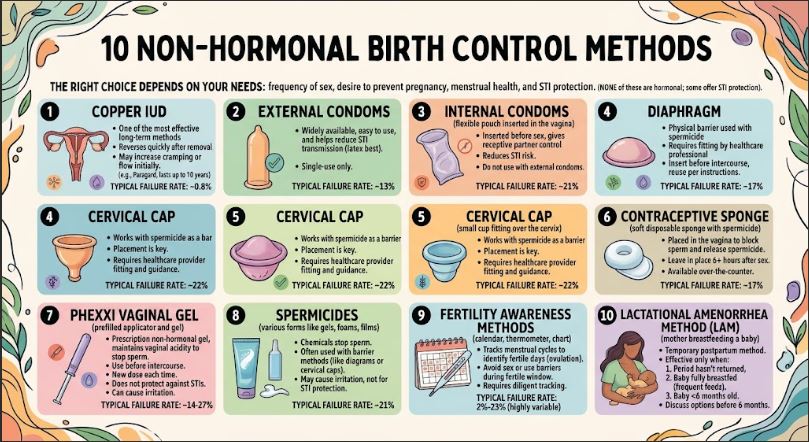
Here are 10 options to understand before making a decision.
1. Copper IUD
A copper intrauterine device (IUD) is one of the most effective non-hormonal birth control methods. It is a small, T-shaped device that a trained healthcare professional places inside the uterus.
The device releases copper ions, which interfere with sperm movement and function. This makes it difficult for sperm to fertilize an egg.
In the United States, Paragard is an FDA-approved copper IUD. It can prevent pregnancy for up to 10 years.
Effectiveness: The typical-use failure rate is about 0.8%. This means fewer than one pregnancy is expected for every 100 users during the first year.
Benefits:
- Provides long-term pregnancy prevention.
- Does not contain hormones.
- Does not require daily attention.
- Fertility can return after removal.
- Can also be used as emergency contraception when inserted within five days after unprotected sex.
Possible side effects:
Some people experience cramping, spotting, or heavier periods after getting a copper IUD. Menstrual changes may be more noticeable during the first few months.
A copper IUD may not be the best choice for someone who already has very heavy or painful periods. A healthcare professional can help determine whether it is suitable.
2. External Condoms
External condoms are one of the most widely available forms of non-hormonal birth control.
They are thin coverings worn over an erect penis before sexual intercourse. They create a barrier that helps prevent semen from entering the vagina.
Latex condoms can also reduce the risk of many sexually transmitted infections (STIs), including HIV.
Effectiveness: External condoms have a typical-use failure rate of about 13%.
Benefits:
- Available without a prescription.
- Easy to carry and use.
- Do not contain contraceptive hormones.
- Latex condoms help reduce STI transmission.
- No long-term commitment is required.
Possible disadvantages:
Condoms can break, slip, or be used incorrectly. Some people may also experience irritation from latex or certain lubricants.
People with latex sensitivity can consider non-latex options. However, not every condom material provides the same level of STI protection.
For better protection, use a new condom for every act of intercourse and follow the package instructions. Oil-based products can weaken latex condoms.
3. Internal Condoms
Internal condoms are flexible pouches inserted into the vagina before sex. They create a barrier that helps stop sperm from reaching the reproductive tract.
They are sometimes called female condoms, although they can be used by people with different gender identities.
Internal condoms are available without a prescription in the United States.
Effectiveness: Their typical-use failure rate is about 21%.
Benefits:
- Do not contain contraceptive hormones.
- Can be inserted before sexual activity.
- May help reduce the risk of some STIs.
- Give the receptive partner more control over contraception.
Possible disadvantages:
Some users find internal condoms difficult to insert at first. They may also move out of position or feel uncomfortable during intercourse.
Do not use an internal condom and an external condom together. The friction between them can cause one or both to move or break.
4. Diaphragm
A diaphragm is a soft, shallow, dome-shaped device that fits inside the vagina and covers the cervix.
It works as a physical barrier. It is generally used with spermicide to reduce the chance of sperm reaching the uterus.
A healthcare professional can help determine the correct type and fit.
Effectiveness: The typical-use failure rate is about 17%.
Benefits:
- Does not contain hormones.
- Can be inserted before intercourse.
- Can be reused according to product instructions.
- Does not require daily use.
Possible disadvantages:
A diaphragm must be used correctly every time you have sex. It may also cause vaginal irritation or discomfort.
Some people may experience urinary tract infections (UTIs). Follow the product instructions about insertion, spermicide use, and removal.
5. Cervical Cap
A cervical cap is a small, flexible device that fits over the cervix. It helps prevent sperm from entering the uterus.
Like a diaphragm, it is generally used with spermicide.
A healthcare professional can help determine whether this method is appropriate and how to use it correctly.
Effectiveness: The CDC reports a typical-use failure rate of about 22%.
Benefits:
- Does not use hormones.
- Can be reused according to product instructions.
- Can be placed before intercourse.
- Does not require daily medication.
Possible disadvantages:
The cervical cap requires correct placement. Its effectiveness may differ depending on factors such as previous childbirth.
It may also cause irritation or discomfort. Follow the instructions for how long to leave it in place and when to remove it.
6. Contraceptive Sponge
The contraceptive sponge is a soft, disposable device placed inside the vagina before intercourse.
It covers the cervix and contains spermicide. This combination helps block sperm and reduce their ability to fertilize an egg.
The sponge can provide protection for multiple acts of intercourse within its approved use period.
Effectiveness: The CDC lists a typical-use failure rate of about 17%.
Benefits:
- Does not contain contraceptive hormones.
- Does not require a prescription in many US settings.
- Can be inserted before intercourse.
- Combines a physical barrier with spermicide.
Possible disadvantages:
Some users experience vaginal dryness, irritation, or difficulty inserting or removing the sponge.
The sponge must remain in place for at least six hours after the last act of intercourse. It should not remain in the vagina longer than 30 hours in total. Always follow the product instructions.
7. Phexxi Vaginal Gel
Phexxi is a prescription, non-hormonal vaginal contraceptive gel available in the United States.
It contains lactic acid, citric acid, and potassium bitartrate. It helps maintain the vagina’s natural acidic environment, making it harder for sperm to move effectively.
Phexxi is used before vaginal intercourse.
How to use it:
A single prefilled applicator is inserted into the vagina immediately before intercourse or up to one hour beforehand. A new dose is required before each episode of vaginal intercourse.
Phexxi is not emergency contraception. Using it after intercourse will not prevent pregnancy from that sexual encounter.
Benefits:
- Does not contain contraceptive hormones.
- Used only when needed.
- Does not require a daily routine.
- Can be used during different parts of the menstrual cycle.
Possible side effects:
Some users experience:
- Vaginal burning or itching.
- Vaginal discomfort.
- Yeast infections.
- Bacterial vaginosis.
- Urinary tract infections.
- Pain or discomfort during urination.
People with a history of recurrent UTIs or certain urinary tract abnormalities should avoid Phexxi according to its prescribing information.
Phexxi does not protect against STIs. Discuss its benefits and risks with a healthcare professional before using it.
8. Spermicides
Spermicides are chemical products that reduce sperm movement or prevent sperm from functioning properly.
They are available in different forms, including:
- Gels
- Creams
- Foams
- Films
- Vaginal suppositories
Many spermicides contain nonoxynol-9.
They are inserted into the vagina before intercourse. Their timing and duration of protection depend on the product.
Effectiveness: The CDC lists a typical-use failure rate of about 21% for spermicides.
Benefits:
- Available without a prescription in many cases.
- Do not contain contraceptive hormones.
- Can be used with certain barrier methods.
- Available in several forms.
Possible side effects:
Some people experience vaginal irritation, itching, or burning.
Frequent use of nonoxynol-9 can irritate vaginal and rectal tissues. It does not protect against STIs and should not be used as a substitute for condoms.
Spermicides are generally more useful when combined with an appropriate barrier method than when used alone.
9. Fertility Awareness Methods
Fertility awareness methods, sometimes called natural family planning, involve tracking changes in your menstrual cycle to identify fertile days.
Pregnancy is more likely around ovulation, when an ovary releases an egg. Sperm can survive in the reproductive tract for several days, so the fertile window includes the days before ovulation and the day of ovulation.
Common tracking methods include:
- Calendar method: Tracks menstrual cycle dates to estimate fertile days.
- Basal body temperature method: Measures body temperature each morning to identify a temperature rise after ovulation.
- Cervical mucus method: Observes changes in vaginal discharge that occur during the menstrual cycle.
- Symptothermal method: Combines temperature, cervical mucus, and other cycle signs.
During fertile days, users who want to avoid pregnancy must avoid vaginal intercourse or use a barrier method.
Effectiveness: Typical-use failure rates vary widely, from about 2% to 23%, depending on the method and how consistently it is followed.
Benefits:
- Does not require hormones.
- Does not involve medication or a medical device.
- Helps users understand their menstrual cycles.
- Can also help people identify their fertile window when trying to conceive.
Possible disadvantages:
Fertility awareness requires consistent tracking and careful interpretation of cycle signs.
It may be harder to use when periods are irregular, cycles change frequently, or other factors make ovulation difficult to predict.
It is important to understand that a period-tracking app alone cannot guarantee that you will avoid pregnancy.
10. Lactational Amenorrhea Method (LAM)
The lactational amenorrhea method is a temporary form of pregnancy prevention based on breastfeeding.
Frequent breastfeeding can delay the return of ovulation and menstrual periods after childbirth. However, breastfeeding alone does not always prevent pregnancy.
LAM is considered a contraceptive method only when all three conditions are met:
- Your menstrual periods have not returned after childbirth.
- Your baby is fully or nearly fully breastfed, with feeding intervals generally no longer than four hours during the day and six hours at night.
- Your baby is younger than six months.
All three conditions must be present.
Benefits:
- Does not require medication or hormones.
- Can be used during the early postpartum period.
- Does not involve inserting a device.
Possible disadvantages:
LAM only works under specific conditions and for a limited period.
If your periods return, breastfeeding becomes less frequent, or your baby reaches six months of age, you should use another contraceptive method if you want to avoid pregnancy.
Discuss postpartum contraception with your healthcare professional before relying on breastfeeding alone.
Which Non-Hormonal Birth Control Option May Suit You?
Start with what matters most to you. These are general starting points, not personal medical recommendations.
Which Non-Hormonal Birth Control Is Most Effective?
The copper IUD is the most effective reversible non-hormonal birth control option in the CDC’s comparison of common contraceptive methods.
However, effectiveness is not the only factor to consider. Some methods require correct use every time you have sex, while others provide ongoing protection without daily attention.
How Effective Are Non-Hormonal Birth Control Methods?
Effectiveness varies by method and how consistently you use it. The figures below show typical-use pregnancy rates during the first year.
| Birth Control Method | Pregnancies per 100 Users in One Year |
|---|---|
| Copper IUD | 0.8 |
| External condom | 13 |
| Diaphragm | 17 |
| Contraceptive sponge | 17 |
| Internal condom | 21 |
| Spermicide | 21 |
| Cervical cap | 22 |
| Fertility awareness methods | 2–23 |
Important: A lower failure rate means better pregnancy prevention. These are population estimates, not a guarantee of what will happen to an individual.
Phexxi and LAM are not included in this particular CDC comparison table because they have separate evidence and usage requirements.
What Is the Difference Between Typical Use and Perfect Use?
Typical use describes how a method works in real life. It includes mistakes such as forgetting to use a condom, inserting a device incorrectly, or not following the instructions.
Perfect use means following all instructions correctly every time.
This difference matters because some contraceptive methods depend heavily on consistent use.
For example, an external condom can provide effective protection when used correctly, but its real-world effectiveness is lower because people may sometimes use it incorrectly or inconsistently.
The copper IUD does not require action every time you have sex, which is one reason it has a much lower typical-use failure rate.
Benefits of Non-Hormonal Birth Control
Non-hormonal contraception offers several advantages, depending on the method you choose.
1. Avoids contraceptive hormones
These methods do not rely on estrogen or progestin to prevent pregnancy.
This may appeal to people who prefer hormone-free contraception or want to discuss alternatives to hormonal methods with their healthcare professional.
2. Offers different levels of protection
You can choose between long-term options, such as the copper IUD, and methods used during individual sexual encounters, such as condoms and diaphragms.
This gives people more flexibility when planning contraception.
3. Some methods require little ongoing attention
Once a copper IUD is properly inserted, you do not need to remember a daily pill or use a contraceptive product every time you have sex.
Other methods, such as condoms and Phexxi, require action before or during each sexual encounter.
4. Some methods also help reduce STI risks
External latex condoms and internal condoms can reduce the risk of many sexually transmitted infections.
This is an important benefit because most other non-hormonal contraceptive methods do not provide STI protection.
5. Fertility can return after stopping reversible methods
Most reversible non-hormonal methods do not permanently prevent pregnancy.
For example, fertility can return after a copper IUD is removed. Barrier methods also stop providing contraception when they are no longer used.
Disadvantages and Possible Side Effects
Although non-hormonal birth control avoids contraceptive hormones, it can still cause side effects or practical difficulties.
The risks depend on the method.
| Method | Possible disadvantages |
|---|---|
| Copper IUD | Heavier periods, cramps, spotting |
| External condoms | Breakage, slipping, latex irritation |
| Internal condoms | Insertion difficulties, discomfort |
| Diaphragm | Irritation, possible UTIs |
| Cervical cap | Incorrect placement, discomfort |
| Sponge | Vaginal irritation, insertion or removal difficulties |
| Phexxi | Burning, itching, UTIs, vaginal discomfort |
| Spermicides | Vaginal irritation or burning |
| Fertility awareness | Requires consistent tracking |
| LAM | Works only under strict conditions |
A method that works well for one person may not be suitable for another.
For example, someone with heavy menstrual bleeding may want to discuss the possible effects of a copper IUD before choosing it. Someone with recurrent UTIs should discuss the risks of Phexxi with a healthcare professional.
Remember: Birth Control Does Not Always Prevent STIs
Most non-hormonal birth control methods help prevent pregnancy, but they do not protect against sexually transmitted infections (STIs).
External and internal condoms can reduce the risk of many STIs when used correctly. However, they may not fully protect against infections spread through skin-to-skin contact.
If STI protection matters to you, discuss condom use and appropriate STI testing with your healthcare professional.
How to Choose the Best Non-Hormonal Birth Control
Choosing birth control is a personal decision. Consider how much pregnancy protection you need, whether you want STI protection, and how much effort you are comfortable putting into using the method.
Here are some common situations to consider.
If You Want the Highest Pregnancy Prevention
The copper IUD is a strong option to discuss with your healthcare professional. It offers long-term protection and does not require daily attention.
If You Also Want STI Protection
External latex condoms and internal condoms can help reduce the risk of many STIs.
If pregnancy prevention is especially important, you may discuss combining condoms with another contraceptive method.
If You Want an Option Without a Prescription
External condoms, many internal condoms, and several spermicide products are available without a prescription.
Availability can depend on the product and retailer.
If You Want Long-Term Protection
A copper IUD can provide pregnancy prevention for up to 10 years in the United States under its current approved labeling.
It must be inserted and removed by a trained healthcare professional.
If You Are Breastfeeding
Several non-hormonal methods may be appropriate during breastfeeding.
LAM is one option during the first six months after childbirth, but only if all three conditions are met. Condoms and copper IUDs are other options to discuss with your healthcare professional.
If You Have Heavy or Painful Periods
Consider discussing the copper IUD’s potential effect on menstrual bleeding and cramps.
Other non-hormonal options may be more suitable, depending on your health history and preferences.
Non-Hormonal Birth Control vs. Natural Birth Control
These terms are related, but they do not mean exactly the same thing.
Non-hormonal birth control is a broad category that includes all contraceptive methods that do not rely on contraceptive hormones.
Natural birth control usually refers to fertility awareness and related behavioral approaches.
For example:
- A copper IUD is non-hormonal but is not a natural family planning method.
- Condoms are non-hormonal barrier methods but are not fertility awareness methods.
- Fertility awareness is both hormone-free and a natural approach to contraception.
- Withdrawal is another behavioral method, but it is less reliable than many other options.
The main difference is how each method prevents pregnancy.
Non-hormonal methods can use physical barriers, copper, vaginal products, or cycle tracking. Natural family planning relies on identifying fertile days and avoiding unprotected intercourse during that time.
How Much Does Non-Hormonal Birth Control Cost in the US?
The cost depends on the method, where you get it, your insurance coverage, and whether you need a healthcare appointment.
Some methods are inexpensive and available over the counter. Others involve prescription costs, medical appointments, or device insertion.
| Method | Where to get it | Potential cost factors |
|---|---|---|
| External condoms | Drugstores, retailers, clinics | Brand, material, package size |
| Internal condoms | Retailers, clinics | Product availability |
| Copper IUD | Healthcare provider or clinic | Device, consultation, insertion |
| Diaphragm | Healthcare provider | Fitting, device, prescription |
| Cervical cap | Healthcare provider | Fitting and device |
| Sponge | Drugstores and retailers | Brand and package size |
| Phexxi | Prescription pharmacy | Insurance and prescription coverage |
| Spermicides | Drugstores and retailers | Product type and quantity |
| Fertility awareness | Self-tracking or trained instruction | Thermometer, supplies, instruction |
| LAM | Postpartum healthcare guidance | Follow-up care and counseling |
Does Insurance Cover Non-Hormonal Birth Control?
Many US health insurance plans cover a range of FDA-approved contraceptive methods under federal preventive-care requirements.
However, coverage can depend on the insurance plan, the specific product, and whether you use an in-network healthcare professional.
Before choosing a method, contact your insurance provider and ask about:
- Device coverage.
- Prescription coverage.
- Appointment and insertion costs.
- Required copayments or deductibles.
- In-network clinics and providers.
People without insurance may also be able to access contraception through community health centers and family planning clinics.
The US Title X family planning program supports clinics that provide reproductive health services, including contraception, to eligible patients.
Important Things to Know Before Choosing Non-Hormonal Birth Control
Before choosing a method, keep these important points in mind:
- No reversible contraceptive method is 100% effective.
- Some methods require correct use every time you have sex.
- Most non-hormonal methods do not protect against STIs.
- Copper IUDs may cause heavier periods and cramping.
- Phexxi requires a prescription and must be used before intercourse.
- Fertility awareness requires consistent tracking.
- Breastfeeding only works as LAM when all three required conditions are met.
- Emergency contraception is different from regular birth control.
If unprotected sex occurs or a contraceptive method fails, emergency contraception may help prevent pregnancy.
A copper IUD can be inserted within five days of unprotected sex for emergency contraception. Emergency contraceptive pills are also available in the United States, although many contain hormones.
Speak with a healthcare professional promptly if you need emergency contraception.
Final Thoughts
Non-hormonal birth control offers several ways to prevent pregnancy without relying on contraceptive hormones. Options range from long-term protection with a copper IUD to barrier methods, vaginal products, and fertility awareness.
The copper IUD provides the highest effectiveness among the common reversible non-hormonal options discussed here. Condoms are useful for people who also want STI protection, while other methods may suit people who prefer different levels of convenience and control.
There is no single best method for everyone. Consider your menstrual health, lifestyle, pregnancy prevention goals, and medical history before making a decision.
A qualified healthcare professional can help you compare the available options and choose a method that fits your needs.
Frequently Asked Questions
1. What is the most effective non-hormonal birth control?
The copper IUD is the most effective reversible non-hormonal birth control option among the common methods listed by the CDC. Its typical-use failure rate is about 0.8% during the first year.
It can provide long-term pregnancy prevention without requiring daily attention.
2. Can I prevent pregnancy without taking hormones?
Yes. Several methods can prevent pregnancy without using contraceptive hormones.
Options include copper IUDs, condoms, diaphragms, cervical caps, contraceptive sponges, spermicides, Phexxi, and fertility awareness methods.
Each option has a different effectiveness rate and usage requirement.
3. Is non-hormonal birth control safer than hormonal birth control?
Not necessarily. Both types have benefits, limitations, and possible risks.
Non-hormonal methods avoid contraceptive estrogen and progestin, but some can cause irritation, heavier periods, or other side effects.
The safest option depends on your health history, preferences, and pregnancy prevention needs.
4. Can non-hormonal birth control affect your period?
Some non-hormonal methods can affect menstrual bleeding.
Copper IUDs may cause heavier periods, spotting, and stronger cramps, especially during the first few months.
Barrier methods, such as condoms, generally do not change your menstrual cycle.
5. Can I use non-hormonal birth control while breastfeeding?
Yes. Several non-hormonal options may be suitable while breastfeeding.
These include condoms and copper IUDs. LAM may also provide temporary pregnancy prevention, but only when the mother meets all three required conditions.
Discuss postpartum contraception with your healthcare professional.
6. Which non-hormonal birth control methods are available without a prescription?
Many external condoms, internal condoms, contraceptive sponges, and spermicide products are available without a prescription in the United States.
Phexxi requires a prescription. Diaphragms and cervical caps also require professional fitting and a prescription.
7. Can you get pregnant while using natural birth control?
Yes. Fertility awareness methods are not completely effective.
Pregnancy can occur if fertile days are miscalculated, cycle changes are missed, or unprotected intercourse happens during the fertile window.
The effectiveness depends on the specific method and how consistently it is followed.
8. Do non-hormonal birth control methods protect against STIs?
Most non-hormonal contraceptive methods do not protect against sexually transmitted infections.
External latex condoms and internal condoms can reduce the risk of many STIs.
Copper IUDs, diaphragms, Phexxi, spermicides, and fertility awareness methods should not be relied on for STI prevention.
9. Is withdrawal considered non-hormonal birth control?
Yes. Withdrawal is a behavioral, hormone-free method in which the penis is withdrawn from the vagina before ejaculation.
However, it is less reliable than several other contraceptive options. It also does not protect against STIs.
10. Can I use two non-hormonal birth control methods together?
Some methods can be used together to provide additional protection.
For example, condoms may be combined with a copper IUD or another suitable contraceptive method. A diaphragm is generally used with spermicide as directed.
However, not every combination is appropriate. Never use an internal condom and an external condom together because friction can cause them to move or break.
Ask a healthcare professional which combinations are suitable for you.
Medical disclaimer: This article is for educational purposes only. It does not replace professional medical advice, diagnosis, or treatment. Speak with a qualified healthcare professional before starting or changing a contraceptive method.