
How Automated Scheduling Can Improve Efficiency in Modern Laboratories
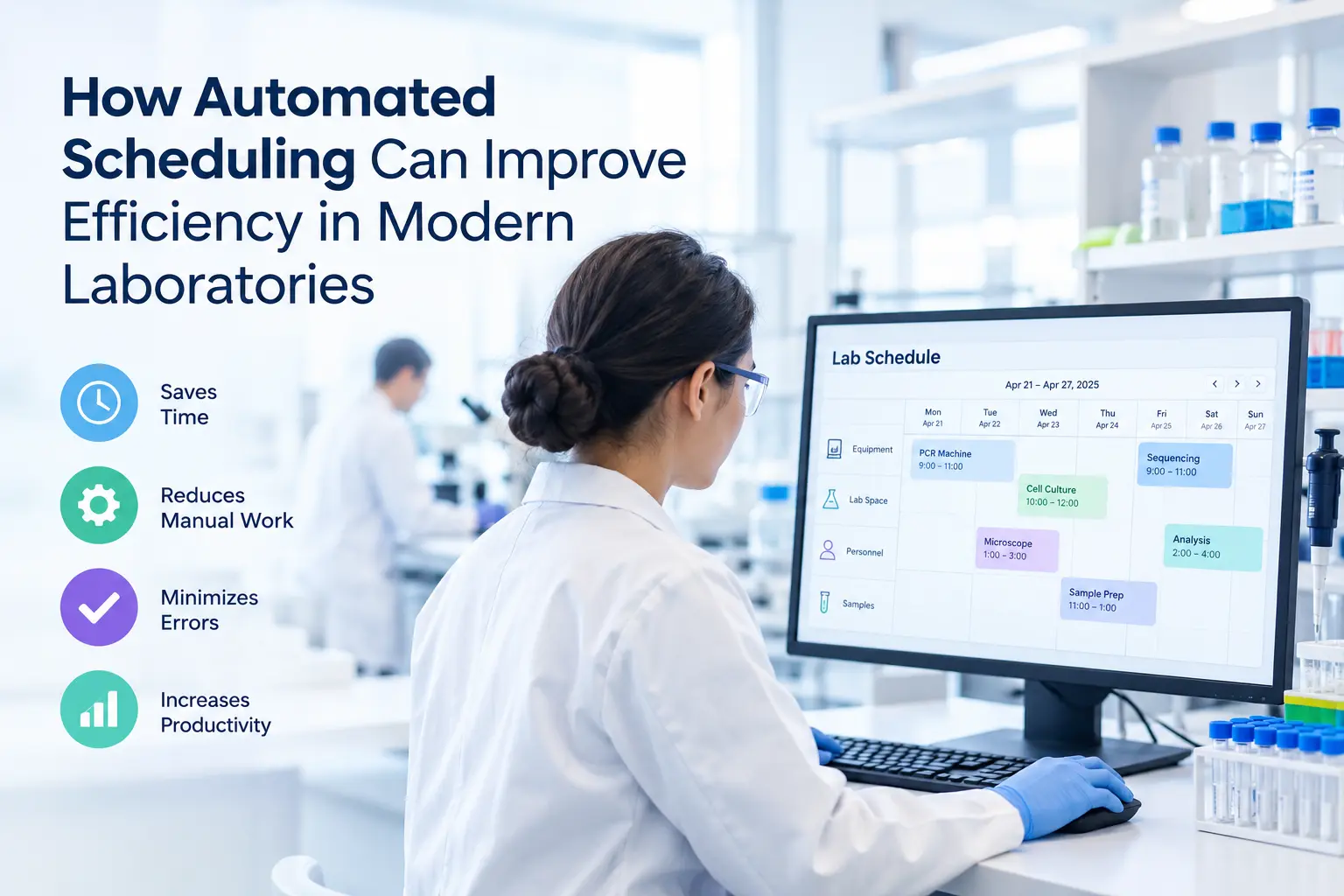
Walk into a busy research lab late on a Thursday and you can usually spot the bottleneck without asking anyone. It is not the liquid handler, which has sat idle for ninety minutes. It is the whiteboard by the door, covered in half-erased run times, with two people arguing quietly about who gets the incubator next.
Labs have spent a decade buying excellent instruments. Fewer have bought a way to make those instruments cooperate. Each robot runs beautifully in isolation, yet the gaps between runs quietly swallow whole afternoons, and the cost of that lost time rarely lands on anyone’s budget line.
Automated scheduling is the unglamorous fix. Rather than having humans broker access to shared resources, a scheduler holds a live model of every device, every consumable and every pending protocol, then builds a plan that keeps hardware busy and keeps people out of each other’s way.
Where Laboratory Time Actually Disappears
Ask a lab manager where throughput is lost and you will usually hear about instrument speed. Measure it and a different picture emerges. A plate sits in a stacker because the reader is mid-run for another project. A technician finishes sample prep at noon and waits until two because nobody flagged the centrifuge queue. An overnight run ends at 3 a.m., then the plates sit at room temperature until someone arrives.
None of those are equipment failures. They are coordination failures, and they scale badly: add a second robot and you have not doubled capacity, you have doubled the number of ways two experiments can collide. NIST has put the problem plainly, noting that scientific instrumentation was designed around human operators for most of the past century, and that the move toward machine control has been mired by fragile hacks rather than robust interfaces.
What a Scheduler Does Differently
A scheduler treats the lab as one system with finite resources instead of a corridor of independent machines. Given a protocol, it reasons about which devices are free, how long each step takes, which steps are time-critical and which can slip. Work gets sequenced so a run starts only when everything it needs will be available at the moment it is needed.
Good lab automation scheduling software goes further and handles the messy parts: priority overrides when an urgent sample arrives, dynamic rescheduling when an instrument errors out mid-run, consumable tracking so a plan does not collapse because the tip boxes emptied. Because the whole picture lives in one place, a scientist can see what Tuesday will look like rather than guess at it.
Why Coordination Is the Real Multiplier
The clearest evidence comes from facilities that treat orchestration as infrastructure. NCATS, part of the National Institutes of Health, runs a primary screening system with three robotic arms and storage for more than three million compound wells. What makes that work is not the arm count. Center staff built custom software to monitor and control the system and to archive the complete process history of every screen in real time.
Standardization carries part of the load. The microplate dimensions maintained by SLAS exist because inconsistent labware kept causing problems on robotics and automated instrumentation, and predictable physical interfaces are what let a scheduler make promises it can keep. Get the labware and the orchestration layer right together, and the same hardware absorbs more work, because software finds slack no human planner can hold in their head.
Making the Shift Without Stalling the Lab
Teams that adopt scheduling well tend to start narrow. Pick the two or three workflows competing for the same contested instrument, model those properly, and let the scheduler own them for a month. Resist encoding every protocol at once, since a half-accurate model produces plans nobody trusts, and plans nobody trusts get overridden until the whiteboard comes back.
Data discipline matters as much as the software itself. Step durations have to reflect reality rather than the optimistic figures in the original SOP, and somebody needs to own the model as instruments arrive and retire. That same emphasis on the coordination layer now shows up far beyond the bench, including in the automated monitoring systems pharmaceutical teams use to catch rare safety signals.
Efficiency in a modern lab is rarely a hardware problem anymore. The instruments are fast, the assays are robust, the people are capable. What tends to be missing is a shared, current, machine-readable answer to one plain question: what is running where, and what happens next.
Automated scheduling supplies that answer, and the payoff arrives in forms that are easy to feel and slightly awkward to quantify. Fewer idle hours. Fewer collisions between teams. Fewer experiments repeated because a plate sat too long. Staff spending their attention on interpretation instead of logistics.
None of that demands a cloud lab or a robotics overhaul. It demands deciding that coordination is a system worth building on purpose, then letting software hold the schedule no whiteboard ever really could.