What “For Research Use Only” Actually Means on a Label
Some products sold online are not meant for people or animals. They carry a short line, often in small print: for laboratory research use only. Behind that sentence sits a vocabulary most buyers have never had explained to them. Here is what those words mean, so a product page makes sense the next time you read one.
The phrase itself
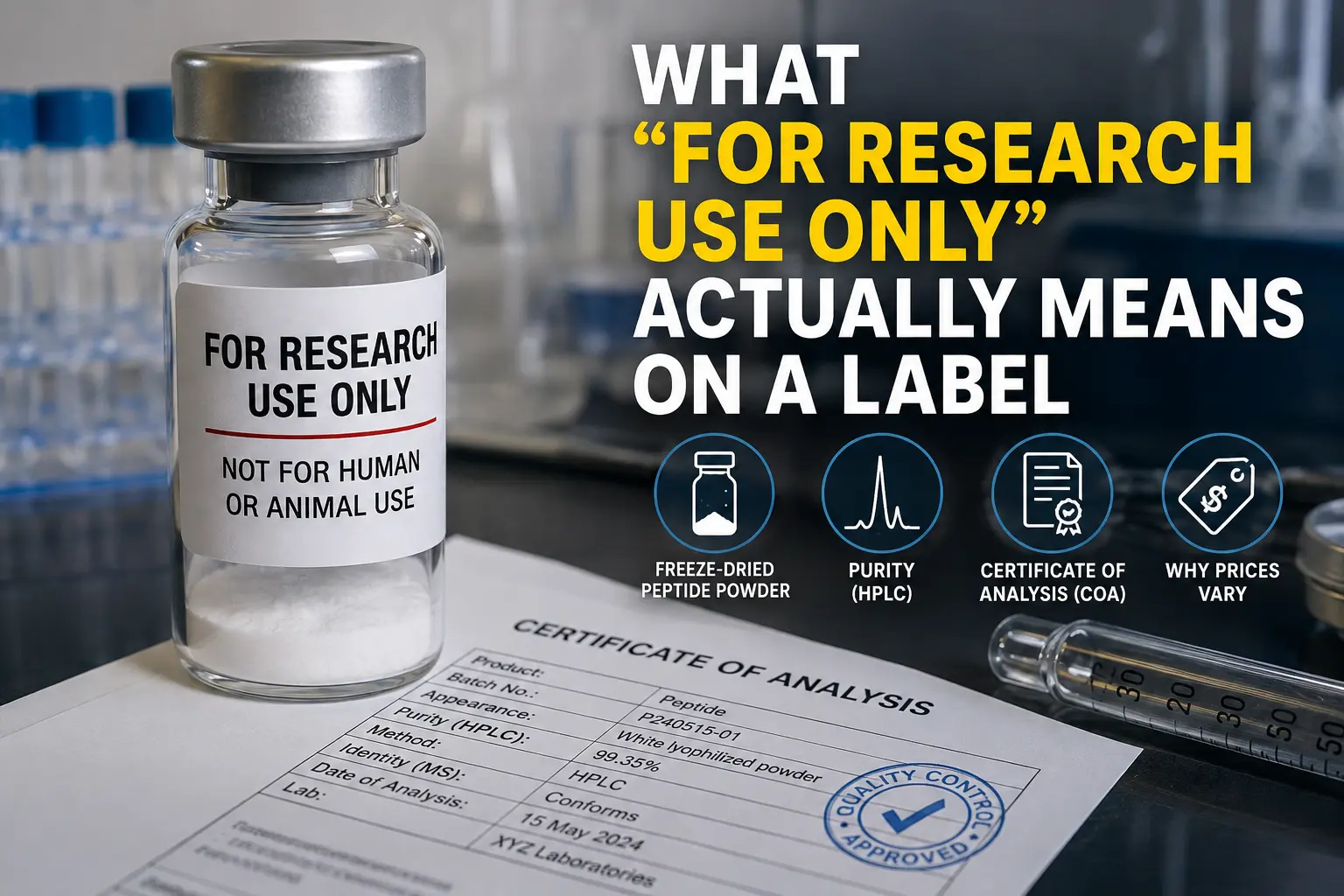
It means what it says. The product is supplied as laboratory material, not as something anyone consumes. It is not a food, not a supplement, and not intended for humans or animals. A vial like this is bench stock, in the same way a solvent is. It exists to produce data.
That line is not decoration. It sets the frame the product is made, described and sold in, and a seller who takes it seriously will describe the contents plainly rather than promising outcomes.
Freeze-dried powder
Most of these molecules are peptides, which are short chains of amino acids, the building blocks that make up proteins. They usually arrive as a lyophilised powder.
Lyophilisation is freeze-drying, the same process behind instant coffee and camping food. The material is frozen, then the water is drawn off under vacuum. What remains is a small white mass, sometimes so light you can barely see it against the glass. These molecules are fragile in liquid and far more stable dry, which is why they are shipped this way.
One thing that confuses people: the milligram figure on the label refers to the weight of the material, not to how much of the vial it fills. A vial that looks almost empty is normal.
What a purity number tells you
HPLC stands for high performance liquid chromatography. A sample is pushed through a column that separates its components, and a detector traces what comes out. The large peak is the expected molecule. The small peaks beside it are impurities.
A stated purity of 99 percent or higher means that main peak accounts for at least 99 percent of the measured area. That is useful, but it is only half the picture. It gives you a proportion, not an identity. Confirming what the molecule actually is falls to mass spectrometry, which measures molecular weight.
Reading a certificate of analysis
The certificate of analysis, usually shortened to CoA, collects those measurements in one place: identity, purity, batch number, date. It is the identity document for a specific batch, and a serious supplier will provide it on request.
The catch is that it belongs to one batch. It says nothing about the vial in your hand if the batch numbers do not match. Three checks are enough:
- the batch number on the document matches the one on the vial
- the laboratory that ran the analysis is named
- the date of the analysis is printed on it
Why prices vary so much
For the same quantity, prices can differ enormously, and there are reasons. Synthesising a long chain costs more than a short one. Testing every batch is a recurring expense that not every supplier takes on. Packaging, cold storage and shipping all add up, and a fast dispatch from inside the European Union avoids long transit times but costs more than a parcel sent from far away.
A low price is not suspicious on its own. It simply raises a question worth asking: what was removed from the process to reach it?
Putting it together
The physical form, the purity figure and a certificate tied to the right batch tell you far more about what is in a vial than any description does. If the terminology is unfamiliar, a plain-language glossary of the terms is a reasonable place to start.