FSH Levels: Normal Ranges, High and Low FSH, and What Your Results Mean
Follicle-stimulating hormone, or FSH, is a hormone made by the pituitary gland that helps control the ovaries in women and the testes in men. If you’re looking at a lab report with an FSH number on it, the short answer is this: there is no single “normal” FSH level for everyone. What counts as normal depends on your age, your sex, where you are in your menstrual cycle if you have one, whether you’re pregnant or past menopause, and the reference range printed by the specific lab that ran your test.
That’s not a dodge, it’s how FSH actually works. A result of 9 IU/L might be unremarkable in the follicular phase of a 28-year-old’s cycle and would be very low for someone who is postmenopausal. This article walks through normal ranges by age and stage, what a high or low FSH level can mean, how FSH relates to fertility and menopause, what happens to FSH during pregnancy, how FSH compares with LH and AMH, and a practical framework for reading your own results.
FSH Levels: At a Glance
FSH results must be interpreted according to age, sex, menstrual-cycle phase, pregnancy or menopause status, and your laboratory’s reference range.
| Key Point | What to Know |
|---|---|
| What is FSH? | Follicle-stimulating hormone (FSH) is produced by the pituitary gland and helps regulate ovarian follicle development and estrogen production in females and sperm production in males. |
| Follicular phase | 2.9–14.6 IU/L — Mayo Clinic Laboratories reference interval. |
| Midcycle | 4.7–23.2 IU/L — Mayo Clinic Laboratories reference interval. |
| Luteal phase | 1.4–8.9 IU/L — Mayo Clinic Laboratories reference interval. |
| Postmenopause | 16.0–157.0 IU/L — Mayo Clinic Laboratories reference interval. |
| When to test for fertility | FSH is commonly measured during the early follicular phase, often around cycle days 2–4, depending on the clinical evaluation. |
| High FSH | May be associated with menopause, perimenopause, primary ovarian insufficiency, reduced ovarian function, or impaired testicular function, depending on the clinical context. |
| Low FSH | May occur with pregnancy, hypothalamic or pituitary disorders, significant undernutrition, rapid weight loss, or excessive exercise. |
| FSH and fertility | There is no FSH level that guarantees or rules out pregnancy. FSH is only one part of a broader fertility assessment. |
| FSH and menopause | FSH generally rises as ovarian function declines, but fluctuating FSH during perimenopause means one test cannot reliably confirm menopause. |
| FSH during pregnancy | FSH is normally low during pregnancy. Pregnancy is diagnosed using hCG, not FSH. |
| Most important point | Do not interpret FSH by the number alone. Always compare it with your laboratory’s reference range and consider your age, cycle day, reproductive stage, symptoms, and related hormone results. |
What Is FSH?
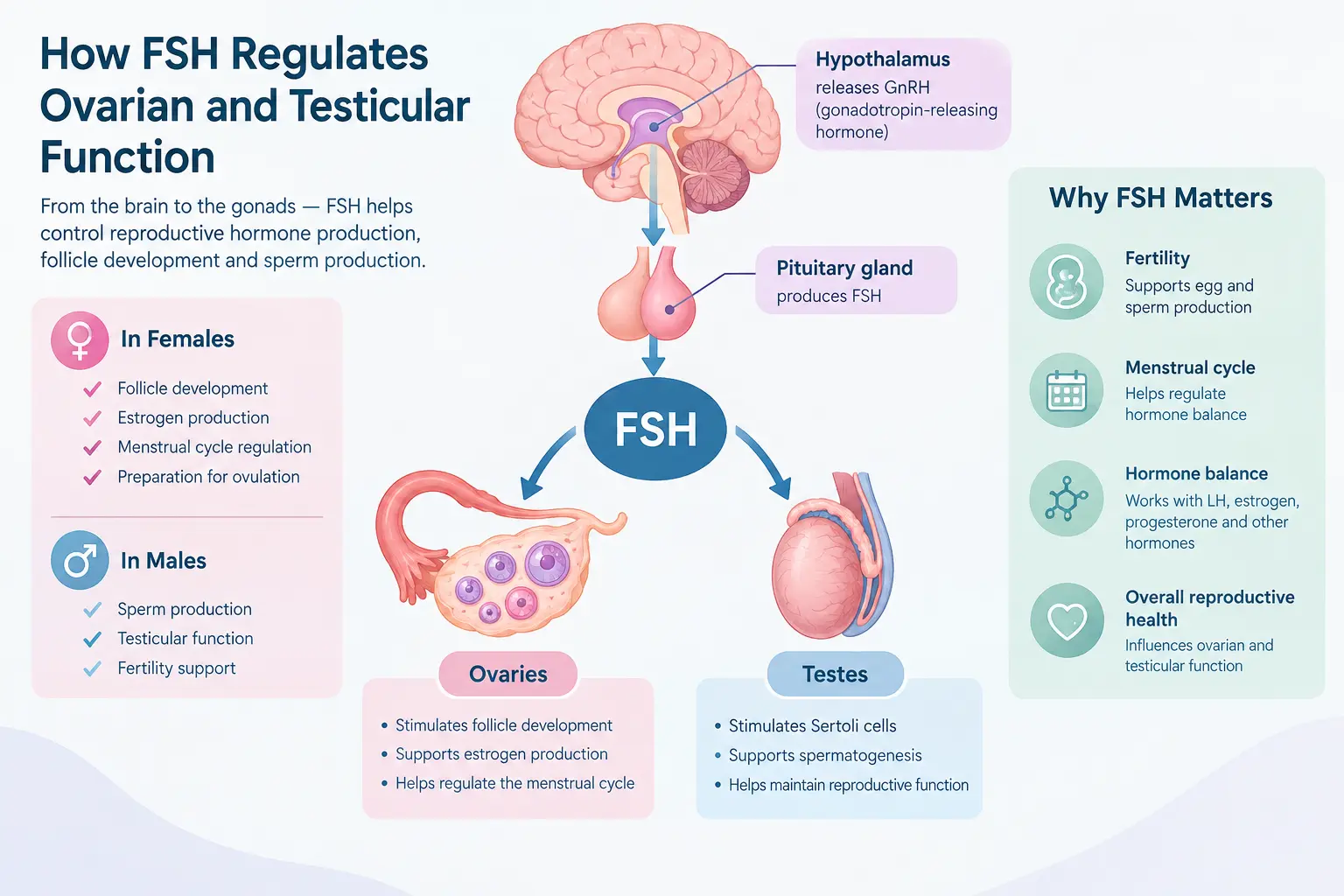
FSH belongs to a family of hormones called gonadotropins. It’s produced in the pituitary gland, a pea-sized gland at the base of the brain, and it travels through the bloodstream to act on the ovaries or testes. FSH doesn’t work alone as it’s the part of a signaling loop called the hypothalamic-pituitary-gonadal (HPG) axis.
What does FSH stand for?
FSH stands for follicle-stimulating hormone. The name comes from its main job in females: stimulating the growth of ovarian follicles, the small fluid-filled sacs that each contain an immature egg.
Where is FSH produced?
FSH is made and released by the anterior pituitary gland. The hypothalamus, a region just above the pituitary, releases gonadotropin-releasing hormone (GnRH) in pulses. GnRH signals the pituitary to release FSH and a related hormone, luteinizing hormone (LH). FSH and LH then travel to the ovaries or testes, where they trigger hormone production and reproductive cell development. Hormones made by the gonads including estrogen, progesterone, testosterone, and inhibin feed back to the hypothalamus and pituitary to adjust how much FSH is released. This feedback loop is why FSH rises and falls in predictable (and sometimes unpredictable) patterns over a lifetime.
What does FSH do in females?
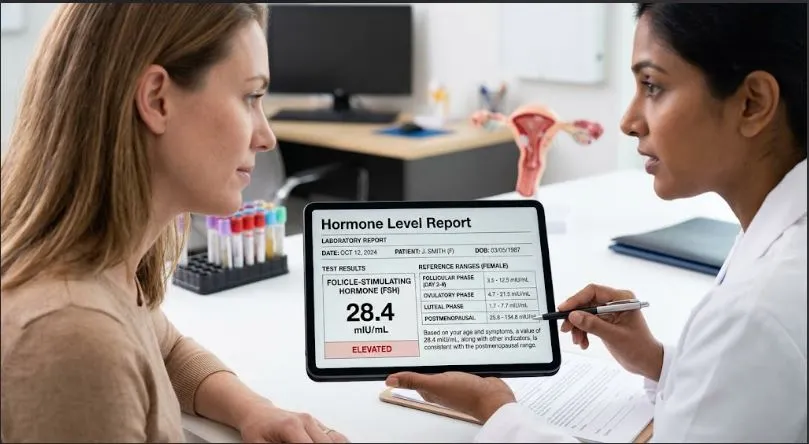
In people who menstruate, FSH:
- Stimulates a group of ovarian follicles to begin growing each cycle
- Supports the follicles’ production of estrogen (specifically estradiol)
- Helps select the single dominant follicle that will eventually release an egg
- Works together with LH to prepare the body for ovulation
As estrogen and a hormone called inhibin rise from the growing follicle, they signal the pituitary to taper FSH output — one of several feedback loops that shape the menstrual cycle.
What does FSH do in males?
In males, FSH acts on structures in the testes called Sertoli cells. These cells support and nourish developing sperm cells. FSH is essential for starting and maintaining spermatogenesis, the process of sperm production, and it works alongside LH, which stimulates testosterone production in the testes’ Leydig cells. Reduced or elevated FSH in men is often evaluated together with testosterone and semen analysis rather than in isolation.
FSH Normal Range: What Is a Normal FSH Level?
There is no single FSH number that is normal for every person. A “normal” FSH range depends on age, sex, menstrual-cycle phase, pregnancy status, menopause status, and the specific laboratory and assay used to measure it. Reputable sources intentionally publish several different ranges rather than one, because combining them into a single number would be misleading.
Normal FSH levels in females
The table below reflects one commonly cited reference source — Mayo Clinic Laboratories’ serum FSH reference intervals — which breaks results down by menstrual-cycle phase and by Tanner stage (a scale used to describe physical stages of puberty).
| Reproductive stage | FSH reference interval | Source population |
|---|---|---|
| Tanner Stage I (prepuberty) | 0.6–4.1 IU/L | Mayo Clinic Laboratories |
| Tanner Stage II–IV (puberty) | roughly 0.1–7.2 IU/L (varies by stage) | Mayo Clinic Laboratories |
| Tanner Stage V (adult) | 0.4–8.6 IU/L | Mayo Clinic Laboratories |
| Follicular phase | 2.9–14.6 IU/L | Mayo Clinic Laboratories |
| Midcycle | 4.7–23.2 IU/L | Mayo Clinic Laboratories |
| Luteal phase | 1.4–8.9 IU/L | Mayo Clinic Laboratories |
| Postmenopausal | 16.0–157.0 IU/L | Mayo Clinic Laboratories |
Reference intervals vary by laboratory and testing method. These specific numbers come from Mayo Clinic Laboratories’ serum FSH test catalog and apply to the assay used there. Your own lab report may show different cutoffs even for the same phase, which is normal and explained further below.
Cleveland Clinic publishes a similarly structured but numerically different set of pediatric and adult ranges, which is a good illustration of why two reputable sources rarely match exactly — they’re often built on different assay platforms and reference populations.
Normal FSH levels in males
Male FSH doesn’t have a cycle-phase component, but it does change substantially with age and pubertal development:
| Stage | General pattern |
|---|---|
| Prepuberty | Low, near the lower limit of the assay |
| Puberty (Tanner stages II–V) | Rises progressively as puberty advances |
| Adulthood | Relatively stable, roughly in the low single digits to low teens (IU/L), varying by lab |
Because male FSH doesn’t shift with a monthly cycle, a single measurement is usually more directly interpretable than in women — but it’s still compared against the ordering lab’s adult male reference range, not a number from a different source.
Normal FSH Levels by Age Chart
Age matters for FSH, but age isn’t the whole story — reproductive stage is what actually drives the hormone pattern. Two 45-year-olds can have very different expected FSH levels depending on whether one still has regular periods and the other is in perimenopause. A chart organized strictly by birthday would be misleading, so the ranges below are organized by life stage, with typical age windows noted.
FSH levels by age in females
| Life stage | Typical age range | What tends to happen to FSH |
|---|---|---|
| Childhood | Birth–~8–9 years | Very low, near the bottom of the assay’s detection range |
| Puberty | Roughly 8–14 years | Gradual rise across Tanner stages as the reproductive system matures |
| Reproductive years | Late teens–~40s | Cycles between low and higher values each month (follicular, midcycle, luteal) |
| Perimenopause | Typically 40s | Increasingly variable; may fluctuate between normal reproductive-range and higher values as ovarian function becomes less predictable |
| Postmenopause | Usually after 45–55 | Persistently elevated compared with the reproductive years |
FSH levels by age in males
| Life stage | Typical age range | What tends to happen to FSH |
|---|---|---|
| Childhood | Birth–~9–10 years | Low |
| Puberty | Roughly 9–14 years | Rises as testes mature through Tanner stages |
| Adulthood | Late teens onward | Generally stable, without the cyclical monthly pattern seen in women |
Tanner staging is more useful than chronological age alone for interpreting FSH during puberty, since children can enter puberty at different ages within a wide but normal window.
Normal FSH and LH Levels by Age
FSH and LH are both gonadotropins released by the pituitary, and they’re frequently tested together. They rise and fall in related but not identical patterns — one can be elevated while the other remains closer to its usual range, which is itself diagnostically useful information.
| Life stage | FSH pattern | LH pattern | General meaning |
|---|---|---|---|
| Before puberty | Low | Low | Both gonadotropins are largely quiet until the hypothalamic-pituitary-gonadal axis activates |
| During puberty | Rising | Rising, often with LH increasing at night first | Reflects reactivation of GnRH pulsing that drives pubertal development |
| Reproductive years (females) | Cycles monthly, peaks at midcycle | Sharp LH surge just before ovulation | Coordinated signaling that triggers ovulation |
| Reproductive years (males) | Relatively stable | Relatively stable | Supports ongoing spermatogenesis and testosterone production |
| Menopause/postmenopause | Elevated, often markedly | Elevated (commonly above roughly 40 IU/L, per Mayo Clinic Laboratories’ LH reference data) | Reduced ovarian hormone production removes the feedback that normally restrains the pituitary |
Don’t assume FSH and LH always move by the same amount. In some conditions — such as certain patterns seen in polycystic ovary syndrome (PCOS) — LH can be elevated relative to FSH without both hormones moving in lockstep. More on that in the FSH vs. LH section below.
Normal FSH and LH before puberty
Both hormones are typically low, reflecting a quiet HPG axis. Some pulsatile activity does occur, especially overnight, but overall levels stay near the bottom of the assay range.
Normal FSH and LH during puberty
As puberty begins, nighttime LH pulses often increase first, followed by daytime elevations in both FSH and LH. This progression, along with physical Tanner staging, is part of how clinicians confirm that puberty is progressing typically.
Normal FSH and LH during the reproductive years
In women, FSH and LH both rise and fall across the menstrual cycle, with a distinct LH surge that triggers ovulation. In men, both hormones stay comparatively steady day to day.
Normal FSH and LH around menopause
As ovarian follicles decline, estrogen and inhibin production drops, removing the negative feedback that normally holds FSH and LH in check. Both hormones typically rise, often substantially, though the timing and degree of the rise vary between individuals during perimenopause.
FSH Levels During the Menstrual Cycle
FSH isn’t a flat number in people who menstruate it shifts across the cycle as part of the process that leads to ovulation.
FSH during the follicular phase
FSH rises in the early follicular phase to recruit a group of ovarian follicles. As one follicle becomes dominant and produces more estrogen, FSH typically begins to decline.
FSH around ovulation
A brief FSH rise accompanies the LH surge at midcycle, contributing to the final maturation and release of the egg.
FSH during the luteal phase
After ovulation, FSH generally falls to its lowest levels of the cycle while progesterone from the corpus luteum dominates, then begins to rise again as the next cycle approaches if pregnancy doesn’t occur.
Why FSH changes throughout the cycle
This rhythm is driven by feedback between the ovaries and the brain. Rising estradiol and inhibin from developing follicles suppress pituitary FSH release; falling estradiol and inhibin (as in the late luteal phase, without pregnancy) reduce that suppression and allow FSH to climb again, restarting the cycle.
What day should FSH be tested?
For fertility evaluations, FSH is often measured early in the cycle — commonly around cycle day 2, 3, or 4 (day 1 being the first day of full menstrual flow). This early-follicular window is used because it reflects the baseline signaling environment before a dominant follicle has started suppressing FSH, which can make results easier to interpret consistently between cycles. Not every woman needs day-3 testing specifically; the exact timing a clinician requests can depend on the reason for testing and the overall evaluation plan.
What Is a Normal FSH Level to Get Pregnant?
There is no single FSH number that guarantees or rules out pregnancy. FSH is one piece of a fertility evaluation, not a standalone predictor. Age, ovulatory function, the health of the fallopian tubes and uterus, sperm quality, and overall reproductive history all matter alongside any hormone result.
Is there one FSH level that guarantees fertility?
No. Even a favorable early-follicular FSH result doesn’t guarantee conception, and an elevated result doesn’t mean pregnancy is impossible. FSH is best understood as one input into a broader clinical picture.
What FSH level is considered favorable for fertility?
Clinicians generally look for an early-follicular FSH that falls within the lab’s normal reproductive-age reference range, often considered alongside estradiol (to make sure FSH isn’t being artificially suppressed by an early estrogen rise) and sometimes AMH or antral follicle count. There isn’t one universal cutoff that applies across all labs and assays, which is why your own provider’s interpretation — using your lab’s specific reference range — matters more than comparing your number to a figure from a different website.
What does day-3 FSH mean?
A day-3 (early-follicular) FSH test is meant to capture FSH before cycle-related hormone shifts complicate the picture. It has traditionally been used as one marker in ovarian reserve testing, though it’s increasingly interpreted alongside AMH and antral follicle count rather than by itself, since a single FSH value can vary somewhat from cycle to cycle.
Can you get pregnant with high FSH?
An elevated FSH level can be associated with reduced ovarian function, but it does not, by itself, establish that pregnancy is impossible. Some people with higher FSH values still ovulate and conceive, sometimes with assistance and sometimes without. High FSH is a signal that warrants a fuller fertility evaluation, not a verdict.
Does high FSH mean low ovarian reserve?
Elevated FSH can be one indicator associated with diminished ovarian reserve, particularly when seen together with a low AMH and a low antral follicle count. However, FSH alone doesn’t measure egg quality, and ovarian reserve testing in general estimates egg quantity-related signals rather than the chance of a successful pregnancy. Reserve, quality, and fertility are related but distinct concepts, discussed further below.
What Is a High FSH Level?
A high FSH level means the amount of follicle-stimulating hormone in the blood is above the reference interval used for that person’s age, sex, reproductive stage, or cycle phase. What counts as “high” is entirely dependent on that context — an FSH of 20 IU/L would be unremarkable after menopause but would be considered high during the follicular phase of a reproductive-age woman’s cycle.
High FSH in females
Elevated FSH in women can be associated with:
- Perimenopause or menopause, as ovarian hormone production declines
- Primary ovarian insufficiency (POI), sometimes called premature ovarian failure, in which the ovaries stop functioning typically before age 40
- Other forms of reduced ovarian function or ovarian damage, including from certain autoimmune conditions
- Certain genetic conditions, such as Turner syndrome
- Ovarian damage related to chemotherapy or radiation treatment
Clinical guidance from the American College of Obstetricians and Gynecologists (ACOG) notes that primary ovarian insufficiency is generally evaluated using an FSH in the menopausal range (often cited as roughly above 30–40 mIU/mL, depending on the laboratory) confirmed on more than one occasion at least a month apart, together with low estradiol, in a woman under 40 with several months of irregular or absent periods. A single high reading is not, by itself, treated as a diagnosis.
High FSH in males
In men, elevated FSH can be associated with impaired testicular function or impaired sperm production, sometimes called primary testicular failure. Possible contributors include testicular injury, certain genetic conditions such as Klinefelter syndrome, prior chemotherapy or radiation, and other causes of reduced Sertoli cell function.
Can FSH be temporarily high?
Yes. Because FSH is released in pulses and can be influenced by the timing of the menstrual cycle, recent medication use, or lab-to-lab assay variation, a single elevated result sometimes doesn’t hold up on repeat testing. This is part of why conditions like primary ovarian insufficiency require confirmation on more than one occasion rather than a single blood draw.
Symptoms of High FSH
FSH itself doesn’t directly cause most of the symptoms associated with a high result. Symptoms usually come from the underlying hormonal shift — most often a drop in estrogen or testosterone — that led FSH to rise in the first place.
Symptoms associated with high FSH in women
Depending on the underlying cause, women with elevated FSH may notice:
- Irregular periods, or periods that become farther apart
- Missed periods or amenorrhea
- Hot flashes or night sweats
- Vaginal dryness
- Difficulty conceiving
Not everyone with high FSH has noticeable symptoms, and these symptoms can also occur with other conditions unrelated to FSH.
Symptoms associated with high FSH in men
Men with elevated FSH related to impaired testicular function may notice reduced fertility, changes in semen analysis findings, or symptoms of low testosterone such as reduced energy or reduced libido, depending on the underlying cause.
When high FSH needs medical evaluation
A high FSH result generally warrants a conversation with a healthcare provider when it’s accompanied by irregular or absent periods, unexplained infertility, menopausal-type symptoms at an unexpectedly young age, or when it appears on more than one test. A clinician can help determine whether repeat testing, additional hormone panels, or referral to a reproductive endocrinologist makes sense.
What Is a Low FSH Level?
A low FSH level means the amount of FSH in the blood falls below the expected range for that person’s age, sex, and reproductive context. Low FSH can occur with hypothalamic or pituitary dysfunction, but it can also occur in other situations — including normal pregnancy — so the result needs clinical context rather than an automatic assumption that something is wrong.
Possible associations with low FSH include:
- Hypothalamic dysfunction, including hypothalamic amenorrhea
- Pituitary gland dysfunction
- Significant undernutrition or rapid weight loss
- Excessive or intense exercise relative to caloric intake
- Pregnancy (a physiologically expected pattern, not a disorder)
- Certain other reproductive hormone disorders
Symptoms of Low FSH
As with high FSH, most symptoms trace back to the downstream effect on estrogen or testosterone production rather than to FSH itself.
Symptoms of low FSH in females
Possible symptoms include irregular or absent periods, difficulty ovulating, difficulty conceiving, and, if estrogen is also low, symptoms such as vaginal dryness or changes in bone density over time.
Symptoms of low FSH in males
Possible symptoms include impaired sperm production, infertility, and other symptoms related to broader reproductive hormone dysfunction, such as reduced libido or fatigue, depending on the cause.
What can cause low FSH?
Low FSH is often related to reduced signaling from the hypothalamus or pituitary — sometimes described as secondary or central hypogonadism — rather than a problem in the ovaries or testes themselves. Nutritional status, extreme exercise, high stress, certain medications, and pituitary or hypothalamic conditions can all play a role.
Low FSH Levels in Females
Low FSH in women is often evaluated together with LH, estradiol, prolactin, and thyroid-stimulating hormone (TSH), because several conditions can produce a similar low-FSH pattern.
Common contexts include:
- Hypothalamic amenorrhea — often related to significant weight loss, very high exercise volume relative to intake, or high physical or psychological stress, which suppresses GnRH pulsing
- Pituitary disorders — including tumors or other conditions that reduce the pituitary’s ability to release FSH and LH
- Undernutrition or rapid weight loss — which can suppress the reproductive axis as an energy-conservation response
- Pregnancy — a normal, expected suppression of typical cycling FSH patterns
Interpreting low FSH almost always benefits from looking at the fuller hormone panel rather than the FSH value in isolation, since a low FSH with a low LH and low estradiol points toward a hypothalamic or pituitary cause, while other combinations point elsewhere.
High FSH Levels in Females
High FSH in women deserves its own closer look because it’s one of the more common reasons people search for this topic.
Associations include:
- Perimenopause, when ovarian function becomes less predictable
- Menopause, when ovarian follicle activity has substantially declined
- Primary ovarian insufficiency, when this pattern occurs before age 40
- Other causes of diminished or damaged ovarian function
- Certain genetic conditions, such as Turner syndrome
- Ovarian damage related to cancer treatment
Does high FSH always mean menopause?
No. Perimenopause — the transition leading up to menopause — is defined by fluctuating hormone levels, not a steady climb. FSH can be elevated on one test and closer to the reproductive range on another during this transition, which is one reason a single FSH result isn’t used on its own to declare that someone has reached menopause.
FSH Levels and Menopause
FSH is closely tied to the menopause transition because it reflects declining ovarian hormone output, but the relationship is more nuanced than “high FSH equals menopause.”
FSH levels during perimenopause
During perimenopause, estrogen and FSH can both fluctuate — sometimes considerably — from one cycle to the next as ovarian follicle activity becomes irregular. A woman in this phase might have one FSH result in a postmenopausal-type range and a lower result weeks or months later.
FSH levels after menopause
After menopause, when ovarian follicle activity has substantially and persistently declined, FSH is generally and consistently elevated compared with typical reproductive-age values, since the estrogen and inhibin feedback that normally restrains pituitary FSH release is much reduced.
FSH level chart for menopause
| Reproductive stage | FSH reference interval (Mayo Clinic Laboratories) |
|---|---|
| Follicular phase | 2.9–14.6 IU/L |
| Luteal phase | 1.4–8.9 IU/L |
| Postmenopausal | 16.0–157.0 IU/L |
These figures come from a single laboratory’s assay and are provided for context, not as a universal diagnostic threshold. Other laboratories publish different postmenopausal intervals using different assay platforms, which is normal and expected.
What FSH level indicates menopause?
There isn’t one universal FSH cutoff that “indicates menopause” across every lab and every person. Clinically, menopause is generally recognized after 12 consecutive months without a period in someone of typical menopausal age, based on menstrual history rather than a lab value. FSH testing is sometimes used in specific situations — for example, in younger women with irregular periods, or after a hysterectomy when menstrual bleeding can no longer be tracked — where a persistently elevated, postmenopausal-range FSH supports the clinical picture.
Can one FSH test confirm menopause?
Not reliably on its own. Because FSH fluctuates during perimenopause, a single test can be misleading in either direction. Clinicians typically weigh FSH alongside age, symptoms, and menstrual history rather than treating one lab value as definitive.
Why FSH fluctuates during perimenopause
As the number of remaining ovarian follicles declines and their responsiveness becomes less consistent, estrogen and inhibin production becomes erratic rather than steadily falling. Because these hormones normally suppress pituitary FSH release, an erratic ovarian signal produces an erratic FSH pattern — sometimes high, sometimes closer to typical reproductive-age levels, even within the same few months.
FSH Level in Pregnancy
Pregnancy changes the entire hormonal picture, and FSH is no exception.
What happens to FSH during pregnancy?
Once pregnancy is established, ongoing high levels of estrogen, progesterone, and human chorionic gonadotropin (hCG) suppress the usual pituitary release of FSH and LH. This keeps the ovaries from starting a new cycle or releasing another egg during pregnancy.
Is FSH normally high or low during pregnancy?
FSH is normally low during pregnancy, reflecting this suppression of the usual monthly cycling pattern.
Does an FSH test diagnose pregnancy?
No. Pregnancy is diagnosed using hCG testing either a urine or blood test not FSH. If you’re wondering whether you might be pregnant, an hCG test is the appropriate first step; you can check your hCG numbers using DecidualCast‘s hCG calculator if you already have blood test results.
What does low FSH during pregnancy mean?
Low FSH in pregnancy is the expected, physiologically normal pattern rather than a sign of a problem. This is exactly why ordinary follicular- or luteal-phase FSH reference ranges don’t apply to a pregnancy blood draw — the reproductive hormone environment is fundamentally different.
FSH vs LH: What’s the Difference?
FSH and LH are both pituitary gonadotropins, but they act on different steps of reproduction.
| Hormone | Full name | Primary role in females | Primary role in males | Common clinical uses |
|---|---|---|---|---|
| FSH | Follicle-stimulating hormone | Stimulates follicle growth and estrogen production | Supports Sertoli cell function and sperm production | Fertility evaluation, ovarian reserve context, menopause-related evaluation, puberty assessment |
| LH | Luteinizing hormone | Triggers ovulation; supports corpus luteum function | Stimulates testosterone production in Leydig cells | Ovulation timing (including at-home ovulation predictor kits), fertility evaluation, puberty assessment, evaluating gonadotropin patterns in PCOS or hypogonadism |
Why are FSH and LH tested together?
Because they’re both produced by the pituitary and respond to similar feedback signals, comparing FSH and LH together often gives more diagnostic information than either hormone alone — for example, whether both are elevated, both are low, or one is disproportionately higher than the other.
What does high FSH and high LH mean?
When both are elevated, it typically points toward reduced function at the level of the ovaries or testes (sometimes called primary or hypergonadotropic hypogonadism), since the pituitary is increasing output in response to reduced feedback from the gonads.
What does low FSH and low LH mean?
When both are low, it typically points toward reduced signaling from the hypothalamus or pituitary itself (sometimes called secondary or hypogonadotropic hypogonadism) rather than a problem originating in the ovaries or testes.
What does high LH with normal FSH mean?
This pattern is sometimes seen in evaluations related to PCOS, among other conditions. However, an elevated LH:FSH ratio is not, by itself, a diagnostic test for PCOS. Current diagnostic criteria for PCOS rely on a combination of clinical features — such as irregular ovulation, signs of elevated androgens, and ultrasound findings — rather than a single hormone ratio.
FSH vs AMH: Which Is Better for Ovarian Reserve?
Ovarian reserve testing typically draws on more than one marker, because no single test tells the whole story.
- FSH reflects pituitary-ovarian feedback and can rise as ovarian reserve declines, but it fluctuates cycle to cycle and is usually measured early in the follicular phase.
- AMH (anti-Müllerian hormone) is produced by small ovarian follicles and tends to be more stable across the cycle than FSH, making it a commonly used marker of the remaining follicle pool.
- Antral follicle count (AFC), measured by ultrasound, directly counts small follicles visible in the ovaries at a given point in the cycle.
- Estradiol is often measured alongside FSH to check that FSH isn’t being artificially suppressed by an early rise in estrogen.
No single ovarian-reserve test provides a complete picture of fertility. These markers estimate something about the quantity of remaining follicles, not egg quality, and none of them directly measures the chance of a successful pregnancy. Age remains one of the strongest independent factors in natural fertility, alongside ovulatory function, tubal and uterine anatomy, and sperm factors. AMH or FSH results are best interpreted by a clinician within that broader picture rather than read as a stand-alone verdict.
How Is an FSH Test Done?
FSH is measured with a standard blood draw, usually from a vein in the arm, and analyzed in a laboratory. For women being evaluated for fertility or ovarian reserve, the sample is often collected on a specific early cycle day (commonly day 2–4). Fasting generally isn’t required for FSH alone, though your provider may ask you to fast if other tests are being drawn at the same time. Results are typically reported in international units per liter (IU/L) or milli-international units per milliliter (mIU/mL) — these units are numerically equivalent for FSH, so a value of “10” means the same thing whichever unit is printed on your report. Depending on the reason for testing, a clinician may also order LH, estradiol, AMH, prolactin, TSH, or testosterone at the same time.
Can you test FSH at home?
Some at-home test kits measure FSH in urine, often marketed as home menopause tests. These can detect a rise in FSH but are generally less precise than a laboratory blood test, and a positive or negative home result isn’t a substitute for clinical evaluation. Urine FSH tests shouldn’t be treated as a complete fertility or menopause diagnosis on their own; if you get an unexpected result, following up with a healthcare provider and a blood test is a reasonable next step.
How to Read Your FSH Test Results
Here’s a practical framework for making sense of your own report.
Step 1: Check the unit. Confirm whether your result is reported in IU/L or mIU/mL. For FSH, these units are numerically interchangeable, but it’s worth double-checking you’re not accidentally comparing your number against a range reported in a different unit or for a different hormone.
Step 2: Check your laboratory’s reference range. Every lab report should include a reference interval next to your result. That interval — not a number from a website — is the one that applies to your specific test, because it reflects that lab’s assay and patient population.
Step 3: Consider your age. Age interacts with reproductive stage, which shapes what’s expected.
Step 4: Consider your sex. Male and female reference ranges differ substantially and aren’t interchangeable.
Step 5: For females, identify your cycle day. A result drawn on day 3 needs a different reference range than one drawn at ovulation or in the luteal phase.
Step 6: Consider your menopause status. Postmenopausal ranges are dramatically different from reproductive-age ranges — comparing across the wrong category is one of the most common sources of confusion.
Step 7: Look at related hormones. LH, estradiol, AMH, progesterone, testosterone, prolactin, and TSH are often reviewed together, since patterns across hormones are more informative than any single value.
Step 8: Consider symptoms and medical history. The same FSH number can mean something different in someone with regular periods and no symptoms compared with someone experiencing months of irregular cycles or infertility.
For example: if your report shows an FSH of 12 IU/L, that number can’t be labeled simply “normal” or “high” without knowing why the test was ordered, your age, your menstrual-cycle stage, and the reference interval your own lab printed next to it.
Why Your FSH Range May Differ
This is one of the most common sources of confusion, and it has a straightforward explanation. Different laboratories:
- Use different assay platforms and antibodies, which don’t always produce identical numbers for the same sample
- Validate their reference ranges against different patient populations
- Define cycle phases (follicular, midcycle, luteal) with slightly different boundaries
- May report pediatric ranges by age bracket rather than Tanner stage, or vice versa
- May include or exclude certain groups (for example, people on hormone therapy) from their postmenopausal reference range
As an illustration: Mayo Clinic Laboratories’ postmenopausal FSH interval and another hospital laboratory’s postmenopausal interval can both be accurate and still show different upper and lower bounds, because each was built on that lab’s own assay and validation data. Neither lab is “wrong.” Reference intervals are not universal diagnostic cutoffs — they’re statistically derived ranges specific to a particular test system, and your own result should be read against the interval your own lab provided.
What Can Affect FSH Levels?
Many factors beyond a single diagnosis can shift FSH:
- Age and pubertal stage
- Menstrual-cycle phase
- Perimenopause and menopause
- Pregnancy
- Ovarian function and follicle number
- Testicular function
- Hypothalamic and pituitary function
- Body weight and energy availability
- Rapid or significant weight loss
- Excessive exercise relative to caloric intake
- Certain hormonal medications, including hormonal contraception and hormone therapy, which can lower FSH
- Certain medical treatments, such as chemotherapy or radiation therapy affecting the ovaries or testes
Because so many variables can move FSH, an unexpected result is often a starting point for further evaluation rather than an endpoint.
When Should You See a Doctor About FSH Levels?
It’s reasonable to check in with a healthcare provider if you notice:
- An FSH result that’s persistently abnormal on more than one test
- Irregular periods that have lasted several months
- Absent periods (amenorrhea) without an obvious cause like pregnancy
- Ongoing difficulty conceiving after regular attempts (commonly defined as 12 months for women under 35, or 6 months for women 35 and older)
- Symptoms suggesting primary or early ovarian insufficiency, especially under age 40
- Menopausal-type symptoms — hot flashes, night sweats, irregular cycles — at an age that feels unexpectedly early
- Male infertility or an abnormal semen analysis
- Signs of unusually early or unusually delayed puberty in a child
- Symptoms that might suggest pituitary or hypothalamic dysfunction, such as unexplained changes in periods alongside headaches or vision changes
Bringing up an abnormal result doesn’t necessarily mean something serious is happening — many causes of abnormal FSH are manageable or resolve with time, and a clinician can help sort out which explanation fits your situation.