
How Long Is Constipation “Normal” After Starting Mounjaro?
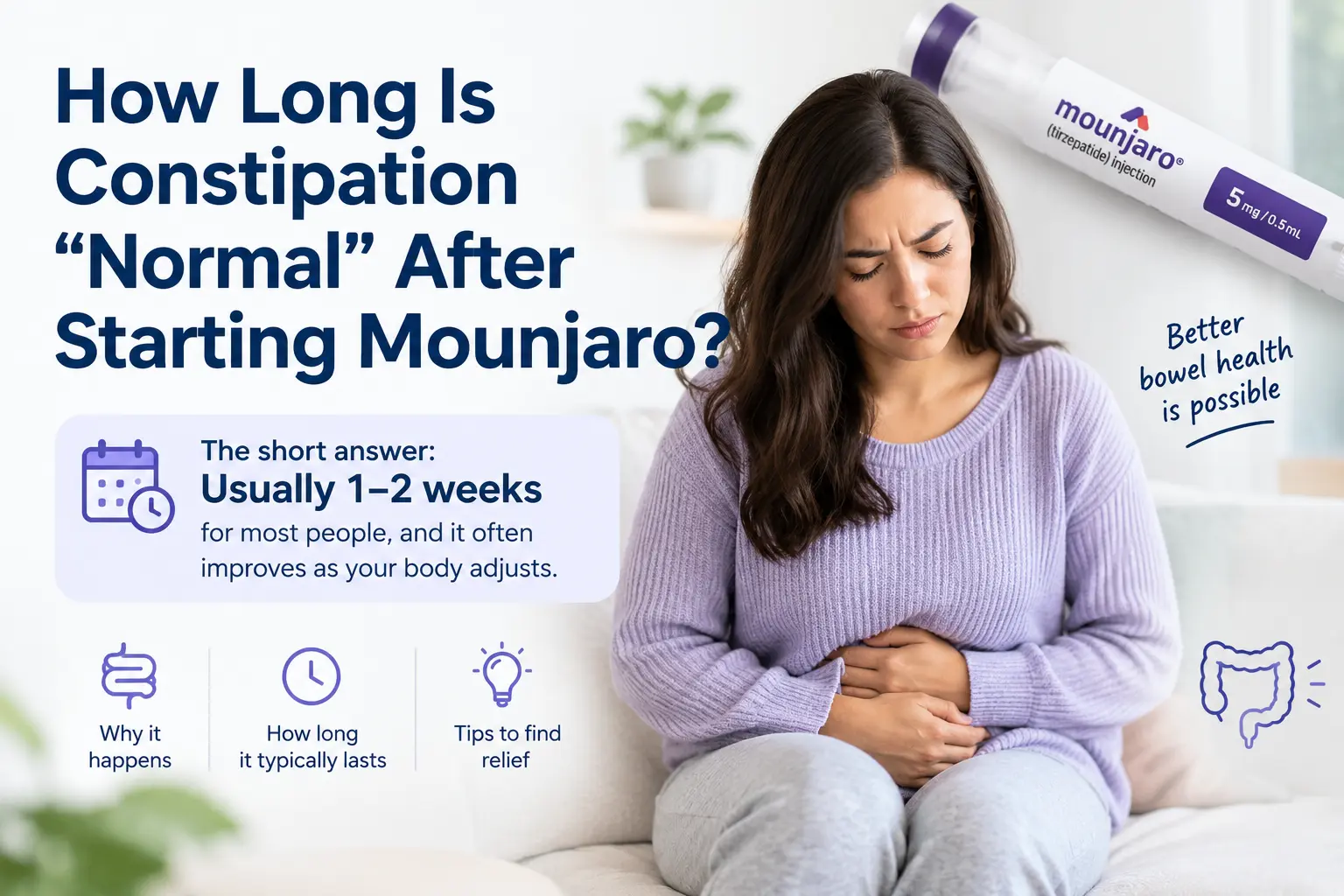
Starting Mounjaro often comes with a side effect nobody warns you about clearly enough: constipation. You’re drinking enough water, not eating dramatically differently, and still nothing is moving the way it should. That’s frustrating, and it raises a fair question: how long should this last before you worry?
The answer depends on where you are in your treatment timeline, how your body responds to the drug, and whether your symptoms fit the expected pattern or point to something that needs a doctor’s attention. Mounjaro (tirzepatide) slows digestion by design, so some constipation in the early weeks is a known and documented effect. But “normal” has a time limit; understanding that limit helps you tell the difference between a temporary adjustment period and a sign that something needs to change.
What Causes Constipation on Mounjaro?
Research on Mounjaro and constipation points to a specific mechanism: tirzepatide acts on GIP and GLP-1 receptors, and both pathways slow the rate at which food moves through your gastrointestinal tract. This effect – called delayed gastric emptying – is part of what makes the medication work for blood sugar control and appetite reduction.
Food stays in your stomach longer, so you feel full faster and eat less. The trade-off is that slower transit time through your intestines often produces constipation. Your colon depends on consistent movement of material through it, and when that movement slows, stool becomes harder and more difficult to pass.
Here’s the thing: this isn’t a malfunction or a sign the drug is hurting you. It’s a predictable result of how tirzepatide interacts with your gut. How frequently it happens, and how severe it gets, varies from person to person based on individual gut motility, baseline fiber intake, hydration habits, and physical activity levels before treatment.
How Tirzepatide Slows the Gut
GLP-1 receptor agonists, the class Mounjaro partly belongs to, reduce the speed of peristalsis – the wave-like muscle contractions that push food through your digestive system. Tirzepatide adds GIP receptor activation on top of that, which means its effect on gastric emptying is generally stronger than older GLP-1-only medications.
Clinical trials for tirzepatide consistently listed constipation as one of the most reported gastrointestinal side effects, occurring in roughly 6% of participants at standard doses. That number rises with higher doses. So if constipation gets worse after you move from 5 mg to 7.5 mg, that’s not a coincidence – higher doses slow gut motility more aggressively.
Your digestive system hasn’t failed; it’s responding to a stronger pharmacological signal. Most people find that their gut eventually adapts, but the window for that adaptation varies depending on how far along in your dose escalation you are and how sensitive your digestive system was to begin with.
Dose Increases and Digestive Timing
One pattern that catches a lot of people off guard is that constipation often returns or worsens at each new dose step, even if it had settled down from the previous one. Mounjaro’s standard titration schedule moves up every four weeks – from 2.5 mg to 5 mg to 7.5 mg and so on – and each increase can restart the adjustment clock for your gut.
Think of it as your digestive system needing a fresh settling-in period every time the dose goes up. During that first week or two after an increase, constipation tends to spike again. For most people, it eases back to a manageable level before the next scheduled dose change.
But if you’re on a stable dose and constipation hasn’t improved after three to four weeks, that’s a longer timeline than most people experience, and it’s worth raising with whoever prescribes your medication.
How Long Does Constipation Typically Last?
Constipation in the first two to four weeks after starting Mounjaro – or after a dose increase – falls within the expected range of adjustment. Your gut is recalibrating to a slower pace of transit, and that process takes time. Most people who track their symptoms report that by weeks three to six, bowel habits stabilize enough that constipation is no longer a daily headache. It might still occur more than it did before Mounjaro, but the severity typically drops.
The marker to watch is whether you’re having complete blockages – not passing stool at all for more than three days – or just less frequent, harder stools that still move with some dietary adjustments. Total absence of bowel movements for three-plus days, especially combined with bloating, nausea, or cramping, sits outside the “normal adjustment” window and warrants a call to your doctor.
The First Few Weeks vs. Ongoing Symptoms
There’s a practical distinction between early-stage constipation and chronic constipation that develops over months on Mounjaro. Early-stage: your gut slows, you go less often, stool is firmer, but things still move with adequate fiber and hydration. Chronic: you’re still dealing with the same severity three months in, and dietary changes don’t seem to help at all.
The latter is less common but does happen, particularly in people who were already prone to constipation before starting treatment. If you hit the three-month mark on a stable dose and constipation remains significant, your prescriber may discuss options, an over-the-counter osmotic laxative, a stool softener, or in some cases a dosing adjustment.
Don’t try to manage it alone with laxative use for more than a week or two without medical guidance, because overuse of stimulant laxatives can make things worse over time.
When Symptoms Signal Something More
Some constipation symptoms fall outside the routine adjustment category and need prompt medical attention. Watch for:
- No bowel movement for more than three consecutive days combined with moderate to severe abdominal pain
- Visible bloating that gets progressively worse rather than fluctuating
- Vomiting alongside constipation, which can signal a blockage
- Blood in your stool
- Severe abdominal pain that doesn’t ease after passing gas or a small bowel movement
These symptoms don’t mean Mounjaro caused a blockage, but they do mean your gut is under more stress than a simple slowdown explains. Rare but documented cases of gastroparesis, a more severe form of delayed gastric emptying, have been reported with GLP-1 class medications.
It’s far less common than ordinary constipation, but it presents with worsening nausea, vomiting, and an inability to tolerate food alongside constipation. If that picture sounds familiar, skip the dietary adjustments and call your doctor the same day.
What You Can Do to Find Relief
Most constipation on Mounjaro responds well to straightforward changes in diet and hydration, especially in the first few weeks. The goal is to support your gut’s transit speed without leaning heavily on laxatives.
Because Mounjaro reduces your appetite, many people inadvertently eat far less fiber than they normally would, and that compounds the problem. You’re already dealing with slower motility, and on top of that you’re sending less bulk through the system. Small, deliberate changes make a measurable difference. Start with water intake; most adults need around 64 ounces per day at minimum, and many fall short.
Add fiber-rich foods gradually rather than all at once, because a sudden large increase in fiber without adequate water can actually make constipation worse. Prunes, ground flaxseed, and cooked vegetables are gentler starting points than raw cruciferous vegetables or high-fiber bars that pack in 10-plus grams per serving.
Dietary and Hydration Changes That Actually Work
A few specific adjustments consistently help people on GLP-1 medications work through constipation:
- Drink at least 8 ounces of water first thing in the morning before coffee or food
- Add one tablespoon of ground flaxseed to yogurt, oatmeal, or a smoothie daily
- Eat warm foods and liquids, which stimulate peristalsis more than cold ones
- Take short walks after meals; even 10 minutes helps signal the gut to move
- Avoid high-fat, low-fiber ultra-processed foods, which slow transit further
And if dietary changes alone don’t help after five to seven days, an osmotic laxative like MiraLAX (polyethylene glycol) is generally considered safe to use short-term alongside Mounjaro. It draws water into the colon and softens stool without harsh stimulation. The catch is you should still confirm it’s appropriate for your situation with your prescriber or pharmacist before starting it.
Conclusion
Constipation in the first two to four weeks after starting Mounjaro – or after each dose increase – is something most people experience, and it usually resolves as your gut adapts. The pattern repeats with each dose step, so recognizing it helps you manage expectations.
What isn’t normal: symptoms lasting longer than four to six weeks on a stable dose, complete absence of bowel movements for three or more days, or any constipation paired with vomiting, severe pain, or blood in your stool. For most people, more water, a bit more fiber, and some movement after meals are enough to get things going again. But if that doesn’t work, or your symptoms feel more intense than a simple slowdown, talk to your doctor. You don’t have to just wait it out if the discomfort is significant.