
Therapy in Muslim Communities: Why an Islamic Therapist Online Can Feel Like a Safer First Step
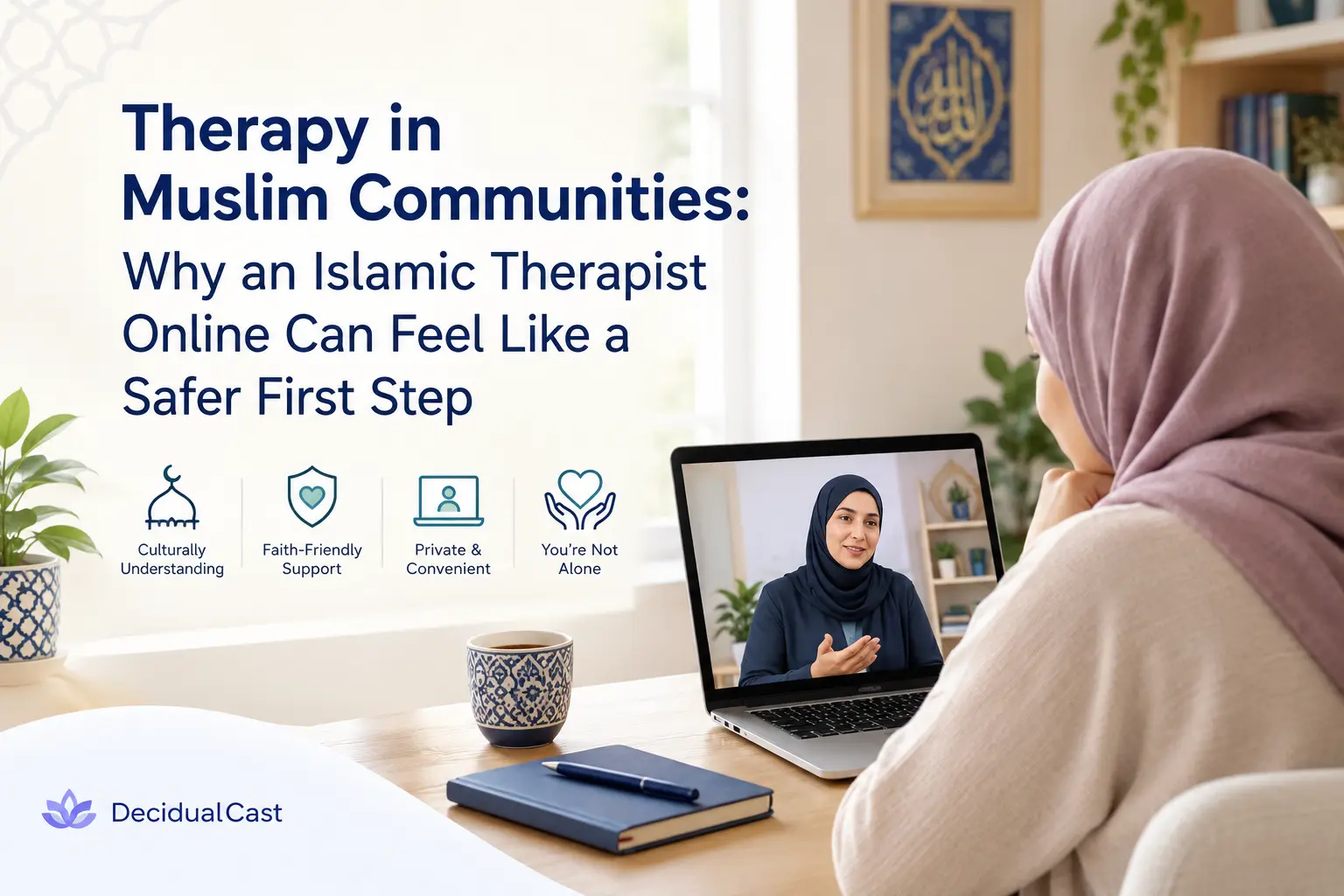
Starting therapy can feel especially difficult when you are unsure whether your faith, family relationships or community values will be understood. Some Muslims worry that a therapist may treat religion as part of the problem, while others fear being told that emotional distress simply reflects weak faith. An Islamic or culturally aware therapist can offer a space where spirituality and mental health are discussed together, without forcing you to choose between them.
What does “Islamic therapist” actually mean?
The term can describe several different types of support. A Muslim therapist is a mental health professional who personally identifies as Muslim. A faith-informed therapist may not share the same faith but understands Islamic practices, values and community contexts. Islamic psychotherapy goes further by deliberately integrating concepts from the Islamic tradition into the therapeutic process.
These descriptions are not interchangeable. Sharing a faith does not automatically mean that a therapist uses an Islamic framework, while a non-Muslim professional may still work respectfully and effectively with Muslim communities.
Before booking, it is worth asking what the therapist means by Islamic or faith-informed therapy. You can also discuss how much you want religion to feature in your sessions. Some people want faith to be central to the work; others simply want a therapist who will understand it without making assumptions.
Finding faith-aware support through Thera
People looking for an Islamic therapist online can use Thera to explore a network of vetted psychotherapists and counsellors serving Global South, SWANA, diaspora, BIPOC and third-culture communities. Profiles can be filtered by background, language, country, specialisation, experience and price.
If you cannot immediately find someone who meets your needs, Thera’s matching team can help identify a suitable professional. The platform also offers a free discovery call, giving you an opportunity to ask about faith, cultural understanding and therapeutic approach before beginning regular sessions.
This matters because religious identity is only one part of a good match. The therapist should also have relevant experience with the concern bringing you to therapy, whether that is anxiety, depression, trauma, grief, marriage, family conflict or another difficulty.
Why cultural and religious understanding can reduce barriers
Therapy often requires discussing parts of life that are difficult to explain. If the therapist is unfamiliar with Muslim communities, you may feel responsible for providing background before reaching the issue itself.
You might need to explain why family approval matters, why a decision affects more than one person or how prayer and religious obligations shape your routine. You may also worry that modesty, gender boundaries or community involvement will be misunderstood as symptoms rather than personal values.
A therapist familiar with these contexts may recognise the difference between respecting family and feeling controlled by it, or between practising faith and experiencing fear-driven religious thoughts. This does not remove the need for questions. It simply allows those questions to begin from a more informed and respectful position.
Muslim communities are not all the same
Muslims live across different countries, cultures, languages and schools of thought. Their relationships with faith range from deeply observant to cultural, questioning, private or changing. Experiences also differ according to race, ethnicity, gender, sexuality, disability, migration history and family background.
A therapist should therefore avoid assuming that every Muslim person has the same views on marriage, gender roles, family responsibilities or religious practice. Cultural familiarity is helpful only when it supports curiosity rather than replacing it.
You should be able to describe what Islam means in your own life. Therapy may involve strengthening your connection to faith, questioning certain interpretations, discussing hurt caused in a religious environment or deciding that religion is not central to the issue at all.
Therapy and faith do not have to compete
Some people hesitate to seek therapy because they believe emotional difficulties should be managed through prayer, patience or support from the religious community. Spiritual practices can be meaningful sources of comfort, but seeking professional help does not make them less valuable.
A therapist and an imam or trusted religious scholar have different areas of expertise. A religious leader may help with spiritual questions, while a qualified mental health professional can assess psychological symptoms and provide appropriate therapeutic support. Some people benefit from both forms of guidance.
A responsible therapist should not present therapy as a replacement for faith. They should also avoid reducing depression, trauma or anxiety to a lack of prayer or religious commitment. Faith can be part of healing without becoming the only explanation for distress.
Family expectations and confidentiality
In close-knit communities, people may worry that seeking therapy will become known to relatives or community members. They may also fear being judged for discussing marriage, sexuality, family conflict, doubt or experiences of abuse.
Online therapy can create more distance between the person seeking support and their local community. It may allow you to work with someone outside your city or country, reducing the chance of overlapping social networks.
Confidentiality should still be discussed directly. Ask how sessions and records are protected, what communication channels are used and what limits to confidentiality apply. You will also need a private place where you can speak without being overheard.
If privacy at home is difficult, consider scheduling sessions when others are away or using a secure room outside the household. The aim is to create enough space to speak freely without worrying about someone listening nearby.
Gender preferences can matter
Some Muslims feel more comfortable discussing personal matters with a therapist of the same gender. This may be connected to modesty, religious practice, earlier experiences or simple personal preference.
Others do not consider gender important and focus more on specialisation, personality or therapeutic style. Neither approach is inherently better. What matters is whether the arrangement allows you to participate honestly in therapy.
Online platforms can make it easier to consider gender alongside language, cultural background and clinical experience, rather than being limited to the small number of professionals available locally.
Issues a faith-aware therapist may help explore
Muslims seek therapy for the same wide range of reasons as anyone else. Faith and culture may influence how those concerns are experienced, but they are rarely the whole story.
Sessions may address:
- anxiety, panic or persistent worry,
- depression and emotional exhaustion,
- grief and bereavement,
- trauma or experiences of abuse,
- marriage and relationship difficulties,
- intergenerational conflict,
- migration and belonging,
- racism or Islamophobia,
- religious guilt or fear,
- doubts and changes in belief,
- identity conflicts,
- pressures related to gender or sexuality.
A culturally responsive therapist should allow these experiences to be explored without immediately blaming either religion or the individual. The aim is to understand how personal, relational, spiritual and social factors interact.
When religious thoughts become a source of distress
Faith can be grounding, but some people experience intense guilt, repeated doubts or fears that they have committed a religious wrong. They may repeat prayers, purification or reassurance-seeking behaviours because anxiety makes it difficult to feel certain.
A therapist experienced with obsessive-compulsive patterns should be able to distinguish between ordinary religious practice and behaviour driven by distress. This requires cultural knowledge as well as appropriate clinical expertise. Without both, normal observance may be mislabelled, or symptoms may be overlooked because they appear religious.
The goal is not to challenge sincere belief. It is to reduce the fear and compulsive behaviour that prevent a person from practising their faith or living daily life with greater freedom.
Questions to ask during a discovery call
An initial conversation can help clarify whether the therapist’s approach matches what you want. Possible questions include:
- What does faith-informed or Islamic therapy mean in your practice?
- How do you decide when to integrate religious concepts?
- Can I choose how much we discuss faith?
- Have you worked with concerns similar to mine?
- How do you approach family and community expectations?
- Are you comfortable discussing doubt, sexuality or religious harm without judgement?
- What qualifications and professional accreditations do you hold?
- How do you protect privacy during online sessions?
- How will we set goals and review progress?
Notice whether the therapist answers clearly and leaves room for your own interpretation of faith. You should not feel pressured to become more or less religious in order to receive support.
Warning signs to take seriously
Cultural or religious familiarity should never replace professional standards. Be cautious if someone:
- has no clear mental health qualifications,
- promises a guaranteed or immediate cure,
- explains every difficulty as weak faith,
- dismisses religion as irrational,
- pressures you towards a particular religious interpretation,
- discourages necessary medical or psychiatric care,
- does not explain confidentiality,
- crosses professional or personal boundaries.
A safe therapist should respect both your beliefs and your autonomy. They should be able to acknowledge the limits of their expertise and recommend additional support when necessary.
A safer first step does not have to be a perfect match
A therapist who understands Muslim communities may make it easier to begin, but shared faith alone does not guarantee trust. Personality, communication style, clinical experience and therapeutic method remain important.
The discovery call is an opportunity to see whether you feel listened to rather than categorised. You can also change therapists if the relationship does not feel right. Searching again is not a failure; finding a suitable professional is part of the process.
Online therapy can make that search broader and more private. For someone who has delayed support because of cultural misunderstanding, community stigma or limited local options, a faith-aware therapist may provide a more comfortable way to take the first step.
If you are in immediate danger or experiencing a life-threatening mental health crisis, an online therapy platform is not an emergency service. Contact local emergency services or go to the nearest emergency department.