Decidual Cast and PCOS: Can PCOS Cause a Decidual Cast?
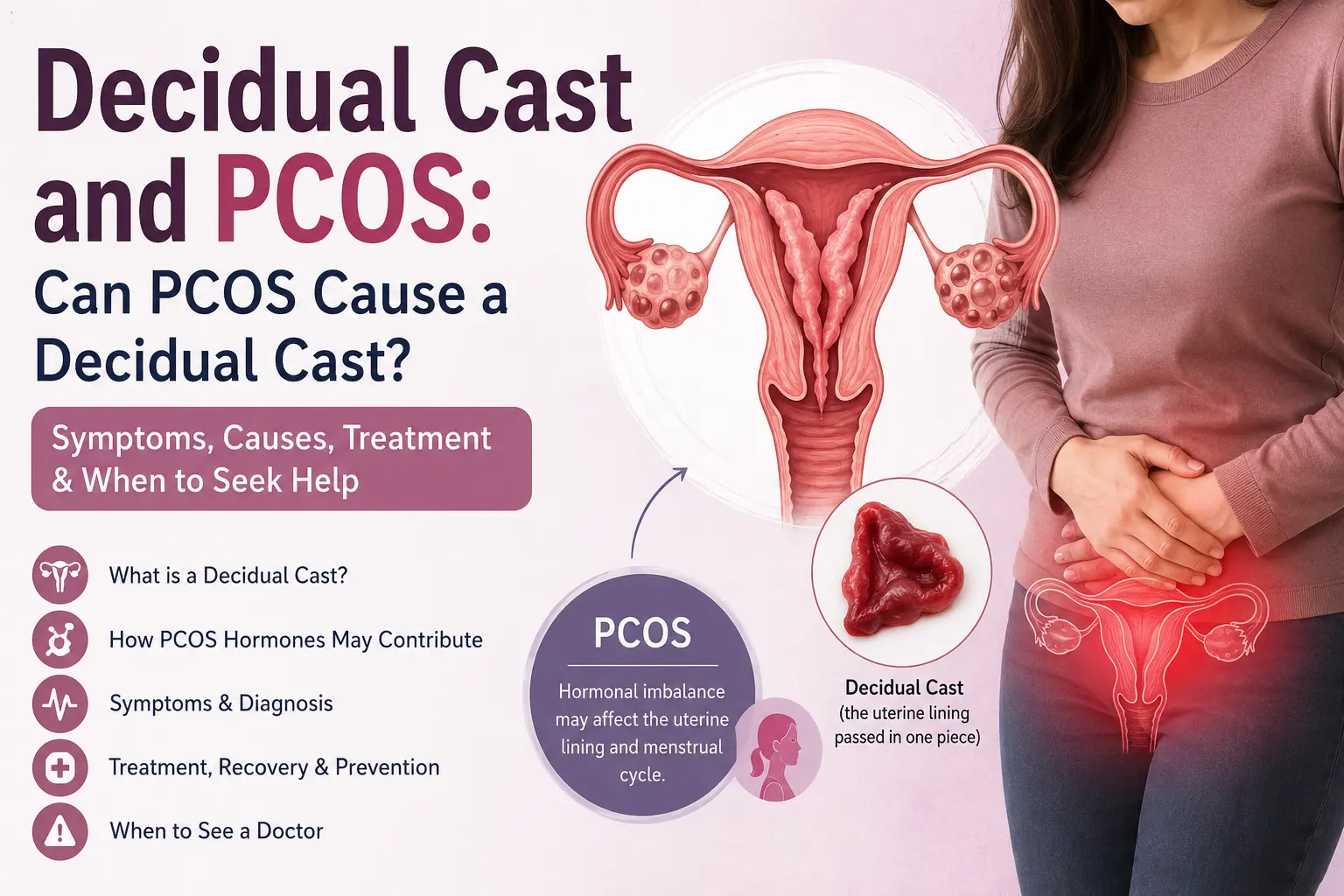
Passing a large piece of tissue during your period can be frightening. Many people search online because they have PCOS and wonder if the two are connected.
A decidual cast happens when the entire lining of the uterus leaves the body in one piece instead of breaking apart during a normal period. It is rare. However, it can cause severe cramping, heavy bleeding, and a lot of anxiety.
So, can PCOS cause a decidual cast?
The short answer is possibly, but not directly.
Researchers do not consider PCOS to be a proven cause of decidual casts. However, the hormonal changes linked to PCOS may create conditions that increase the chance of one forming. In many cases, the medications used to treat PCOS may play a bigger role than the condition itself.
Quick Answer
PCOS is not a proven direct cause of a decidual cast. However, hormonal imbalances associated with PCOS and hormone-based treatments, such as progesterone or birth control pills, may increase the likelihood of abnormal shedding of the uterine lining in some people.
Key Takeaways
✅ A decidual cast is the entire uterine lining passing in one piece.
✅ PCOS does not directly cause a decidual cast.
✅ Hormonal changes in PCOS may contribute to abnormal endometrial changes.
✅ Progesterone medications and hormonal birth control are more commonly linked to decidual casts.
✅ Severe cramping and passing tissue should always be discussed with a healthcare provider.
✅ Pregnancy, miscarriage, and ectopic pregnancy should be ruled out if there is any chance you could be pregnant.
Can PCOS Cause a Decidual Cast?
This is one of the most common questions people ask after passing a decidual cast.
The answer is not exactly.
Current medical research does not identify Polycystic Ovary Syndrome (PCOS) as a direct cause of decidual casts.
However, PCOS affects hormones that control the menstrual cycle. Because of these hormonal changes, experts believe there may be an indirect connection in some people.
In other words:
PCOS may create the right hormonal environment for a decidual cast to develop, but it is usually not the only factor involved.
What Is a Decidual Cast?
A decidual cast is a rare condition where the lining of the uterus, called the endometrium, comes out of the body as one large piece instead of breaking apart during a menstrual period.
Normally, your uterine lining sheds gradually over several days. Blood, tissue, and mucus leave the uterus little by little.
With a decidual cast, the lining stays together. It often keeps the shape of the uterus. This is why some people describe it as looking like a triangle or the inside of the uterus.
Although it can look alarming, a decidual cast is usually not life-threatening. However, it can cause intense pain and should be evaluated by a healthcare provider to rule out other serious conditions.
How Does a Decidual Cast Form?
To understand a decidual cast, it helps to know what happens during a normal menstrual cycle.
Step 1: The uterine lining grows
After your period ends, estrogen helps build a fresh layer of tissue inside the uterus.
This lining prepares the uterus for a possible pregnancy.
Step 2: Progesterone thickens the lining
After ovulation, progesterone changes the lining into a soft, nutrient-rich layer.
This process is called decidualization.
Step 3: Pregnancy does not happen
If no pregnancy occurs, progesterone levels fall.
The lining breaks down.
Step 4: Normal menstruation
Most people shed the lining gradually over several days.
The tissue mixes with menstrual blood and leaves the uterus in small pieces.
Step 5: Decidual cast formation
Sometimes, instead of breaking apart, the entire lining separates from the uterus all at once.
It then passes through the cervix as one large piece of tissue.
Because the cervix must stretch to allow the tissue to pass, many people experience severe cramping before the cast comes out.
What Does a Decidual Cast Look Like?
The appearance can vary from person to person.
Many decidual casts are:
- Large
- Firm
- Pink, red, or dark red
- Fleshy
- Triangular
- Shaped like the inside of the uterus
Some people mistake it for a miscarriage because of its size and appearance.
This is one reason why medical evaluation is important, especially if pregnancy is possible.
Important: A decidual cast cannot be diagnosed by appearance alone. Your healthcare provider may recommend a pregnancy test, ultrasound, or laboratory testing to determine the cause of the tissue.
Why Does Passing a Decidual Cast Hurt So Much?
Many people describe the pain as one of the worst menstrual cramps they have ever experienced.
There are several reasons for this.
First, the uterus contracts strongly to push out the large piece of tissue.
Second, the cervix must open wider than it normally does during a period.
Finally, the cast often passes all at once instead of gradually.
These factors can cause:
- Sudden pelvic pain
- Sharp cramping
- Lower back pain
- Heavy bleeding
- Pressure in the pelvis
The pain often improves quickly after the tissue has passed.
Why People Think PCOS Causes Decidual Casts
Many women notice a decidual cast shortly after:
- Starting birth control
- Stopping birth control
- Taking progesterone
- Fertility treatment
- Missing several periods because of PCOS
Because these events often happen together, it is easy to assume that PCOS itself caused the cast.
In reality, hormone fluctuations are a more likely explanation.
How PCOS Changes Your Menstrual Cycle
PCOS is a hormonal condition that affects how the ovaries work.
Many people with PCOS do not ovulate every month.
Without regular ovulation, progesterone levels may not rise and fall in the usual pattern.
Instead, the uterine lining may:
- Continue growing for longer than normal
- Become thicker
- Shed irregularly
- Cause unpredictable bleeding
These hormonal changes may contribute to abnormal shedding of the uterine lining in some individuals.
However, researchers still need more studies before they can say that PCOS directly causes decidual casts.
Is It the PCOS or the Treatment?
This is an important question.
Many people with PCOS take medications such as:
- Progesterone tablets
- Combination birth control pills
- Hormonal injections
- Fertility medications
These treatments change hormone levels quickly.
Rapid hormone changes are thought to be one of the strongest triggers for decidual cast formation.
For many patients, the medication—not the PCOS itself—may be the more likely explanation.
Can You Have a Decidual Cast Without PCOS?
Yes.
Many people who pass a decidual cast have never been diagnosed with PCOS.
Other possible factors include:
- Hormonal birth control
- Progesterone therapy
- Early pregnancy changes
- Ectopic pregnancy
- Miscarriage
- Hormonal fluctuations with no clear cause
In some cases, doctors cannot identify a specific reason.