Decidual Cast During Period: Causes, Symptoms & What’s Normal
Experiencing unexpected tissue during your “period” can trigger alarm, confusion, and sometimes fear. If you’ve ever passed a fleshy, intact piece of tissue that seems bigger than a typical clot, you may have wondered: Was this just a heavy period? Or could it be something unusual like a decidual cast? In this article, we focus strictly on cases when a decidual cast occurs in the context of the menstrual cycle — not pregnancy-related, not in the context of miscarriage (that topic is covered in our other post) — and explore what it means for your period, cycle health, and next steps.
We’ll examine how a decidual cast can show up during, just before, or just after your typical period, how it differs from normal menstrual tissue or clots, what triggers it, how to recognise it, and when to seek medical advice.
What Happens When a Decidual Cast Occurs During a Period?
In a normal menstrual cycle, the lining of the uterus (the endometrium) gradually thickens under hormonal influence in preparation for possible pregnancy. If pregnancy does not occur, the lining is shed over several days in small fragments along with blood and tissue.
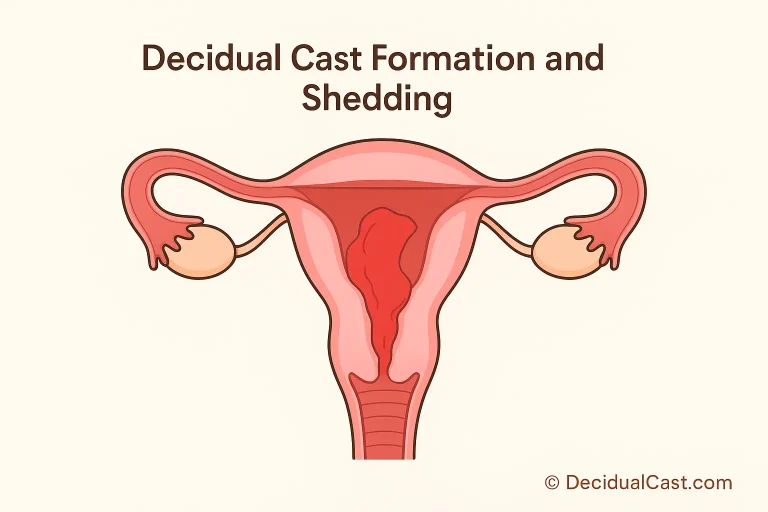
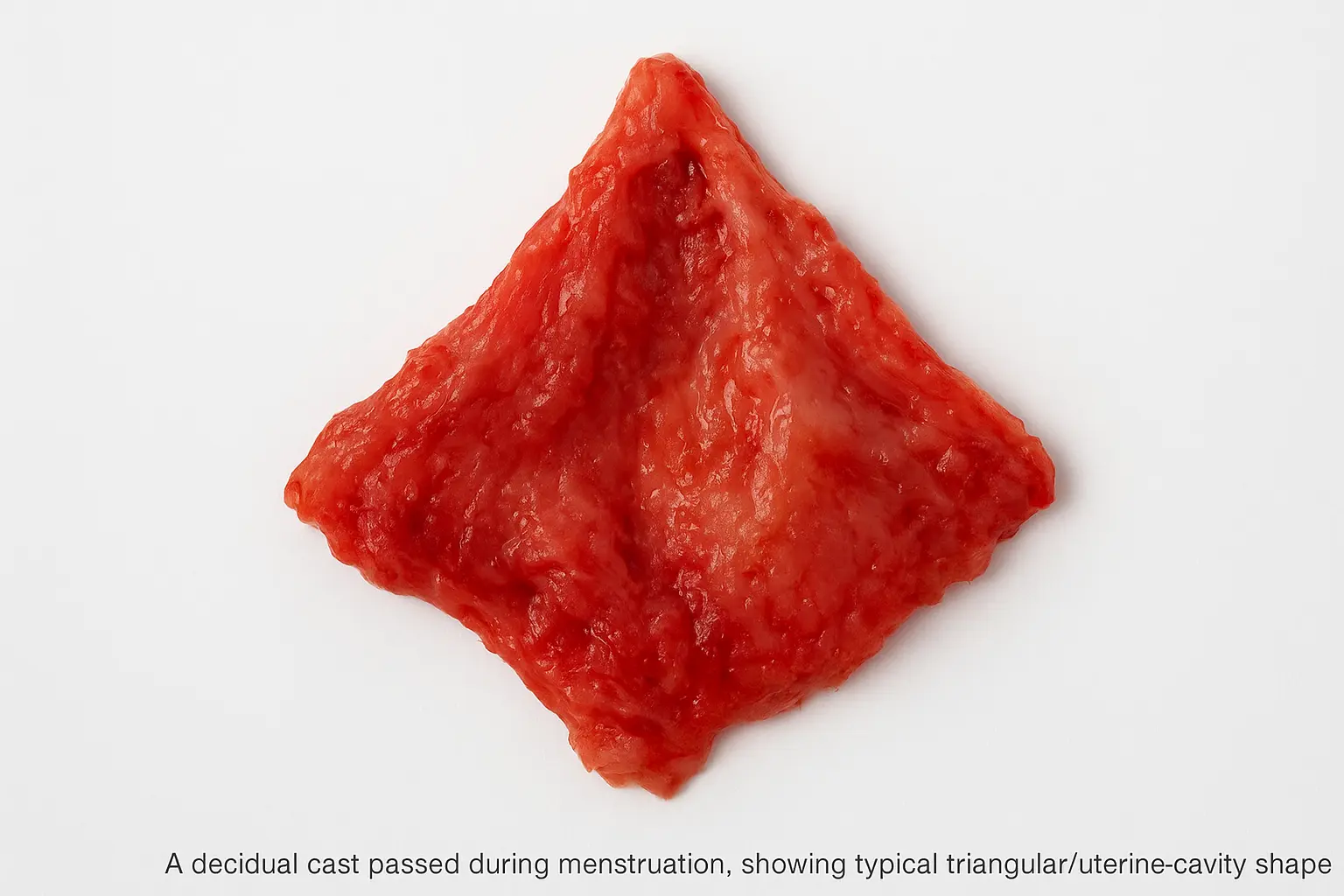
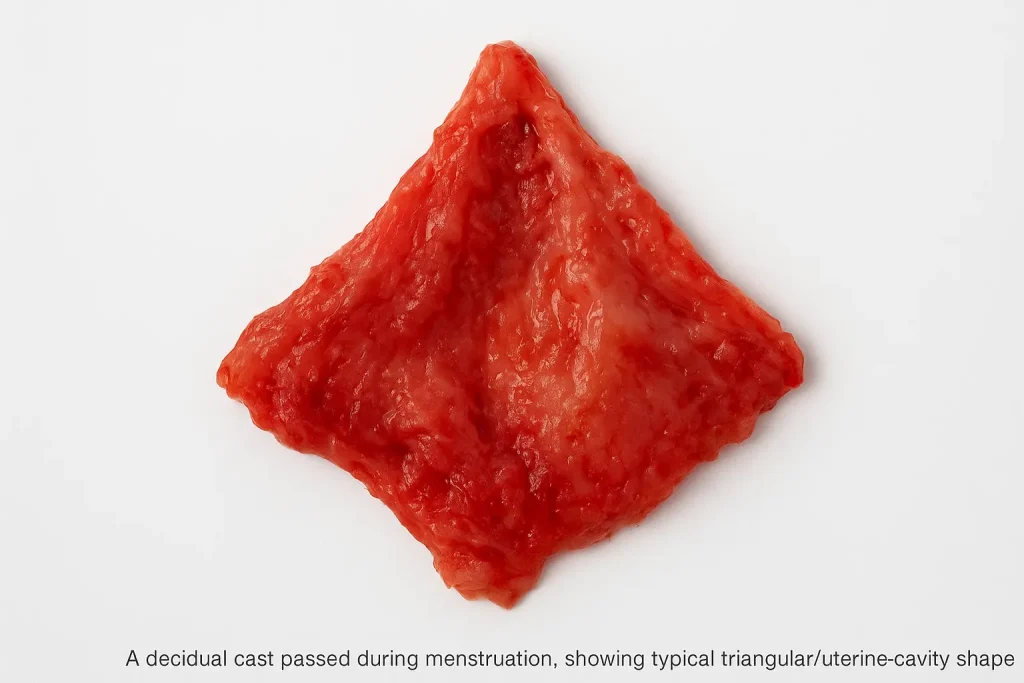
With a decidual cast, however, the entire lining (or a major portion) is shed in one piece — often retaining the shape of the uterine cavity (commonly described as triangular or light-bulb shaped) rather than tiny clots or fragments. decidualcast.com
When this happens during what appears to be a “regular period”, you might read this and think: “But isn’t this just heavy bleeding or big clot?” The difference is subtle but important for recognition (see next section).
The expression uterus lining decidual cast period, decidual cast shedding during period, and decidual cast passing uterine lining during period all reflect this phenomenon of the lining being expelled during the typical menstrual window rather than outside it.
Related: What Is a Decidual Cast? Full Guide
Decidual Cast vs Period Blood Clots — How to Tell the Difference
One of the most common questions is: “How is a decidual cast different from a big clot?” Below is a comparison to help clarify:
| Feature | Decidual Cast | Large Menstrual Clot |
|---|---|---|
| Size & Shape | Often large, intact piece, may resemble the shape of the uterine cavity (triangular, light-bulb) | Irregular, amorphous clot shapes |
| Texture | Fleshy, rubbery or thick tissue appearance (sometimes described as “flesh‐like”) | More gelatinous or “chunky” blood clot |
| Cramping & Pain | Often sudden, intense cramps just before or while expelling the tissue | May be heavier cramps than usual, but not always sudden spike |
| Timing | Could occur during period, or slightly before/after expected flow | Occurs during heavy flow days of period |
| Pregnancy test (if taken) | Usually negative (in non-pregnant cases) | N/A |
Related: Decidual Cast vs Miscarriage — Key Differences
Causes: Why It Can Happen During Your Period
Hormonal Shifts & Birth Control
One of the most frequently reported associations with a decidual cast is the use (or recent cessation) of progestin-based contraceptives (injections, implants, high-dose pills) or abrupt hormonal changes.
The theory is: when progesterone is high or in flux, the endometrium becomes overly decidualised (thick, gland-rich), and when hormone levels drop, instead of gradual shedding, the lining detaches as a whole piece.
Thus keywords such as decidual cast period causes and what causes decidual cast during period are relevant here.
Sudden Hormone Withdrawal or Stress
Significant stress, illness, or abrupt medication changes may disrupt the normal hormonal equilibrium, causing the endometrium to detach grossly rather than gradually. This can lead to a cast-type shedding during what appears to be your period.
Underlying Conditions (e.g., Endometriosis)
While not proven, there is discussion in clinical literature that uterine conditions such as chronic endometrial inflammation or endometriosis may play a role. Some searches refer to decidual cast endometriosis fleshy tissue during period. More research is needed, but it is worth considering if you have a known endometrial condition.
Symptoms of a Decidual Cast During Period
When a decidual cast occurs during a menstrual-type bleeding episode, you might see or feel:
- Sudden severe cramps that are worse than your usual period pain (due to a large tissue piece passing through the cervix).
- Passage of a large, fleshy tissue mass — pink to red, sometimes greyish/mucous mixed; may retain shape of uterus.
- A feeling of relief once the cast has passed — often the heavy bleeding and pain decreases quickly after.
- Bleeding that may be heavy for a day or two, but not necessarily longer than a typical period.
- In rare cases, dizziness, nausea or faintness related to pain or blood loss.
Keywords relevant here include decidual cast period symptoms, decidual cast fleshy tissue during period, small decidual cast during period, decidual cast in period.
Timing Variations in the Menstrual Cycle
Before Period
Sometimes the cast may appear just before your expected period. In this case you might experience decidual cast before period — the tissue passes and may trigger or coincide with onset of bleeding.
During Period
This is the most frequent descriptive scenario: decidual cast during period is it normal? and is decidual cast normal during period?. While it’s rare, it can happen and doesn’t necessarily indicate something catastrophic — but it warrants attention and monitoring.
After Period
You may also find a cast emerges after your main period bleeding: keywords like decidual cast after period or period after decidual cast apply. In this scenario, the cast may pass during lighter spotting or in the “tail” of your cycle.
Questions people often ask: Do you still have a period after a decidual cast? or Does your period stop after a decidual cast? The answer: typically yes, the cycle proceeds but bleeding patterns may shift; in most cases the next period occurs normally, though follow-up is wise.
Recurrence: Experiencing a Decidual Cast Every Period
Some individuals may worry if they pass a decidual cast every period. Keywords: decidual cast every period, passing decidual cast every period, is it normal to have a decidual cast every period, is it normal to pass a decidual cast every period.
If you are seeing a pattern of a cast every cycle, it may suggest an underlying hormonal imbalance, thickened lining, or contraceptive issue — and it’s advisable to bring this up with your gynaecologist.
Recurrence is discussed in the article “Recurrent decidual cast with membranous dysmenorrhea.”
Decidual Cast When You’re Not On Your Period
Sometimes you might pass decidual‐type tissue when you are not on your expected period: keywords decidual cast not on period or decidual cast no period. This can still represent the same phenomenon of the lining sloughing in one piece, but it may raise more concern because the context is outside the expected menstrual window. Always rule out pregnancy, ectopic pregnancy, or other uterine pathology in these cases.
Period Recovery and Next Cycle
After the cast passes, your body needs a short recovery. Here’s what to expect and what to do:
- You may notice your bleeding lighten considerably once the cast is expelled.
- Your next period should occur roughly on schedule, but you may see a lighter flow or altered tissue pattern. This is described under keywords like period after decidual cast.
- If the bleeding or pain persists for more than a couple of days, or if the next cycle is delayed significantly, contact your doctor.
- While your cycle recovers, track any changes in pain, flow, or tissue passed — bring this information to your OB/GYN.
When to See a Doctor
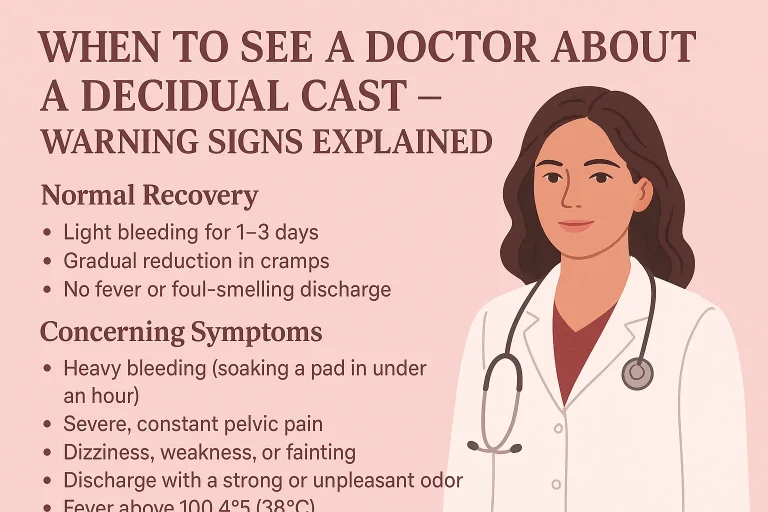
Because a decidual cast can mimic more serious events, it’s important to know when to seek medical attention. Red-flags include:
- Heavy bleeding (soaking a pad or tampon in under one hour).
- Pain that is significantly greater than previous periods, not relieved by usual measures.
- Passing very large tissue masses when pregnancy is possible (always do a pregnancy test).
- No period following the event (in someone who usually cycles).
- Fever, foul-smelling discharge, or signs of infection.
- Recurrence of cast every cycle.
In these cases, your healthcare provider may perform: pregnancy testing (β-hCG), ultrasound, pelvic exam, and possibly histopathology of the passed tissue.
Small vs Large Decidual Casts During Period
Not all decidual casts are massive. Some may be small decidual cast during period — a fragment rather than a full-shaped cast. Even small casts can cause intense pain or discomfort. The size of the cast does not always correlate with seriousness, but smaller casts may be easier to pass and less alarming. Conversely, a large cast may mimic miscarriage tissue — so size alone is not diagnostic.
Decidual Cast Period Images
FAQs
Q1: What causes a decidual cast during period?
A1: The most common triggers include hormonal contraceptive use or withdrawal (especially progestin-only methods), sudden hormone shifts, or underlying thickening of the uterine lining. Rarely, it might reflect other uterine conditions.
Q2: Is a decidual cast normal during period?
A2: While not common, passing a decidual cast during a period is medically recognised and not immediately dangerous in most cases, provided a pregnancy has been ruled out and you’re not experiencing severe complications.
Q3: Is it normal to have a decidual cast every period?
A3: No — recurrence each cycle is uncommon and warrants evaluation by a gynaecologist for hormonal, anatomical, or contraceptive-related causes.
Q4: Do you still have a period after a decidual cast?
A4: Yes — in almost all cases the menstrual cycle continues. You may have a lighter flow or a shifted pattern, but your next period generally occurs.
Q5: Does your period stop after a decidual cast?
A5: No — the event of passing the cast does not stop your cycle. If bleeding stops permanently or you miss several cycles, you should see a healthcare provider.
Q6: What does a decidual cast look like during a period?
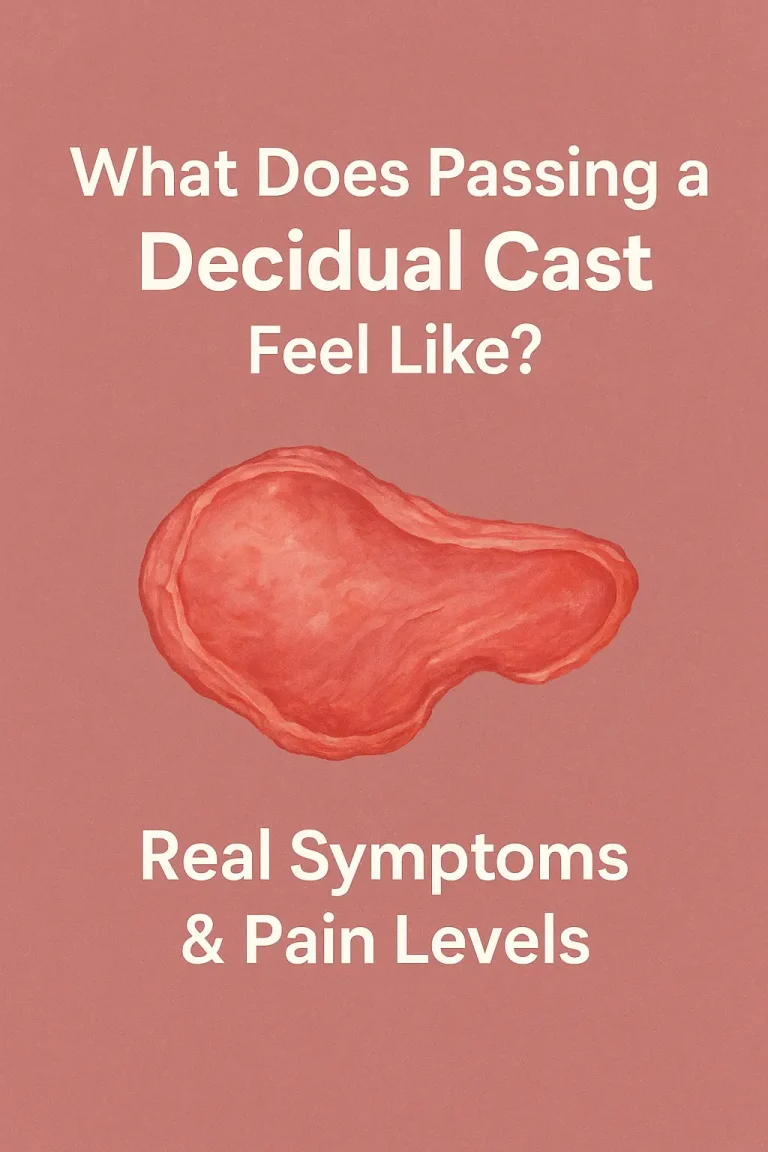
A6: It may appear as a fleshy, rubbery piece of tissue—often triangular or pear-shaped—red or pink mixed with mucus and blood. It may be mistaken for a large clot unless the shape and texture are recognised.
Q7: Should I worry if I pass fleshy tissue during my period?
A7: It’s wise to monitor the event. While it could be a decidual cast, it could also represent other conditions (e.g., miscarriage, retained products, uterine mass). Pregnancy test and clinical evaluation are prudent, especially if this is first-time, heavy, or accompanied by other red-flags.
Key Takeaways
- A decidual cast during a period is when the uterine lining is shed as a whole piece rather than gradually.
- It is rare but recognised; passing it during your period is possible and falls under decidual cast period, decidual cast during period.
- It differs from large clots by its shape, texture, and sudden nature.
- Common triggers involve hormonal shifts or contraceptives; less commonly, underlying conditions.
- If it happens once, and you recover with normal cycle return, the prognosis is excellent.
- If it recurs, or if you have heavy bleeding/pain, get a gynecological evaluation.
- Use this article as a guide, but always consult your healthcare provider for personal diagnostics.